
Where is it? Why is it there? So what?
~~~
Geographers apply spatial understanding to the real world.
Saturday, January 30, 2010
Hope.Help.Haiti
I have been moved and gratified -- but not surprised -- by the outpouring of support for the people of Haiti that I have witnessed among students and colleagues at Bridgewater State College. We created this blog to keep up with the many helpful resources and events that are taking place. Most important at the moment is the day-long remembrance on Wednesday, February 3. All are invited to learn, mourn, contribute, and - yes - celebrate.


Michigan and Kansas
Pam the geo-librarian is at it again, bringing geography to life at our house. On Tuesday, it was warm pot pies in the tradition of the Upper Peninsula, known as pasties. (See her blog to learn how to pronounce that.) On Friday, we shared cool tomato and cheese sandwiches, Kansas style. Food is a big part of spatial identity; so are films and books. See the Celebrating the States blog for Pam's reviews of a book and movie for each state, reflections on her own travels and friendships, and occasional chime-ins from me!
Sunday, January 03, 2010
Land Grabs in the Amazon
My interest in Brazil originated in the problem of deforestation, and I chose to go to Rondonia, because in the mid-1980s it was experiencing the highest rates of clearing, and this was combined with a poorly understood process of urbanization. That part of the Amazon has a majority urban population now, and a growing economic base that will place pressure on natural resources for generations to come.
Now the most rapid clearing seems to be far to the east, in São Félix do Xingu. This New York Times article describes federal efforts to control the fraud, corruption, and violence in this area of Para state, as well as the deforestation itself.
View Larger Map
Ironically, the article alludes to the importance of geography -- by explaining how poor mapping contributes to the confusion, conflict, and destruction -- but then fails to give any indication of where the story takes place. Para, after all, is almost twice as large as Texas!
The problems of mapping and land tenure are, by the way, relevant to my Brazil program. Even though urban development is our focus, the geotechnology and planning tools we study are relevant in rural areas as well, and do relevant research.
As much as the violence described in this article does concern me, it is an example of a kind of one-diminensional media attention that also deserves some critical thought. Almost a decade ago, we published a small book about perceptions of the region, and if anything the coverage has become less nuanced since then. We are hoping to have a second edition of our book -- Olhares Sobre a Amazonia - Looking at the Amazon -- available soon.
Thanks to my friend Vernon for bringing this article to my attention!
Now the most rapid clearing seems to be far to the east, in São Félix do Xingu. This New York Times article describes federal efforts to control the fraud, corruption, and violence in this area of Para state, as well as the deforestation itself.
View Larger Map
Ironically, the article alludes to the importance of geography -- by explaining how poor mapping contributes to the confusion, conflict, and destruction -- but then fails to give any indication of where the story takes place. Para, after all, is almost twice as large as Texas!
The problems of mapping and land tenure are, by the way, relevant to my Brazil program. Even though urban development is our focus, the geotechnology and planning tools we study are relevant in rural areas as well, and do relevant research.
As much as the violence described in this article does concern me, it is an example of a kind of one-diminensional media attention that also deserves some critical thought. Almost a decade ago, we published a small book about perceptions of the region, and if anything the coverage has become less nuanced since then. We are hoping to have a second edition of our book -- Olhares Sobre a Amazonia - Looking at the Amazon -- available soon.
Thanks to my friend Vernon for bringing this article to my attention!
Georgia on Our Mind
My wife Pam, the professional librarian and avocational geographer, has yet another ambitious blogging project, which will involve the whole family. Over the course of this year, Pam is celebrating each of the 50 U.S. states on the anniversary of its admission to the Union.
First up was Georgia, which was admitted on January 2, 1788. Read all about our meal, the movie we watched, and the book Pam read. That's right -- Munchies, Movies and Manuscripts for each. (See my own Georgia Counties page for a bit more information about our travels there.)
Tonight I'm looking forward to an Alaskan meal before my departure for Nicaragua. I look forward to reading what Pam has to say of the Alaska movie we watched -- which at least tripled our lifetime hockey viewing.
Sadly, although I was born in the continental United States, my birth place is not going to be included, as it is not yet a state.
First up was Georgia, which was admitted on January 2, 1788. Read all about our meal, the movie we watched, and the book Pam read. That's right -- Munchies, Movies and Manuscripts for each. (See my own Georgia Counties page for a bit more information about our travels there.)
Tonight I'm looking forward to an Alaskan meal before my departure for Nicaragua. I look forward to reading what Pam has to say of the Alaska movie we watched -- which at least tripled our lifetime hockey viewing.
Sadly, although I was born in the continental United States, my birth place is not going to be included, as it is not yet a state.
Saturday, January 02, 2010
Another Geographic Life List
My wife Pam is a librarian and a fan of lists. As a geographer, I have a life list of the U.S. counties I have visited and a list of the states I have visited in other countries. (Pam and our daughter also have analog versions of the county map.) So, a pattern of keeping track is well-established.
The two of us have embarked on another life-long list, to appear sporadically on a blog that Pam started recently. Our first adventure as part of the Bridgewaters Project was to the lovely hamlet of Bridgewater, New Hampshire, on the penultimate day of 2009.
Friday, January 01, 2010
Guy Lombardo: Managua, Nicaragua ... a wonderful town
For four of the past five years, I have enjoyed a nice New Year's Day tradition -- attending an open house with many friends here in snowy Bridgewater in the midst of final preparations to lead a study tour to Nicaragua. As of January 1, I have usually gotten most of the gifts I will take to my host family and the other coffee farmers we will meet, and I have gotten all of the information I can to my students. So I spend the day savoring the good company of my friends and my family, while also thinking about the upcoming adventure far to the south ... and the last-minute preparations of packing and travel documents.
January 1 (or more likely, late the night before) is the only day most people think of Guy Lombardo. And for years, Auld Lang Syne was his one-hit wonder, to my knowledge. That is, until a friend shared this gem from 1946. The song is kitchy, to say the least, and the lyrics both celebrate and stereotype Managua as a tropical place. The video below puts the song in sharp relief, as it shows imagery from the days of the elder Somoza, a dictator installed by the United States Marines. Managua never developed the cachet of Havana, but it was a bit of a playground.
The video is brilliant in its juxtaposition of the song's flippant remark about siestas and laziness with the languid lounging of the lily-white elites of a bygone era.
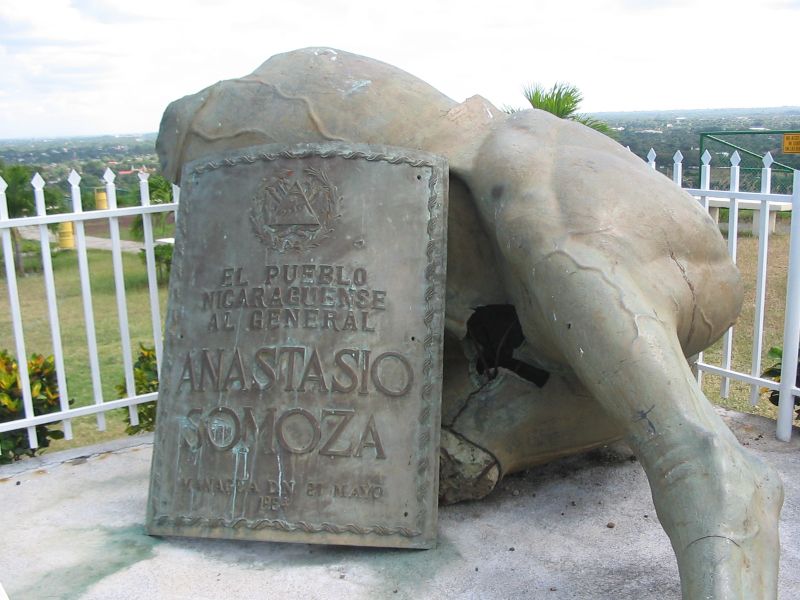
The elaborate statuary shown in the middle of the video are in contrast to the ironic statuary currently found at the site where Samoza's treachery resulted in the death of Sandino.
The video is brilliant in its juxtaposition of the song's flippant remark about siestas and laziness with the languid lounging of the lily-white elites of a bygone era.
The elaborate statuary shown in the middle of the video are in contrast to the ironic statuary currently found at the site where Samoza's treachery resulted in the death of Sandino.
See my entire 2006 Nicaragua photo set on Flickr.
Tuesday, December 29, 2009
Water Vapor and Climate Change
Two short letters to the editor of the Boston Globe illustrate the need for better geographic education and better science education in general. The first is entitled "Why Fight CO2," and perpetuates the common assumption that since water vapor is a more major greenhouse gas than carbon dioxide, the latter does not need regulation. This writer misses several critical details, which a second writer outlines in "Defogging the denial in the debate over CO2."
Water vapor varies from zero to four percent of the atmosphere, but as the second writer points out, its overall concentration is not changing. Over the past half-century, carbon dioxide has steadily increased from about 0.028 percent to about 0.036 percent of the atmosphere. It is the rapidity of this change that is the essential part of the story, and what makes the enhanced greenhouse effect so frightening.
Water vapor varies from zero to four percent of the atmosphere, but as the second writer points out, its overall concentration is not changing. Over the past half-century, carbon dioxide has steadily increased from about 0.028 percent to about 0.036 percent of the atmosphere. It is the rapidity of this change that is the essential part of the story, and what makes the enhanced greenhouse effect so frightening.
Friday, December 25, 2009
Boxing Day, Five Years On
I awoke Christmas morning to this sad reminder of the tragic events of Boxing Day, 2004, when over 230,000 people were killed in the world's most deadly tsunami. All was not negative, though, in this interview with Mark Fritzler of Save the Children. His response was surprising when Renee Montagne asked whether the Aceh region -- which had experienced the highest death tolls -- had returned to normal. It had not been normal before the tragedy, and the rebuilding has actually brought some improvements to the war-torn region.
Coincidentally, the Aceh region is home to some exquisite coffees. See Sumatra coffee and travel notes from Sweet Maria's.
The before/after images below are from the Earth from Space series compiled by The Guardian UK.

Coincidentally, the Aceh region is home to some exquisite coffees. See Sumatra coffee and travel notes from Sweet Maria's.
The before/after images below are from the Earth from Space series compiled by The Guardian UK.

Thanks to my friend Wing-Kai for pointing me to this five-year remembrance from CNN. Reporter Dan Rivers revisits stories he covered at the time, including that of Fitri Ani, a woman who was three months pregnant the day she survived the tsunami. The report combines grim images from the original event with more recent reflections. It shows that even those lucky enough to survive endured an ordeal most of us cannot imagine.
Sunday, December 20, 2009
Dinero al Norte
 Thanks to my colleague Vernon for pointing me to Marc Lacey's fascinating NY Times cover article about impoverished families in southern Mexico struggling to send money north to their relatives in the United States. Although the trend Lacey describes remains relatively small, this story is relevant to many key facets of migration between Latin America and the United States.
As I write this, I am enjoying a cup of decaf coffee from Chiapas, the home state of some of the families mentioned in the article. Although the article does not mention coffee, it is an important part of the background. People continue to leave coffee-growing areas because prices fluctuate between low and lower, so that even people who own their own land often work as virtual slaves. Since people in this position are not often represented at "free" trade negotiations, their options become fewer year by year. Nobody should complain about "illegal" immigration before thoroughly understanding these dynamics, because the "legal" and "just" are divergent concepts. The same process is unfolding in coffeelands throughout the world; see these examples from Oaxaca and Chiapas, and know that a similar story is behind every cup of conventional coffee sold.
Back to the NY Times story: It was first brought to my attention when we were discussing the exodus of Brazilians from the town of Framingham, Massachusetts. As the U.S. dollar has weakened, many who moved to Massachusetts in order to bring or send money back to Brazil have decided to leave. In many cases, these have been middle-class Brazilians who saw coming to this region for a year or two as an expedient way to earn money to invest in a business or a nicer home in Brazil. When the U.S. economy weakened, many of these folks found their way back home, revealing the extent to which some sectors of the Massachusetts economy had become dependent upon them.
The case in Mexico is similar in some ways, except that the migrants tend to be much poorer, and the ability to move back and forth is much reduced. An ironic consequence of the poorly-conceived border wall is that crossing once is so risky that people will remain in the U.S. who in previous years might have gone home. As Lacey points out, this is not an option for people who have risked everything for a chance to earn money in the North.
For some families of Oaxaca and Chiapas, the result of these current absurdities is that undocumented workers in the richest country in the world are receiving small payments from some of the poorest people in Mexico, hoping to keep them in place until the economy improves. Eventually, they hope, the work that U.S. citizens usually eschew will be available to them once again, and the remittances will resume their usual pattern.
Wednesday, December 16, 2009
Wisdom from Bill O'Reilly
Bill O’Reilly’s recent column on climate change (“Hmm, is it getting a bit warm in here?” December 15) includes at least one welcome suggestion but also some very problematic ideas about climate science.
It is good that O’Reilly’s understands the value of “positive environmental behavior” and a cleaner Earth. His authentically conservative conclusion is that conserving resources is a good idea, whether the climate is changing or not. Most of the remedies that arise from concerns about a changing climate are simply good stewardship.
O’Reilly’s interpretation of climate science and its implications, however, is flawed in several important ways. First, he asserts that “only the deity knows for sure whether the planet is in danger from warming.” It is one thing to exaggerate the uncertainty about climate change; it is quite another to assert that such uncertainty is inevitably permanent. We already know enough about our interruption of the carbon cycle – and its results – to act.
Second, O’Reilly describes the growing consensus on climate change and the growing business interest in alternative energy, and assumes that the latter caused the former. A far more reasonable interpretation is that the smart money is following the science. It is laughable to suggest that the “climate change industry” has somehow outflanked Big Oil in its ability to influence governments.
The reality is that the evidence is mounting in favor of the most direct explanation for climate change: roughly half the carbon that accumulated in fossil fuels over eons has been released in just two centuries, increasing the concentration of carbon dioxide dramatically and increasing average temperatures steadily.
Near the end of the article, O’Reilly expresses a desire for an affordable system to provide renewable energy for his home; on that, we can agree. At the very end of the article, however, he could not resist a flippant dismissal of the science that underscores the need for such innovations.
It is good that O’Reilly’s understands the value of “positive environmental behavior” and a cleaner Earth. His authentically conservative conclusion is that conserving resources is a good idea, whether the climate is changing or not. Most of the remedies that arise from concerns about a changing climate are simply good stewardship.
O’Reilly’s interpretation of climate science and its implications, however, is flawed in several important ways. First, he asserts that “only the deity knows for sure whether the planet is in danger from warming.” It is one thing to exaggerate the uncertainty about climate change; it is quite another to assert that such uncertainty is inevitably permanent. We already know enough about our interruption of the carbon cycle – and its results – to act.
Second, O’Reilly describes the growing consensus on climate change and the growing business interest in alternative energy, and assumes that the latter caused the former. A far more reasonable interpretation is that the smart money is following the science. It is laughable to suggest that the “climate change industry” has somehow outflanked Big Oil in its ability to influence governments.
The reality is that the evidence is mounting in favor of the most direct explanation for climate change: roughly half the carbon that accumulated in fossil fuels over eons has been released in just two centuries, increasing the concentration of carbon dioxide dramatically and increasing average temperatures steadily.
Near the end of the article, O’Reilly expresses a desire for an affordable system to provide renewable energy for his home; on that, we can agree. At the very end of the article, however, he could not resist a flippant dismissal of the science that underscores the need for such innovations.
Subscribe to:
Posts (Atom)