Friday, July 23, 2010

Mato Grosso: The Future of Food

Last week I heard a very well-produced story about the expansion of soybean production in Mato Grosso, which is a huge savanna area just south of my old rain forest haunts in Rondonia, Brazil. Bruce Gellerman is one of my favorite environmental reporters, and he did a masterful job of explaining the many ways in which landscape change in this part of Brazil is connected to both causes and consequences throughout the world.

It is for this reason that I decided to make his story of modern frontier expansion the focus of my first article for the new blog, Wiley GeoDiscoveries. I will be writing for the blog regularly over the next year or so, and Mato Grosso: The Future of Food is my first contribution.

Geography and Science

I claim that geography is both a natural science and a social science, with a bit of the arts thrown in. A recent article about one of my department's outreach projects makes the case for the natural science side.

The Real USDA Racism Story

If there is any good to have come from the sordid affair of Shirley Sherrod's firing from the US Department of Agriculture, it is the possibility -- however slim -- that this fake story about reverse racism will lead to some justice in an incredibly well-documented story of actual racism.
Meanwhile, the fringe blogosphere rages on about the oppression of the majority. When economic times are tough, the majority begins to suffer in ways that are normally common for the minority, and eventually some  get resentful and start to think that the minority is somehow victimizing the majority. In such times, demagogues will always emerge to take advantage of the fear, and to help divert attention toward scapegoats. I've written a lot in this space about how this translates to discussions of immigration; it is even more deeply rooted in discussions of race.

In the present case, one white family was supposed to have been the victim of a racist African-American government official, and she got fired. The incident was 24 years ago, and she in fact did help them. The story was about the feelings she overcame in the process of doing so. The supposed "victims" of Sherrod's racism, Eloise and Roger Spooner, rushed to her defense and are at this point planning a reunion.

So the white victim of racism in this case was not real. "Reverse" racism might exist somewhere, but not in this case. Meanwhile, very real cases of racism have been documented, proven in court, and awarded compensation. The United States Senate has, however, so far refused to fund to the compensation due hun

The National Black Farmers Association is hoping that the attention to the one fake case might just lead to justice in the thousands of real cases, and is calling on all friends of farmers to do something about it. NPR's Brian Naylor describes the deep history of racism at USDA and the claims of many thousands of African American, Latino, and female farmers who have proven their cases but received nothing so far. Some have, in fact died of old age while waiting.


Back to the Sherrod story: as reporter Mara Liasson mentioned in a story about the president's apology to Ms. Sherrod, most people involved in this case have apologized, from Secretary Vilsack and President Obama to the NAACP (partly) and Bill O'Reilly (partly). The only person not to have apologized is the real culprit, faux journalist Andrew Breitbart, who is most responsible for starting this mess.

Of course, what energized this whole incident was the recent controversy over the NAACP characterizing some elements of the Tea Party movement as racist. This video, posted on the NAACP site, provides more than a few bits of anecdotal evidence.

Thursday, July 22, 2010

Direct Trade Coffee

Most of the coffee I buy is Fair Trade, which means it comes from cooperatives of small-scale farmers and meets the certification requirements of Transfair or TransfairUSA. I plan to continue buying most of my coffee this way, because of all I have heard, read, and seen about this model.

A number of people I have met in the industry -- including quite reputable buyers and some of the farmers themselves -- have criticized some of the certification requirements and the cost of the process. These criticisms are more common when -- as now -- arabica prices are relatively high.

I continue to support Fair Trade, but I have been very intrigued by the direct-trade model. One thing I have noticed is that every direct-trade program I have seen is internal to a single company. The purpose of this posting is to introduce readers to the direct-trade programs of two companies for which I have a great deal of respect: Counter Culture Coffee and sweet maria's. Each makes the case for direct trade in its own way. Interestingly, sweet maria's is the more critical of the two when it comes to the FT model, even though this company does still use it.

Some Fair Trade purists call of direct trade the "trust me" model, and there is some truth to it: it is fair to scrutinize companies that run their own direct trade programs and ask them tough questions. By the same token, a Transfair label alone does not put a company above reproach; some cooperatives are operated more democratically than others, and some buyers go further than others in ensuring the integrity of the transactions.

Eventually I hope to move beyond certifications, to a scenario in which we know farmers are being treated fairly, whether on large farms or small, whether labeled fair or not. But I'm afraid that is a distant future indeed.

Wednesday, July 21, 2010

U-Boat Attacks Cape Cod


Well, a U-Boat did attack Cape Cod, but 92 years ago today. Read the description of the event on Mass Moments to learn how concerns about the security of  North Atlantic shipping had helped lead the United States into World War I. One shell landed in Orleans -- the only direct hit on U.S. soil during the war. We will try to find the site as part of our Geography Department's 2010 HumPhy trip, October 8-10 (see posts from 2009 HumPhy to get a flavor for that field camp).

Tuesday, July 20, 2010

The Political Geography of a Giant Cheese Ball

It was 209 years ago today that Cheshire, Massachusetts made a bold political statement about the presidential election of the previous fall. Farmers there showed their support for the new President Jefferson -- and their disdain for the candidate from their own state -- by sending the Virginian and fellow farmer an enormous block of cheese. Mass Moments uses the anniversary as a point of departure for an engaging lesson about the differential political legacy of the Revolutionary War in Massachusetts.

Concept Caching

I am very pleased that I was recently asked to join the Concept Caching site at Wiley Higher Education. The site allows users to see the world through the eyes of geographers who connect images to locations and concepts to the images. I promise mine will not all be about coffee, but the first two are. I posted snapshots of a fascinating coffee shop in West Branch, New York and an important coffee processing mill in Matagalpa, Nicaragua.

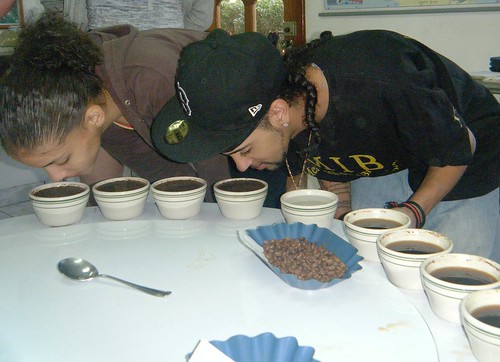
For the Matagalpa post, I almost included this photo of Silvy and Jesse, two of my excellent Bridgewater State University students, because education is the most important part of the work I do with coffee -- and because it is a great photo. In the end, I chose a different photo, to emphasize that control of the cupping lab by the farmers is what makes the SOLCAFE important.
Check Concept Caching in the future -- I'm committed to posting many more photos over the coming months.

Friday, July 16, 2010

Fair Trade Tea

As I begin to study the tea industry, I have found it difficult to learn much about Fair Trade tea. I see it for sale quite often, alongside Fair Trade coffee, but details are scarce. From my friends at Equal Exchange, I have learned the reason: because nearly all of the world's tea is grown on large estates, it has been nearly impossible to apply the small-holder model common to Fair Trade coffee. As a result, there is not yet much agreement on what constitutes Fair Trade tea. (Some tea companies, feeling the pinch of consumer conscience, have taken token measures, such as Teavana's commitment of one percent of its profits to development projects. That is not a typo.)

Following a 2009 visit to India, Equal Exchange describes how it is working with farmers to find its way in this new market.

Wednesday, July 14, 2010

Dear Abby

At our house, reading advice columns to each other is a daily ritual. For many years, we were able to read the two most famous rivals in the genre -- Abigail Van Buren (Dear Abby) and her sister Ann Landers. When Abby retired, her daughter took over; something similar was attempted on the Ann Landers side of the family, but I think it has fizzled, at least in our newspaper market area. So we read Pauline Philips (Abby) on a regular basis, along with the other Agony Aunts (as the genre is known in Britain) whenever we find them.

Often we are sympathetic to the poor souls who write in or intrigued by the problems they describe. Sometimes we are compelled to snicker or make snide remarks, and the third letter of May 13 was just such an occasion. A well-meaning reader sought advice on the disposal of plastic jewelry cases. Sometimes Abby goes to the real root of a reader's problem, but in this case she did not. Within minutes, I had grabbed my trusty laptop and fired off my own analysis.

Weeks passed, and gradually I forgot both the letter and my reply, which had been submitted through an online form.  Then a member of Abby's staff called to ask for my permission to publish my letter. Figuring I must have had something useful to say, I consented and the phone call was over before I realized that I had no recollection of what I had written about. So I waited anxiously for the July 6 column, the entirety of which was dedicated to reader follow-up on those jewelry boxes.

I reprint my contribution here:


DEAR ABBY: I have another suggestion for Diana in Lakewood. Quit buying so much stuff!

Recycling is only a partial solution to a wasteful lifestyle. Millions of tons of plastic, no matter how many times it is recycled, end up in our oceans, where Texas-sized flotillas of plastic goo will outlast us all. The key is to generate less in the first place.

When considering a purchase, consider all four "R's": Reduce, Reuse, Recycle and Repair. In this case, the option to "Reduce" should be observed by either buying less jewelry, or asking the vendors to quit over-packaging the stuff. -- DR. JAMES HAYES-BOHANAN, PROFESSOR OF ENVIRONMENTAL GEOGRAPHY
In the end I was pleased -- as I was able to get people thinking, if only for a few seconds, about consumerism AND geography!

Those who are interested in this topic can find it more fully explained at The Story of Stuff. A lot has been written about the plastic flotillas, most recently an article in the Boston Globe about local researchers skimming plastic in the Atlantic, a couple thousand miles from the nearest human settlements. Both the article and the user comments are instructive.

NOTE: Careful readers will observe that I already wrote something about this, under the title The Four Rs -- I guess my enthusiasm got the better of me. But the two reports do emphasize somewhat different aspects of the story, so I am leaving both.

Political Geography of Coffee Shoppes: Tel Aviv


We recently watched the 2006 Israeli film The Bubble, in which one of the main characters is a coffee shop. From the essential "making of" feature on the DVD, I learned that Orna and Ella on Sheinkin Street was not created for the film -- it actually was a gathering spot for the modern young adults of this seaside city. (2021 update: sadly, the restaurant closed in 2018.) The title of the film refers to the relative isolation that Tel Aviv -- in particular that street and even more in particular its cafes and clubs -- has enjoyed from the strife that grips much of Israel.

In the "making of" piece, the role of coffee in defining this space is described clearly:
"Politics in Tel Aviv are a little confused. There is poitical awareness, usually left-winged, but not much action is taken between one espresso to the next."
As the film unfolds, of course, we find that reality does have ways of intruding on the most hip and detached communities. The intersecting geographies of homophobia and Israel-Palestine strife dominate this film. The "bubble" is a space between xenophobia and homophobia that Director Eytan Fox masterfully compresses throughout the film. The film's conclusion is the ultimate collapse of that space.

The trailer above and the NY Times review by Jeannette Catsoulis are good introductions to the film. After the film, I highly recommend seeing the "making-of" extra on the DVD, which provides valuable insights  on the variety of contested social and political spaces in which the filming itself took place. After that, I recommend reading a few of the critical reviews, in particular John Esther's interview with Eytan Fox, Brandon Judell's Blowing Up Middle-Eastern Rancor with Copulation, and especially Michael Bronski's analysis for Z magazine.

Finally, if any readers of this blog end up at Orna and Ella in Tel Aviv, please let me know how the coffee is!

Blog Ideas

coffee (25) GEOG381 (24) GEOG388 (23) GEOG470 (18) climate change (18) GEOG130 (16) geography (16) GEOG332 (13) GEOG431 (12) musica (11) GEOG 332 (9) GEOG 381 (9) Mexico (9) Brazil (8) GEOG286 (8) Texas (8) education (8) migration (8) GEOG298 (7) borderlands (7) GEOG199 (6) GEOG331 (6) Massachusetts (6) US-Mexico (6) deBlij04 (6) immigration (6) GEOG 130 (5) GEOG 286 (5) GEOG287 (5) climate justice (5) cultural geography (5) fair trade (5) food (5) geographic education (5) nicaragua (5) water (5) Arizona (4) GEOG 171 (4) GEOG171 (4) GEOG295 (4) Safina (4) africa (4) deBlij05 (4) land protection (4) music (4) politics (4) Bolivia (3) Boston (3) COVID-19 (3) Detroit (3) Ethiopia (3) Managua (3) Obama (3) border (3) cartography (3) drought (3) libraries (3) pesticides (3) suburban sprawl (3) trade (3) unemployment (3) Alaska (2) Amazon (2) Bridgewater (2) Canada (2) Chiapas (2) China (2) Colonialism (2) EPA (2) EarthView (2) Economy (2) Environment (2) GEOG 199 (2) GEOG 287 (2) GEOG 388 (2) Google Maps (2) Government (2) Hawaii (2) India (2) Lexington (2) Maldives (2) Mozambique (2) NOLA (2) NPR (2) National Monuments (2) National Parks (2) New Orleans (2) Religion (2) Rio Grande (2) Taunton River Wild and Scenic (2) Tex-Mex (2) The View from Lazy Point (2) United States (2) Venezuela (2) anthropocene (2) cape verde (2) censorship (2) central america (2) chocolate (2) corn (2) deBlij07 (2) deforestation (2) demographic transition (2) demography (2) education reform (2) employment (2) environmental geography (2) film (2) forest fire (2) global warming (2) islands (2) landscape ecology (2) librarians (2) maps (2) organic (2) peak oil (2) refugees (2) sense of place (2) soccer (2) sustainability (2) television (2) water rights (2) whales (2) #bbc (1) #nicaragua (1) #sosnicaragua (1) #sosnicaragua #nicaragua (1) 100 Years of Solitude (1) ACROSS Lexington (1) Accents (1) Adam at Home (1) Alice (1) Alt.Latina (1) American Hustle (1) April (1) Association of american Geographers (1) Audubon (1) Aunt Hatch's Lane (1) BBC (1) BSU (1) Baby Boomers (1) Banda Aceh (1) Bay Circuit Trial (1) Bechtel (1) Beleza Tropical (1) Belize (1) Beloit College (1) Ben Linder Cafe (1) Bet The Farm (1) Bhopal (1) Biafra (1) Bikeway (1) Bikini (1) Bill Gates (1) Bill Moyers (1) Boeing 777 (1) Brazilian (1) Brazilianization (1) Bridge (1) British Columbia (1) Brockton (1) Bus Fare (1) Bush (1) Cabo Verde (1) California (1) Cambridge (1) Cape Cod Bay (1) Carl Stafina (1) Catholic (1) Ceuta (1) Chalice (1) Chipko (1) Citgo (1) Climate risks (1) Cochabamba (1) Colombia (1) Common Core (1) Commuter (1) Computers (1) Cuba (1) Cups and Summits (1) Dallas (1) David Byrne (1) Deans Beans (1) Delaware Valley (1) Dunkin Donuts (1) Earth Day (1) Earth View (1) Easton (1) El Salvador (1) Elizabeth Warren (1) Ellicott City (1) Emilia Laime (1) English-only (1) Environmental History (1) Euphrates (1) European Union (1) Evo Morales (1) FIFA (1) FYS (1) Fades Out (1) Farms (1) First-Year Seminar (1) Food Trade (1) Frederick Kaufman (1) French press (1) Fresh Pond Mall (1) GEOG 431 (1) GEOG 441 (1) GEOG213 (1) GEOG490 (1) Gabriel García Márquez (1) Garden of Gethsemane (1) Gas wells (1) Gateway Cities (1) General Motors (1) Gini Coefficient (1) Girl in the Cafe (1) Google (1) Gordon Hempton (1) Gravina Island Bridge (1) Great Migration (1) Great Molasses Flood (1) Guy Lombardo (1) Haiti (1) Hawks (1) Heart (1) Higher Education (1) History (1) Holyhok Lewisville (1) Homogenous (1) Honors (1) How Food Stopped Being Food (1) Hugo Chavez (1) IMF (1) Iditarod (1) Imperial Valley (1) Income Inequality (1) Indonesia (1) Iraq (1) Irish (1) Japan (1) Junot Diaz (1) Kenya (1) Ketchikan (1) Key West (1) Kindergarden Students (1) King Corn (1) Kiribati (1) Latin America (1) Limbaugh (1) Literature (1) Living On Earth (1) Louisiana (1) Love Canal (1) Luddite (1) M*A*S*H (1) MCAS (1) MacArthur Genius (1) Maersk (1) Malawi (1) Malaysia (1) Malaysian Air Flight 370 (1) Mali (1) Manu Chao (1) Map (1) Marblehead (1) Mary Robinson Foundation (1) Maryland (1) Massachusetts Bay Colony (1) Math (1) Maxguide (1) May (1) Maya (1) Mayan (1) Mayan Gold (1) Mbala (1) McDonald's (1) Melilla (1) Mexicans (1) Michael Pollan (1) Michelle Obama (1) Micronesia (1) Military (1) Military Dictatorship (1) Minuteman Trail (1) Mongolia (1) Monsanto (1) Montana (1) Morocco (1) Mount Auburn Cemetery (1) Muslim (1) NPS (1) Nantucket (1) National Education Regime (1) Native American (1) Native Americans (1) New Bedford (1) New Hampshire (1) New York City (1) New York Times (1) Nigeria (1) No Child Left Behind Act (1) Norquist (1) North Africa (1) Nuts (1) Oakland (1) Oaxaca (1) Occupeligo (1) Occypy (1) Oklahoma (1) Oklahoma City (1) Oppression (1) PARCC (1) Pakistan (1) Pascal's Wager (1) Peanut (1) Pearson Regime (1) Philadelphia (1) Philippines (1) Pink Unicorns (1) Poland (1) Portuguese (1) Protest (1) Public Education (1) Puebla (1) Puritans (1) Quest University (1) Rachel Carson (1) Reading (1) Republican (1) Retro Report (1) Robert Reich (1) Rock Legend (1) Ronald Reagan (1) Rondonia (1) Rosa Parks (1) SEXCoffee (1) Safety (1) Samoza (1) Sandino (1) Sara Vowell (1) Save the Children (1) Scotch (1) Scotland (1) Seinfeld (1) Senegal (1) Sergio Mendes (1) Severin (1) Sharrod (1) Silent Spring (1) Sinatra (1) Slope (1) Smokey the Bear (1) Somalia (1) Sombra (1) Sonora (1) Sonoran desert (1) Sonoran hot dog (1) South America (1) Spain (1) Stairway to Heaven (1) Storm (1) Suare Inch of Silence (1) Sumatra (1) Swamp (1) Tacloban (1) Tanzania (1) The Amazon (1) The Amazon Trail (1) Tigris (1) Tucson (1) Tufts (1) U.S Federal Reserve (1) U.S Government (1) U.S. economy (1) USDA (1) USLE Formula (1) Uganda (1) Unfamiliar Fishes (1) Union Carbide (1) Vacation (1) Vexillology (1) Vietnam (1) ViralNova (1) WNYC Data News (1) Wall Street (1) Walsenburg (1) Walt Disney (1) Walt and El Grupo (1) Ward's Berry Farm (1) West (1) Whaling (1) Wilson (1) Winter Storm Saturn (1) Wisconsin (1) World Bank (1) Xingu (1) YouTube (1) Zombies (1) agriculture (1) antitrust (1) aspen (1) austerity (1) aviation (1) banned books (1) bark beetle (1) bean (1) beavers (1) bicycle (1) bicycling (1) bike sharing (1) binary (1) biodiversity (1) bioneers (1) books (1) boston globe (1) cacao (1) cafe (1) campaign (1) campus (1) cantonville (1) capitals (1) carbon dioxide (1) carbon offsets (1) carioca (1) cash (1) cashews (1) census (1) chemex (1) chemistry (1) chronology (1) churrasco (1) civil rights (1) coffee grounds (1) coffee hell (1) coffee prices (1) coffee quality (1) college (1) compost (1) computerized test (1) congress (1) conservation commission (1) corporations (1) countries (1) cubicle (1) dams (1) deBlij06 (1) deBlij08 (1) death (1) deficit (1) development (1) dictatorship (1) distracted learning (1) distraction (1) drug war (1) dtm (1) earth (1) economic diversification (1) economic geography (1) election (1) embargo (1) energy (1) enhanced greenhouse effect (1) environmentalist (1) ethnomusicology (1) exremism (1) failed states (1) farming (1) financial crisis (1) football (1) forestry (1) forro (1) fracking (1) free market (1) free trade (1) fuel economy (1) garden (1) genocide (1) geography education (1) geography games (1) geography of chocolate (1) geography of food (1) geologic time (1) geotechnology (1) gerrymandering (1) global pizza (1) globe (1) goodall (1) green chemistry (1) ground water (1) guacamole (1) guatemala (1) habitat (1) high-frutcose (1) home values (1) hospitality (1) hourglass (1) housing (1) hydrology (1) illegal aliens (1) income (1) indigenous (1) interfaith (1) journalism (1) kitchen garden (1) labor (1) language (1) libertarianism (1) library (1) linguistics (1) little rock (1) llorona; musica (1) macc (1) maccweb (1) magic realism (1) maple syrup (1) mapping (1) masa no mas (1) massland (1) medical (1) mental maps (1) mi nina (1) microlots (1) microstates (1) mining (1) mltc (1) monopoly (1) municipal government (1) nautical (1) neoclassical economics (1) new england (1) newseum (1) newspapers (1) noise pollution (1) pandas (1) petroleum (1) piracy (1) pirates (1) poison ivy (1) police (1) political geography (1) pollution (1) provincial government (1) proxy variables (1) public diplomacy (1) quesadilla (1) rabbi (1) racism (1) real food cafe (1) regulations (1) remittances (1) resilience (1) resistance (1) respect (1) rigoberta menchu (1) rios montt (1) romance (1) roya (1) runways (1) russia (1) satellites (1) science (1) sea level (1) selva negra (1) sertao (1) sertão (1) sex (1) sex and coffee (1) simple (1) sin (1) smokey (1) solar (1) solar roasting (1) south africa (1) sovereignty (1) species loss (1) sporcle (1) sports (1) state government (1) taxes (1) tea party (1) teaching (1) textile (1) texting (1) tortilla (1) training (1) transect; Mercator (1) travel (1) triple-deckers (1) tsunami (1) urban geography (1) utopia (1) vermont (1) vice (1) video (1) wall (1) water resources (1) water vapor (1) whiskey (1) whisky (1) widget (1) wifi (1) wild fire (1) wildfire (1) wildlife corridor (1) wto (1)