Last Sunday's Boston Globe carried two interesting articles about an idea that I have discussed on this blog previously. The first describes efforts to eliminate tiny "towns" that were created for questionable purposes, such as Green Hills, Pennsylvania, an enclave of another town, created in 1978 for the sole purpose of allowing alcohol sales at a golf course. More generally, the article mentions efforts to consolidate small towns in Pennsylvania (which has 2,652 boroughs), Ohio, and Indiana (with 1,008 township governments).
Reading this, I was discouraged by this evidence that Massachusetts has failed to address the problems of waste and redundancy created by the "illusion of local control." I was delighted, then, to see that Gov. Patrick's efforts to regionalize services are beginning to bear fruit, if only gradually. "The Push is on to Share Dispatchers" mentions several towns south of Boston that have taken advantage of administration incentives to study dispatch centers that would serve multiple towns, increasing the number of police officers and fire fighters that can be kept on duty with the same funds.
Unfortunately, as the second article mentions, county government in Massachusetts has all but disappeared; it would be the most logical scale for organizing many -- if not most -- of the services currently administered by towns. The savings in overhead -- both equipment and personnel -- could then be devoted not only to more firefighters and police officers, but also to more teachers, librarians, senior-center staff, highway workers, animal-control officers, health inspectors, and so on. Currently, Massachusetts spends less than it should on such public servants and more than it should on their supervisors. Moreover, some sectors of state government are bloated simply by the need for staff to interact with scores -- even hundreds -- of departments where only a couple dozen are needed.
Congratulations to Gov. Patrick and Lt. Gov. Murray for the small successes they have had so far. As I have detailed in my previous regionalization posts, we still have a long way to go!

Where is it? Why is it there? So what?
~~~
Geographers apply spatial understanding to the real world.
Tuesday, May 31, 2011


Monday, May 30, 2011
Parking Lessons
View Larger Map
Before the opening credits had finished rolling, I exclaimed that "The Parking Lot Movie" (see also The Parking Lot Movie web site) is a geography movie. By the end of this quirky documentary, I was convinced it was one of the best movies I have seen. Confining the lens to a tiny parking lot -- and the people who attend it -- this film has a lot to say about cultural and economic geography.
As soon as I realized that the film is about parking lot attendants, I was reminded of something I think about quite a lot. All kinds of enterprises that employ people perform a miraculous kind of alchemy, as the value generated by the business is converted into the things its employees or owners purchase. For example, a dentist's office might convert a tooth filling into a pair of shoes for the hygienist's daughter. Enterprises -- be they public, private, or non-profit -- generate economic activity that creates an unknowable variety of outcomes.
This was all flashing through my mind during the opening credits because in this case, attendants are trading labor for livelihoods, but most of the value arises not from the labor itself but from the land rent. A rent cone describes the tendency of land values to be greater toward the center of urban areas, where demand for use of the land is greatest. Interestingly, the term is not "value cone," which would suggest the total wealth represented by a piece of land. Rather, the word rent is used, connoting the stream of revenue that is represented by the same piece of land. In open markets, land owners tend to put their land to uses that will earn the prevailing rent for each location, so that higher-earning uses such as office towers tend to be found where land rents are highest.
In the case of a parking lot, the land rent is earned more literally, essentially by subletting the land on a temporary basis and in very small quantities. A rent that might usually be expressed in per-acre-per-month terms is now earned on units less that 0.004 acre, for periods measured in increments of around 0.001 month.

Of course, the act of collecting those rents is labor, and the best insights of this film are into how we think about labor, and especially the relationship between labor and education.
Because higher education often allows people to earn more money, many people have come to assume that the main purpose of higher education is access to higher-paid work. Few remember that higher education itself was once considered a benefit of having wealth, rather than a means to gaining wealth. The owner of Central Parking Lot employs people he meets through his own social networks, which include a lot of graduate students, graduates, and even professors at the University of Virginia (which also provides many of the lot's customers). These attendants are either assumed to be uneducated or, if educated, to have wasted that education by not turning it into more remunerative employment.
Given their generally high level of education in the humanities and social sciences, the attendants are rather keen observers of the social implications of higher education. They recognize, for example, that many of their most obnoxious, drunken customers are likely to return in the future as business and political leaders, because in some powerful circles higher education is more about networking and belonging than about actual learning.
We noticed that all of the dozen or so employees shown in the film are male, almost all white. This may be explained by the lot owner's reliance on his social network as a source of applicants, but it does cause us to wonder whether the total population of employees (said to have totaled about 100 since the lot's opening) is as homogeneous. I have written to the film's producer about this, and will update this post if I receive an answer.
Room In Rome

The 2010 film Room in Rome answers the age-old cinematic question:
Can a film be romantic, erotic, and geographic?
Apparently, yes. On one level, the film is an echo of the 2005 En la Cama, which is actually cited in the closing credits. In both films, a passionate love affair plays out -- with many emotional ups and downs -- within the confines of a single night and a single hotel room. In both cases, the lovers struggle with the tension between the unexpected passion of the present and commitments elsewhere, which in each case includes impending nuptials.
What sets the newer film apart is its explicit use of geography. (The explicit use of sex is common to both films.) The film opens and closes with Natasha and Alba in a courtyard, viewed from high above. Throughout the film, the stories they tell each other about their lives are mediated through -- of all things -- Bing Maps, a Microsoft competitor of GoogleEarth. I am not making this up!
As the lovers/strangers grapple with their feelings for each other and with questions about anonymity and honesty, the dialog frequently turns on what they have inferred and implied about the satellite imagery they have viewed together. Even the timing of the images -- which is often not noticed by viewers -- has implications for the characters, as does the spatial resolution available.
I will not spoil the final scene, except to say that director Julio Medem is clearly conscious of how online availability of satellite images has changed our understanding of social spaces. The "inverted" view of Rome in its broad geographic context reminds us that orientations can be arbitrary.

Geography bonus: The characters show that learning a second or third language can have benefits.
Sunday, May 29, 2011
Coffee Giant
As I mentioned last month, Brazil remains the world's leading producer of coffee, responsible for more than a quarter of all the coffee in the world. As important as Brazil is to coffee, however, the growth of other sectors means that the relative economic importance of coffee in Brazil is declining. According to the most recent country profile by the International Coffee Organization, coffee represents less than 3 percent of commodity exports from Brazil (which exports far more soybeans, for example), and only 0.27 percent of Brazil's Gross Domestic Product.
Brazil still devotes more than two million hectares (an area a bit larger than New Jersey) to the production of coffee. That such effort now represents such a thin sliver of its economic activity is testimony to the sustained growth and diversification of Brazil in recent decades.
Brazil still devotes more than two million hectares (an area a bit larger than New Jersey) to the production of coffee. That such effort now represents such a thin sliver of its economic activity is testimony to the sustained growth and diversification of Brazil in recent decades.
Wednesday, May 25, 2011
Sleeping on the Cusp
Today's lesson on the world space-economy comes from Dear Abby (whom I've cited in previous blog entries). The gap between the rich and poor is widening even as the dependencies of the rich on the poor are increasing. No place is a middle-class North American more likely to encounter this gap than in a hotel room. The Strauss-Kahn case is an extreme example of the imbalance of wealth and power between guest and housekeeper, but even with more ordinary travelers the imbalance is greater than many people realize.
That some guests are oblivious to this gap is perfectly illustrated by a letter printed by Abby on April 16:
These suggestions are not adequate to address the disconnect this writer is experiencing. The telling word is his use of "exceptional," suggesting that only exceptional work should be "rewarded" with a gratuity. This suggests that he both undervalues the work done by the housekeeper and overvalues his own work. Two things I have learned about work that this writer has not:
Fortunately, Abby's readers wrote in with much more cogent and forceful responses than her original effort, and she was wise enough to print some of them today. The writers make clear the connection between tipping and justice.
The geography lesson is this: those who live a middle-class lifestyle in the wealthier countries rely on a vast network of workers -- near and far -- who make our relative comfort possible and affordable (even when we think we are struggling). Sometimes it is by selling their coffee for five cents a pound. Sometimes it is by assembling our latest electronic gadget at a cost far below what it should be.
When members of the global underclass make our lives easier at a low cost, there is often little we can do about it. But in some instances -- and hotel cleaning is one of them -- the connection between the lifestyle producer and the lifestyle consumer is so direct, so intimate really, that it is not reasonable to withhold the few bucks that stand between minimum (or sub-minimum) wage and something a bit more fair.
That some guests are oblivious to this gap is perfectly illustrated by a letter printed by Abby on April 16:
DEAR ABBY: My wife and I recently returned from a vacation where we had a disagreement regarding hotel service and towels.
Regarding the towels, my wife thinks we should hang them to dry daily for reuse later. I say the cost of washing the towels is included in the price of the room, and I want a fresh towel daily.
The other issue is my wife feels obligated to tip the housekeeping staff. I have never felt that obligation. Not a single housekeeper has been exceptional, regardless of the hotel we stayed in.
We're hoping you could shed some light on hotel etiquette.
-- WEST VIRGINIA TRAVELERAbby's original response was inadequate. She dismissed the writer's wife's commitment to conservation as a "preference" and then offered a bizarre suggestion that gratuities be offered up front to let housekeepers know they will be rewarded for good work.
These suggestions are not adequate to address the disconnect this writer is experiencing. The telling word is his use of "exceptional," suggesting that only exceptional work should be "rewarded" with a gratuity. This suggests that he both undervalues the work done by the housekeeper and overvalues his own work. Two things I have learned about work that this writer has not:
- Everyone's job is harder than it looks to other people.
- There is no such thing as unskilled labor.
Fortunately, Abby's readers wrote in with much more cogent and forceful responses than her original effort, and she was wise enough to print some of them today. The writers make clear the connection between tipping and justice.
The geography lesson is this: those who live a middle-class lifestyle in the wealthier countries rely on a vast network of workers -- near and far -- who make our relative comfort possible and affordable (even when we think we are struggling). Sometimes it is by selling their coffee for five cents a pound. Sometimes it is by assembling our latest electronic gadget at a cost far below what it should be.
When members of the global underclass make our lives easier at a low cost, there is often little we can do about it. But in some instances -- and hotel cleaning is one of them -- the connection between the lifestyle producer and the lifestyle consumer is so direct, so intimate really, that it is not reasonable to withhold the few bucks that stand between minimum (or sub-minimum) wage and something a bit more fair.
Tuesday, May 24, 2011
Diaspora Resources
Speaking recently at the Global Diaspora Forum organized by the U.S. Department of State, Secretary Hilary Clinton addressed representatives of diaspora communities in the United States. In some ways, almost the entire United States is a diaspora community, though many seem to forget the importance of immigration in both the founding and the development of our country.
Secretary Clinton makes the case that those Americans who retain ties to their countries of origin are a tremendous national resource. She cites as an example the importance of Irish-Americans in helping to resolve the conflict in Northern Ireland. She emphasizes the potential role of Mexican-American leaders in addressing some of the very serious bilateral concerns between the United States and Mexico, which I have addressed previously on this blog. Specifically, the secretary announces the Mexican-American Leadership Initiative, which she addressed in more detail in a separate speech last week. The global diaspora forum and other initiatives announced by the State Department last week mark the Obama Administration's welcome departure from the recent approaches that favored isolationism.
Whenever the economy is weak, xenophobia increases as does hostility toward immigrant communities. This is a long-established pattern in American history that often leads us to build barriers just when we most need cooperation with other countries. Public diplomacy, by contrast, encourages citizens to promote better international relations by forming positive relationships with people in other countries. Sec. Clinton is recognizing not only the importance of building connections globally but also the value of employing immigrants and the descendants of immigrants in that effort.
If military spending alone were adequate to secure our interests, it would have worked by now: we spend as much on our military as all other countries in the world combined. Our leaders are right to be pursuing other approaches, and Secretary Clinton convincingly argues for the strong potential of working with diaspora communities.
Our interests, by the way, are not limited to matters of security or short-term economic advantage. As Junot Diaz recently explained in a wide-ranging and insightful discussion about Haiti, calamities like the 2010 earthquake are magnified as inequality increases. A world that is increasingly interdependent and unequal is therefore unthinkably unstable. Working citizen-to-citizen in pursuit of better relationships and common solutions is therefore well-advised.
The Obama Administration's constructive approach to international engagement is a welcome alternative to the calls for isolationism that I hear from some quarters. "Take care of our own first," is a frequent refrain from those who think the United States does too much to help others. The United States does lead the world in foreign aid, but the spending involved is trivial compared to our military spending and is only about one third of the amount that diaspora communities send to their home countries through remittances to family members, as the Secretary rightly points out.
Old River Control
The first time I heard Randy Newman's "Louisiana 1927," it was the version at the beginning of Aaron Neville's Warm Your Heart CD, and as I had it on the background, I did not realize at first that it referred to events from the better part of a century ago. It turns out that President Bush was not the first to view flooding in Louisiana and fail to respond. Randy Newman discussed the song in an NPR interview shortly after the original events were so eerily echoed in the aftermath of Hurricane Katrina. His interview is worth hearing, but the song itself is essential!
Fatal Flood is an American Experience documentary that tells the 1927 story from a different perspective. In Greenville, Mississippi, flooding resulted from a broken levee and laid bare the deep racial divides in what was essentially a feudal society at the time. The story is also told in the National Geographic Great Flood article.

As Alexis Madrigal explains in the excellent What We've Done to the Mississippi River, the name is actually no longer accurate. Over close to three centuries of modifications, the "river" has become a largely engineered system that is tied in numerous complex ways to 41 percent of the middle of the country.
 |
| Source: Mississippi River Commission, 1944 View zoomable version on Atlantic.com |
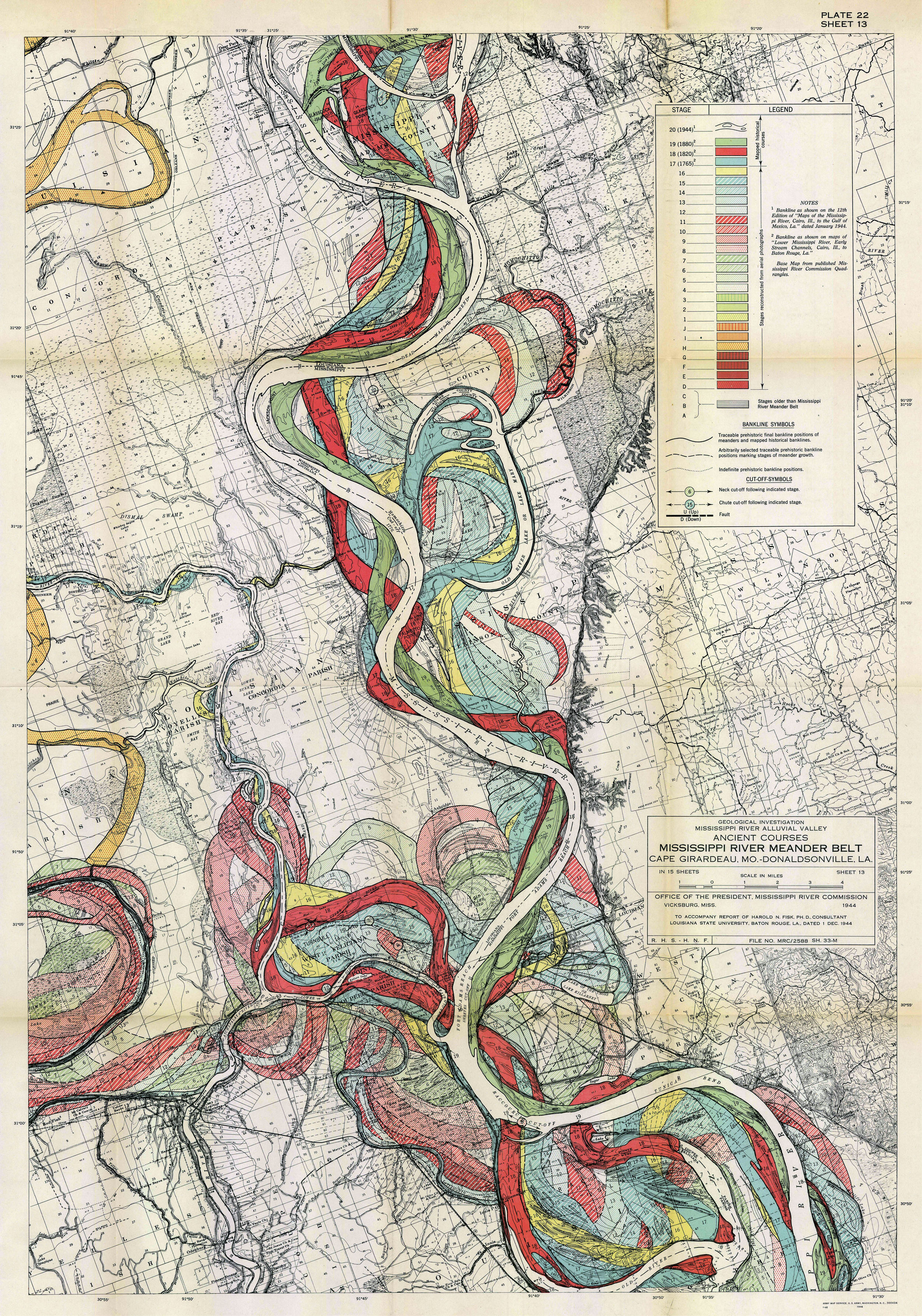
A particular story about these engineering efforts that has long fascinated me, and being reminded of it again this weekend led me to spend much of the past few days exploring various aspects of Mississippi River flooding. The story is that of Old River Control. The first book I ever read about the environment -- and one that really changed my life -- was Encounters with the Archdruid by John McPhee (I'll need to blog about that and about my own encounters with the Archdruid some other time.) The three stories in McPhee's The Control of Nature really cemented my understanding of environmental geography as the intersection between human endeavor and natural process.
Of the three, the story "Atchafalaya" (available from here from New Yorker magazine) has been the most interesting to me, especially since fluvial geomorphology was a major part of my graduate work. As McPhee explains, Old River Control is a critical structure among the many that intend to keep the Mississippi River in a constant position. As illustrated in the 1944 map above, levees contain the river in a position that is just the latest of many it had occupied in previous years. A similar process operates near the mouth of the river, where distributaries shift constantly as both water and sediment are carried toward the sea. For decades, the path of least resistance would be for the main stem of the river to shift in such a way that most of its flow would be carried through the Atchafalaya Basin.
As I alluded above, this was all brought back to me by Remaking the Mississippi, an interview by Bruce Gellerman with John Barry, author of the book Rising Tide, the Great Mississippi Flood of 1927 and How it Changed America. I recommend listening to the interview as perhaps the best introduction to this complicated subject.
Connecting Our World

Geographic education at all of these scales is important, of course, but the need for geographic understanding at the global level may well be the most critical educational need of all. As our friend Harm de Blij has said, "Ignorance of geography is a threat to our national security."
A new organization called Connecting Our World is trying to build support for international education. Although the effort is not limited to geography -- foreign languages, for example, are equally important -- much of what the group advocates is of critical interest to geographers. Examine the group's Talking Points page for some persuasive arguments in favor of learning more about the world!
Cultural Geography of Food in U.S.

The geography of food encompasses many aspects of economic and environmental geography, but food is also very much about culture. As a nation of immigrants that also encompasses many kinds of climate, soil, and topography, the variety of food cultures in the United States is tremendous. Parade magazine celebrates this diversity in a recent cover story on food festivals taking place throughout the summer and into the autumn, and has invited readers to post additional festivals on its web site. Also see our comments on the Nueva Receta blog.
Monday, May 23, 2011
Finding a Geography Program
A new post on my department blog points to two useful resources for people looking for a geography department. One is a bit of "how to" advice from geographer Matt Rosenberg. The other is a global database of departments. (Data for my own department has changed, but I've submitted a replacement entry.)
Subscribe to:
Posts (Atom)