Monday, January 28, 2013

Holguín Son

Revised January 2020

During my 2003 visit to Cuba, the entire group quickly grew tired of the catchy, ubiquitous song "Guantanamara," to the point that we considered implementing a fine for involuntary humming of the song by group members. I might have felt differently had I understood the political significance of the song, but probably not: it is the ultimate earworm.

The opening chords of "Chan Chan" evoked no such response. We heard it almost as often, and I certainly never tired of it. A decade later, it always takes me on a brief mental journey back to Havana. The song is a romantic -- even somewhat ribald -- example of Cuban son, a style introduced to many North American audiences (including me) by Ry Cooder's Buena Vista Social Club project.

As much as I associate the song with Havana -- because it was recorded there -- the song itself is set in the eastern province of Holguín, coincidentally home to Fidel and Raul Castro. It evokes a day of traveling from three small towns in the hills down to the beach town of Mayari.


View Chan Chan in a larger map

Lagniappe

Enjoy more music and landscapes in this video set to "El Carretero" -- another song in the Buena Vista Social Club repertoire. I enjoy it because it captures parts of the ride I took from Havana to Trinidad in 2003.

Thursday, January 03, 2013

Crossroads Conversation

Yesterday I noticed that Bill Moyers -- one of my favorite Baptists -- had interviewed Junot Díaz -- the only Pulitzer-prize winner I have met. I was immediately drawn to the conversation, both by the great integrity and intellectual rigor that these public intellectuals share and by the sharply different style they each bring to conversation.

Even before the interview itself, I was rewarded in the opening snippet by a reference to libraries and librarians. As I was reminded later in the interview, Díaz remembers an early childhood in the Dominican Republic without libraries, where a Bible might be seen, but where he had never seen two books together. For this future writer, one of the greatest gifts of coming to America was his immediate introduction to the local library. (It is appropriate that it was my wife the librarian who made it possible for my students and me to meet Professor Díaz a couple of years ago.)


Moyers & Company Show 151: Rewriting the Story of America from BillMoyers.com on Vimeo.

Speaking for a full hour, six weeks after the re-election of Barack Obama, Díaz and Moyers have had time to think carefully about what the election might mean as a marker of a country undergoing profound change.

“There is an enormous gap between the way the country presents itself and imagines itself and projects itself, and the reality of this country,” Díaz tells Moyers. “Whether we're talking about the Latino community in North Carolina, a whole new progressive generation of Cuban Americans in Florida, a very out queer community across the United States, or an enormous body of young voters who are either ignored or pandered to, I think we're having a new country emerging that's been in the making for a long time, and that I think for the first time is revealing itself more fully to the entire country.”

He shares with me an reluctance to apply the word "conservative" to the Republican party as it currently operates at the national level. He explains the difficulty more deftly than I could and more brazenly than I would. “Wouldn’t it be nice to have a real conservative party in this country for once?” he asks. Instead, what the GOP currently offers is a “shelter for a lot of messed-up and toxic paradigms.”

What needs to happen is not easy, he admits, but needs to be done. He tells Moyers that it is "much harder than we ever gave it credit for to really embrace a country like this one, a country that is so dynamic and so diverse at all different levels.”

What is needed, he insists, is genuine conversation, and he and Moyers provide a rich example, and one that is not limited to the election itself. The conversation ranges from surprising differences in the racial dynamics of Hollywood and Wall Street, for example, to the importance of reading Moby Dick and the travesty of student-loan debt.

Those who find this conversation as compelling as I did may wish to hear his conversation with another great interviewer, as he spoke with Tom Ashbrook about the profound lessons of disaster in Haiti.

Wednesday, January 02, 2013

Alt-dot-musica

See Alt.Latino main page to search stories or to listen live
I have been interested in the music of Latin America for more than a decade, and have incorporated some of the rich variety of the region's music in my teaching and outreach.


My very first exposure to the musical traditions of Brazil and Cuba was even earlier, through the production work of David Byrne at Luaka Bop. My interest really grew through  friends and colleagues who shared their favorite music during my visits to Latin America, Once I started listening to these songs (mainly on CDs), I started to make connections. I must confess, though, that my seven years in the border area were wasted, musically speaking, as I did not even attempt to understand Tejano or Conjunto music until I moved north.

I continue to appreciate the incredible variety of music from Latin America, but must admit that my pursuit of coffee, tea, and now chocolate have distracted me a bit in recent years, so that my Musica web pages have experienced a bit of neglect.

This is where Alt.Latino comes in. I first started hearing about it a few months ago, around the edges of my habitual NPR listening and reading. When I decided to fluff up my pages this week, I decided to have a look around, and I was richly rewarded. Hosts Jasmine Garsd and Felix Contreras have put a name to a pattern I had started to notice but could not articulate: From them I have realized that Latin Alternative is a way to describe many of the musics to which I was being drawn.

Like the music, the program seems to be evolving, from its chance beginnings near the NPR vending machines, into a major force with several different manifestations, including hour-long produced shows, blog posts, various social-media and spots on other NPR programs. It also has a continues internet radio stream. As I browsed through the weekly shows, the first I found was an interview with Manu Chao, whose Clandestino CD each member of my family has memorized to varying degrees.

The wide-ranging interview is a genuine treat, mixing insights about politics and art with samples of his work and the work of others whose music he enjoys. It was my first encounter with the song "Me gustas tu," a silly and catchy tune that is as close to pop as I've heard him. As with many of his songs, the "VIDEO OFFICIAL" version is a visual feast, and the best way to enjoy the music. This track is from the Proxima Estacion: Esperanza (Next Station: Hope) CD. On my first perusal, I noticed many songs that sample his own earlier works.


On YouTube, it was not difficult to find an unofficial version of the song with printed lyrics (albeit with a few typos). For those learning a language, such videos are a real blessing.


More about my own thoughts on Manu Chao and some similar artists is on my Musica - Eclectic page.

Muertos


¡Que Miedo! was the Halloween 2012 episode of the program, which explored the intersection of folklore and contemporary Latin music, including sexy horror that predates Twilight. The discussion includes, of course, both the chupacabras and various versions of the La Llorona tale. The Chavela Vargas version they play is used in a popular Frida Kahlo tribute video; my 2010 La Llorona post includes two other variations -- a spoken-word reading and television advertisement.

(In addition to the musica web page, this blog includes a number of posts with a musica label. I am available for presentations on this topic at high school and college campuses, as I am for presentations on the geography of coffee, tea, or chocolate. )

Monday, December 24, 2012

Queen Lisa?


Political geography often finds its way onto The Simpsons. In connection with Queen Elizabeth's annual Christmas greetings, Philip Reeves explains how the most political of the Simpsons characters -- Lisa -- is herself now a factor in British politics. She is something of a celebrity among separatists in the English county of Cornwall, where tourism officials are now prohibited from using the words England or county.

This story requires some understanding of the distinctions among such terms as England, Great Britain, and United Kingdom. Although he twice makes a false distinction between politics and geography -- and online commentators object to some of his claims, CGP Grey offers some clarifying remarks on the differences.

Sunday, December 23, 2012

A Line in the Water

Photographer John  Legge posted this image on the Visit Derby
web site in honor of Samuel Plimsoll's life-saving contribution.
Early this morning, I heard a story on the 99% Invisible design program, in which Roman Mars expressed his admiration for the elegant design of the Plimsoll Line. In looking for the program online, I also found a very nice 2008 BBC story about Samuel Plimsoll's political struggle to get a simple line painted on ships.

The simple line is a triumph of design and -- to be honest -- of the triumph of good over evil.

Honored in Bristol England
Photo by Mike Smith
via Roman Mars 
Now taken for granted on ships throughout the world, the 450mm-long line marks the maximum depth to which a ship can be safely loaded. If the line is not visible at or above the water line, the ship is too low in the water and subject to sinking. The lines to the sides of the basic Plimsoll Line indicate adjustments for the density of water by salinity and season.

The Plimsoll story piqued my interest because of my general pursuit of all things nautical these days. It is also relevant to my teaching about environmental and safety regulations, as it is an unusually clear case of greed (and evil) blocking an obvious need for reform.

I am currently reading Philbrick's In the Heart of the Sea, which describes many of the ways in which indifferent ship owners put the lives of their crews in danger. I purchased the book at the Bookworks on Nantucket, where most of the wealth generated by whaling accumulated. As cavalier as ship owners were with the lives of their sailors in 1819, they had become even more likely to take risks by the middle of the century, when insurance made ships worth more at the bottom of the sea.

As a member of parliament, Samuel Plimsoll found this unacceptable. It may be that the insurance companies would have eventually ended the practice of overloading ships (known as "coffins" by wary sailors), but by 1873 they had not acted, so Parliament did. The mandate to include Plimsoll's simple mark was a compromise -- he wanted stricter regulations -- but the intervening years it has saved many thousands of sailors from a watery grave.

Related Non-News
Readers of this post are very unlikely to have heard of the wreck of the Stena Primorsk, an oil tanker that ran aground on the Hudson River on December 20, 2012. The reason the wreck is little-known it is a double-hulled ship. Most tankers have been double-hulled since the 1989 Exxon Valdez wreck (a DUI of catastrophic proportions on the part of Captain Hazelwood). It has been against considerable industry resistance that most countries in the world have pledged to ban single-hull tankers by 2015. Although Exxon does continue to use them, they are now rare because regulators imposed restrictions over industry objections.

Lagniappe:
Roman Mars (in the story above) explains why these shoes are still sometimes called Plimsolls in the UK:

Tuesday, December 11, 2012

Imagine No Fracking

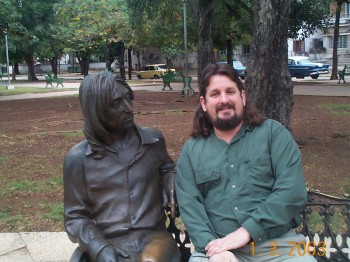
Some say that artists should not advocate controversial points of view. In my view, that is what artists are for, and Yoko Ono apparently agrees. John Lennon's widow and their son Sean took out the following ad in yesterday's New York Times. New York Governor Mario Cuomo recently announced that he has delayed a decision on the regulation of hydraulic fracturing until February. Yoko and Sean have joined with other Artists Against Fracking to encourage him to ban the practice.


John and I approve.

Sitting at the Imagine memorial in Havana, 2003

Monday, December 10, 2012

Mapping Sandy's Reach

Excerpt from a Sandy flood map compiled from FEMA data
by CARTODB and hosted by New York Newsday
The image above was clipped for the Long Beach Hurricane Information page from a much larger, interactive map posted by New York Newsday. It looks a lot like the maps of future sea levels about which I recently wrote in Rising Stakes, but this is not a hypothetical map. Pan and zoom to see where the recent flood waters reached. It is particularly interesting to see which familiar Manhattan landmarks were under water or became waterfront during this storm.

A similar storm on higher future base levels would of course reach much farther inland.

As of this writing (December 10), news about the impact of Sandy continues. A few recent items are particularly relevant to this image. According to the New York Times, Lower Manhattan Residents and Businesses Still Grapple with Recovery.  In a very interesting analysis, NPR reports that Sandy Forces Questions About Waterfront Rebuilding.

And finally, an effort  -- with a bit of good humor -- to restore a very important place that was flooded.

Westport to Freetown


Today's installment of Mass Moments connects two places about which I have written in this space frequently, but which today seem worlds apart: Westport and Sierra Leone. They are connected, of course, by the Atlantic Ocean and also by a remarkable individual who sailed from one to the other on this date in 1815. Having read his remarkable story, I look forward to visiting the Paul Cuffe memorial and grave site on an upcoming visit to Westport.

Among the many causes he championed was that of voting rights for all who pay taxes. Although slavery itself has ended, the problem continues among marginalized people living in the United States. Undocumented workers contribute both labor and taxes without any chance to vote, as their labor has been successfully sieved from their humanity, and even some citizens are barred from representation in Congress, if they live in Washington, D.C.

Thursday, December 06, 2012

Climate On Point

"Climate is not weather. But when climate arrives, it arrives as weather."
~~ On Point host Tom Ashbrook

We have had a year in which radio and television reporters sound like they are actors in future disaster films. Today, Tom Ashbrook and his guests focus on a country that finally is paying attention.

Only 10 percent of Americans are categorized as "dismissive," believing that climate change is some kind of hoax. As Ashbrook points out, this minority has had disproportionate influence, but perhaps that is changing.

Callers represent a wide range of views, which are addressed with clarity -- and patience -- by Tom's guests.


Tuesday, December 04, 2012

For the Night Stand

Sprudge is the site for "Coffee News & Frothy Gossip," where the pace of posting seems to be as caffeinated as the subject matter. For those awake enough to read all this and wonder, "Where can I read more about coffee?" the site's Holiday Gift Guide should do the trick.

Image: Sprudge.com
Most of the books are recent and -- I hate to admit -- unfamiliar to me. I agree that God in a Cup is more of a gossipy 2009 time capsule than a serious discussion of the industry (though I took guilty pleasure in knowing some of the subjects of that gossip) and that Uncommon Grounds is an essential (though heavy) primer on the industry. As I point out in the comments section (where other coffee enthusiasts have likewise posted suggestions), no list of coffee books is complete without Javatrekker

The rest of these titles look intriguing, though, and I look forward to finding the ones I do not already have in my personal collection or in our university library (which has an unusually robust coffee collection, in print and online). Incidentally, Sprudge has done booksellers a good turn by linking to local sources (through Abe Books) wherever it can. I will try to do that myself in the future.

Blog Ideas

coffee (25) GEOG381 (24) GEOG388 (23) GEOG470 (18) climate change (18) GEOG130 (16) geography (16) GEOG332 (13) GEOG431 (12) musica (11) GEOG 332 (9) GEOG 381 (9) Mexico (9) Brazil (8) GEOG286 (8) Texas (8) education (8) migration (8) GEOG298 (7) borderlands (7) GEOG199 (6) GEOG331 (6) Massachusetts (6) US-Mexico (6) deBlij04 (6) immigration (6) GEOG 130 (5) GEOG 286 (5) GEOG287 (5) climate justice (5) cultural geography (5) fair trade (5) food (5) geographic education (5) nicaragua (5) water (5) Arizona (4) GEOG 171 (4) GEOG171 (4) GEOG295 (4) Safina (4) africa (4) deBlij05 (4) land protection (4) music (4) politics (4) Bolivia (3) Boston (3) COVID-19 (3) Detroit (3) Ethiopia (3) Managua (3) Obama (3) border (3) cartography (3) drought (3) libraries (3) pesticides (3) suburban sprawl (3) trade (3) unemployment (3) Alaska (2) Amazon (2) Bridgewater (2) Canada (2) Chiapas (2) China (2) Colonialism (2) EPA (2) EarthView (2) Economy (2) Environment (2) GEOG 199 (2) GEOG 287 (2) GEOG 388 (2) Google Maps (2) Government (2) Hawaii (2) India (2) Lexington (2) Maldives (2) Mozambique (2) NOLA (2) NPR (2) National Monuments (2) National Parks (2) New Orleans (2) Religion (2) Rio Grande (2) Taunton River Wild and Scenic (2) Tex-Mex (2) The View from Lazy Point (2) United States (2) Venezuela (2) anthropocene (2) cape verde (2) censorship (2) central america (2) chocolate (2) corn (2) deBlij07 (2) deforestation (2) demographic transition (2) demography (2) education reform (2) employment (2) environmental geography (2) film (2) forest fire (2) global warming (2) islands (2) landscape ecology (2) librarians (2) maps (2) organic (2) peak oil (2) refugees (2) sense of place (2) soccer (2) sustainability (2) television (2) water rights (2) whales (2) #bbc (1) #nicaragua (1) #sosnicaragua (1) #sosnicaragua #nicaragua (1) 100 Years of Solitude (1) ACROSS Lexington (1) Accents (1) Adam at Home (1) Alice (1) Alt.Latina (1) American Hustle (1) April (1) Association of american Geographers (1) Audubon (1) Aunt Hatch's Lane (1) BBC (1) BSU (1) Baby Boomers (1) Banda Aceh (1) Bay Circuit Trial (1) Bechtel (1) Beleza Tropical (1) Belize (1) Beloit College (1) Ben Linder Cafe (1) Bet The Farm (1) Bhopal (1) Biafra (1) Bikeway (1) Bikini (1) Bill Gates (1) Bill Moyers (1) Boeing 777 (1) Brazilian (1) Brazilianization (1) Bridge (1) British Columbia (1) Brockton (1) Bus Fare (1) Bush (1) Cabo Verde (1) California (1) Cambridge (1) Cape Cod Bay (1) Carl Stafina (1) Catholic (1) Ceuta (1) Chalice (1) Chipko (1) Citgo (1) Climate risks (1) Cochabamba (1) Colombia (1) Common Core (1) Commuter (1) Computers (1) Cuba (1) Cups and Summits (1) Dallas (1) David Byrne (1) Deans Beans (1) Delaware Valley (1) Dunkin Donuts (1) Earth Day (1) Earth View (1) Easton (1) El Salvador (1) Elizabeth Warren (1) Ellicott City (1) Emilia Laime (1) English-only (1) Environmental History (1) Euphrates (1) European Union (1) Evo Morales (1) FIFA (1) FYS (1) Fades Out (1) Farms (1) First-Year Seminar (1) Food Trade (1) Frederick Kaufman (1) French press (1) Fresh Pond Mall (1) GEOG 431 (1) GEOG 441 (1) GEOG213 (1) GEOG490 (1) Gabriel García Márquez (1) Garden of Gethsemane (1) Gas wells (1) Gateway Cities (1) General Motors (1) Gini Coefficient (1) Girl in the Cafe (1) Google (1) Gordon Hempton (1) Gravina Island Bridge (1) Great Migration (1) Great Molasses Flood (1) Guy Lombardo (1) Haiti (1) Hawks (1) Heart (1) Higher Education (1) History (1) Holyhok Lewisville (1) Homogenous (1) Honors (1) How Food Stopped Being Food (1) Hugo Chavez (1) IMF (1) Iditarod (1) Imperial Valley (1) Income Inequality (1) Indonesia (1) Iraq (1) Irish (1) Japan (1) Junot Diaz (1) Kenya (1) Ketchikan (1) Key West (1) Kindergarden Students (1) King Corn (1) Kiribati (1) Latin America (1) Limbaugh (1) Literature (1) Living On Earth (1) Louisiana (1) Love Canal (1) Luddite (1) M*A*S*H (1) MCAS (1) MacArthur Genius (1) Maersk (1) Malawi (1) Malaysia (1) Malaysian Air Flight 370 (1) Mali (1) Manu Chao (1) Map (1) Marblehead (1) Mary Robinson Foundation (1) Maryland (1) Massachusetts Bay Colony (1) Math (1) Maxguide (1) May (1) Maya (1) Mayan (1) Mayan Gold (1) Mbala (1) McDonald's (1) Melilla (1) Mexicans (1) Michael Pollan (1) Michelle Obama (1) Micronesia (1) Military (1) Military Dictatorship (1) Minuteman Trail (1) Mongolia (1) Monsanto (1) Montana (1) Morocco (1) Mount Auburn Cemetery (1) Muslim (1) NPS (1) Nantucket (1) National Education Regime (1) Native American (1) Native Americans (1) New Bedford (1) New Hampshire (1) New York City (1) New York Times (1) Nigeria (1) No Child Left Behind Act (1) Norquist (1) North Africa (1) Nuts (1) Oakland (1) Oaxaca (1) Occupeligo (1) Occypy (1) Oklahoma (1) Oklahoma City (1) Oppression (1) PARCC (1) Pakistan (1) Pascal's Wager (1) Peanut (1) Pearson Regime (1) Philadelphia (1) Philippines (1) Pink Unicorns (1) Poland (1) Portuguese (1) Protest (1) Public Education (1) Puebla (1) Puritans (1) Quest University (1) Rachel Carson (1) Reading (1) Republican (1) Retro Report (1) Robert Reich (1) Rock Legend (1) Ronald Reagan (1) Rondonia (1) Rosa Parks (1) SEXCoffee (1) Safety (1) Samoza (1) Sandino (1) Sara Vowell (1) Save the Children (1) Scotch (1) Scotland (1) Seinfeld (1) Senegal (1) Sergio Mendes (1) Severin (1) Sharrod (1) Silent Spring (1) Sinatra (1) Slope (1) Smokey the Bear (1) Somalia (1) Sombra (1) Sonora (1) Sonoran desert (1) Sonoran hot dog (1) South America (1) Spain (1) Stairway to Heaven (1) Storm (1) Suare Inch of Silence (1) Sumatra (1) Swamp (1) Tacloban (1) Tanzania (1) The Amazon (1) The Amazon Trail (1) Tigris (1) Tucson (1) Tufts (1) U.S Federal Reserve (1) U.S Government (1) U.S. economy (1) USDA (1) USLE Formula (1) Uganda (1) Unfamiliar Fishes (1) Union Carbide (1) Vacation (1) Vexillology (1) Vietnam (1) ViralNova (1) WNYC Data News (1) Wall Street (1) Walsenburg (1) Walt Disney (1) Walt and El Grupo (1) Ward's Berry Farm (1) West (1) Whaling (1) Wilson (1) Winter Storm Saturn (1) Wisconsin (1) World Bank (1) Xingu (1) YouTube (1) Zombies (1) agriculture (1) antitrust (1) aspen (1) austerity (1) aviation (1) banned books (1) bark beetle (1) bean (1) beavers (1) bicycle (1) bicycling (1) bike sharing (1) binary (1) biodiversity (1) bioneers (1) books (1) boston globe (1) cacao (1) cafe (1) campaign (1) campus (1) cantonville (1) capitals (1) carbon dioxide (1) carbon offsets (1) carioca (1) cash (1) cashews (1) census (1) chemex (1) chemistry (1) chronology (1) churrasco (1) civil rights (1) coffee grounds (1) coffee hell (1) coffee prices (1) coffee quality (1) college (1) compost (1) computerized test (1) congress (1) conservation commission (1) corporations (1) countries (1) cubicle (1) dams (1) deBlij06 (1) deBlij08 (1) death (1) deficit (1) development (1) dictatorship (1) distracted learning (1) distraction (1) drug war (1) dtm (1) earth (1) economic diversification (1) economic geography (1) election (1) embargo (1) energy (1) enhanced greenhouse effect (1) environmentalist (1) ethnomusicology (1) exremism (1) failed states (1) farming (1) financial crisis (1) football (1) forestry (1) forro (1) fracking (1) free market (1) free trade (1) fuel economy (1) garden (1) genocide (1) geography education (1) geography games (1) geography of chocolate (1) geography of food (1) geologic time (1) geotechnology (1) gerrymandering (1) global pizza (1) globe (1) goodall (1) green chemistry (1) ground water (1) guacamole (1) guatemala (1) habitat (1) high-frutcose (1) home values (1) hospitality (1) hourglass (1) housing (1) hydrology (1) illegal aliens (1) income (1) indigenous (1) interfaith (1) journalism (1) kitchen garden (1) labor (1) language (1) libertarianism (1) library (1) linguistics (1) little rock (1) llorona; musica (1) macc (1) maccweb (1) magic realism (1) maple syrup (1) mapping (1) masa no mas (1) massland (1) medical (1) mental maps (1) mi nina (1) microlots (1) microstates (1) mining (1) mltc (1) monopoly (1) municipal government (1) nautical (1) neoclassical economics (1) new england (1) newseum (1) newspapers (1) noise pollution (1) pandas (1) petroleum (1) piracy (1) pirates (1) poison ivy (1) police (1) political geography (1) pollution (1) provincial government (1) proxy variables (1) public diplomacy (1) quesadilla (1) rabbi (1) racism (1) real food cafe (1) regulations (1) remittances (1) resilience (1) resistance (1) respect (1) rigoberta menchu (1) rios montt (1) romance (1) roya (1) runways (1) russia (1) satellites (1) science (1) sea level (1) selva negra (1) sertao (1) sertão (1) sex (1) sex and coffee (1) simple (1) sin (1) smokey (1) solar (1) solar roasting (1) south africa (1) sovereignty (1) species loss (1) sporcle (1) sports (1) state government (1) taxes (1) tea party (1) teaching (1) textile (1) texting (1) tortilla (1) training (1) transect; Mercator (1) travel (1) triple-deckers (1) tsunami (1) urban geography (1) utopia (1) vermont (1) vice (1) video (1) wall (1) water resources (1) water vapor (1) whiskey (1) whisky (1) widget (1) wifi (1) wild fire (1) wildfire (1) wildlife corridor (1) wto (1)