Tuesday, April 26, 2022

Iturbide and Kahlo

While contemplating a good way to wrap up my course on the geography of Latin America, I was fortunate enough to hear this bit of radio journalism.

I thought I recognized the photographer's name and I was even more certain that I recognized her focus on indigenous people as her favored subjects at a certain point in her career.

Indeed, this was the photographer I was thinking of, and I had posted an article about the work of Graciela Iturbide in this space early in 2019. I wrote Mexico Contrasts, In Black & White based on a NYT article before I even went to her exhibit at the Museum of Fine Arts in Boston. (Search the MFA site for her name to see a lot of related stories.)

It was also in early 2019 that I learned of a Frida Kahlo exhibit that was coming to MFA in the same season and some new scholarship around her life and work. I wrote about this at the time in Frida La Pared.

I did not write much about the exhibit itself, but at the time I did post this sign that I had found just outside the gallery.

To honor the voice of the artist, throughout this exhibition we have included texts in both Spanish and English.

I have seen a lot of bilingual signage in museums, but I do not think I have ever seen a bilingual sign about bilingual signs. Attention was being called to their use because they were the first such signs used in MFA since it opened in 1876. A Juneteenth 2019 story on WGBH reminds me that this was during a time of controversy and introspection about race and access in the museum. 

Iturbide's Casa de la Muerte (1975) captures Mexican motifs of the dead.

Lagniappe

Those reading this post now (April 26, 2022) might have an opportunity to visit the Immersive Frida exhibit in Boston or in another city.

Monday, April 25, 2022

Ukraine Library Heroism

From the journalists at Here & Now (WBUR) comes a story of heroic librarianship and unfortunate timing. The current war on Ukraine is an effort not only of territory but also of erasure. 
Ukrainian-American Wolodymyr Mirko Pylyshenko dedicated his life to building a collection of artifacts that would make denial of Ukrainian identity impossible. Scott Tong's  interview (11-minute listen) with his daughter and a Ukrainian municipal official describes the building of that collection and the unfortunate timing of its return to Ukraine.

Pylyshenko's ID from a US-operated refugee camp is a reminder
of the high stakes of his library project and of a time when the
United States was more accomodating of refugees than it is today. 

This story is not unprecedented; what comes to mind most immediately is the tale of the Bad Ass Librarians of Timbuktu, who heroically protected artifacts in Mali.

Lagniappe: Poetry

Among the documents considered vital to this archive are poems. The most brutal dictators, it seems, fear poetry. I recall a Romanian friend who was imprisoned as a teenager for reading a poem. Her father was able to get her released after five days; her classmate who had written the poem served five years. For a poem about the beauty of the land.

In Nicaragua today, poets and their readers take similar risks.

Arizona Coffee

 Despite the popular brand name, tea does not grow in Arizona; nor does coffee. Except where it does: in the terrarium known as Biosphere 2, which was built just north of my old home in Tucson when we lived there in the 1990s. 

Coffee is growing in both the "rain forest" and "orchard" portions of the experimental planet-in-miniature.

New plants are being added as part of a peculiar fundraiser related to Earth Day. Donors can pay $500 for the chance to help plant seedlings, and $100 for 12 ounces of a decaf version of the crop. Details are scant, and as a Coffee Maven I do have some questions. One of the collaborators in the project is a part-time faculty member in the department from which I eventually wrested my doctorate, so I might start my inquiries with him. Stay tuned.

Wednesday, March 09, 2022

Musica: Paraguay

My interest in Latin America began with deforestation in the Amazon and eventually led me to the study of coffee. Along the way, I have found the many kinds of Latin American music to be an excellent lens on the region's cultural geography.

I was therefore very pleased to learn something about the music of Paraguay from the BBC global podcast Music Planet: Road Trip.  An episode originally broadcast in May 2020 describes the invention and diffusion of Guarani, an entire genre that can be traced to a single composer. The samples are long and the narration short, so this is a very enjoyable listen. I will be delving into other episodes, both from the Americas and elsewhere.

The story never really defines the genre, but it gives many examples in several languages. I found this intriguing, because the genre is named for GuaranĂ­, one of the two national languages of Paraguay. Journalist William Costa explains in Culture is Language (The Guardian, September 2020) why this language is important to the identity of Paraguans -- indigenous and otherwise. I find the embrace of Guarani as a musical genre in Spanish and Portuguese somehow heartwarming.

This story of the music of Paraguay reminds me of story of music in Paraguay. In other words, I am using it as yet another excuse to encourage readers -- especially those with any interest at all in education -- to watch Landfillharmonic. This is a film about the intersection of education and sustainability, and of classical and heavy-metal musics.

See the trailer and background from the producers on the Landfillharmonic web page.


It is available as a DVD at the BSU Maxwell Library and streaming on Amazon. It may also be on Apple TV -- I cannot keep up with the platform options. I suggest a purchase: once you see this film, you might want to watch it again or share it with your own friends and students right away. 

Lagniappe

One of the artists who is sampled in the Guarani episode is the brilliant Brazilian musician and dissident Chico Buarque, about whom I have written in Overcoming Condor and other posts.

Friday, February 25, 2022

Just-in-Case Chaos

Long Beach containers: the giant Legos that move the world
Image: Port Technology

During one of my brief bouts of non-academic employment, I worked in a business that was deeply involved in supply-chain issues. We packaged 100,000 meals every day, with food and packaging materials flowing into our warehouse and back out in an incredibly complex dance. 

Thankfully, I was not in charge of all that -- in fact, no one person could be. Even then -- in the mid-1990s -- logistics were complicated and pricing was so competitive that we measured the cost of everything to the tenth of a U.S. cent. Even though my role in all of this was rather peripheral, my employer knew the value of my understanding it better, and so I was one of many employees sent to take a course for supply-chain professionals called Just-In-Time. It was one of six parts of a certification program I did not complete, but it was the overview -- offering a global perspective that I continue to value as a geographer.

Of course, most normal people do not pay much attention to supply chains and do not even hear the two words being used together. But 2020 and 2021 (and 2022) are not normal times, so many people have become reluctant students of the vagaries of the world space-economy (as we geographers like to call it). 

For many, the incredible stuckedness of the Evergiven in the Suez Canal in March 2021 -- and the even more incredible stuckedness of hundreds of other vessels -- was the introduction to supply chains. For others, it had been the disruption of microchip and automobile manufacturing because of the March 2011 Fukushima nuclear disaster. In both cases, we became aware that efficiency and expediency come at the cost of resilience and redundancy.

In short, Just-in-Time minimizes costs and maximizes speed by not storing inventory. In extreme cases -- and most cases now are extreme -- parts enter an assembly line directly from a delivery truck, which got them from a train or a ship. I explained some of the technologies that make this possible in my 2011 post The Biggest Ships Ever

This is all very efficient and convenient, up until the moment it is not. Late in 2021, massive disruptions led to wild speculation and finger-pointing on the part of people who had not given the system much thought previously. I found two brief radio pieces quite instructive. 

In November, NPR reporter A Martinez spoke with Danny Wan, executive director of the Port of Oakland, about the persistent backlog at California ports. In December, NPR's Steve Inskeep talked with John Porcari, port envoy of the White House's Supply Chain Disruptions Task Force about the federal role in facilitating global traffic.

It is easy to conclude that when something goes wrong, some individual is to blame. But the world has become complicated in ways that are sometimes revealed only in crisis. We have an obligation to become better informed so that we can meaningfully participate in decisions that might make us even more vulnerable in the future, in exchange for small gains in efficiency.

Lagniappe 

Gas prices are another example of something that is far more complex than it seems and whose response to market factors triggers irrational responses, even among those who claim to love the free market

Blogger Crazy Eddie draws on the wisdom of Trevor Noah to explain why gas prices are high in a recovering economy. I share it here because both fuel prices and supply-chain problems have a prectable (and predicted) post-pandemic trajectory.

Bugging Out

In a recent episode of Fresh Air, co-host Dave Davies interviewed journalist Oliver Milman, whose reporting for The Guardian led him to write the new book The Insect Crisis: The Fall of the Tiny Empires That Run the World

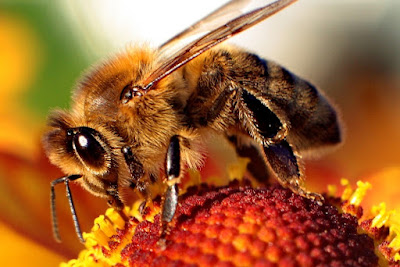
Bees are just one of many kinds of essential insects.
Image: WikiMedia

The subtitle is a good summary of the 40-minute interview, which is nevertheless worth our attention. Milman piqued my interest when he described what a world without insects would be like; he credits the recently deceased ecologist E.O. Wilson -- whom I mention many times on this blog -- with some rather grim ways of describing just how empty our world would be without insects. He then describes some of our dependencies in detail, along with some interesting ways in which the sharp decline of insects is being documented. He offers some small glimmers of hope, because modest changes in human habits have been shown to benefit insects greatly. They require our attention, though.

From the beginning, this discussion reminded me of the work of an earlier biologist about whom I have written even more on this blog: Rachel Carson. After all, her landmark 1962 book Silent Spring derives its title from a grim, quiet scenario in which birds are no longer present. Her focus was birds, but she described their endangerment in the context of human attacks on insects. 

Silent Spring did lead to some softening of those attacks, but as Milman makes clear, human activity continues to threaten these essential creatures in many ways, both deliberate and accidental.

The insecta class has persisted for 400,000,000 years, through several mass-extinction events. We have an opportunity -- and responsibility -- to ensure that a brief century of human "progress" does not prove to be their undoing. 

Lagniappe 

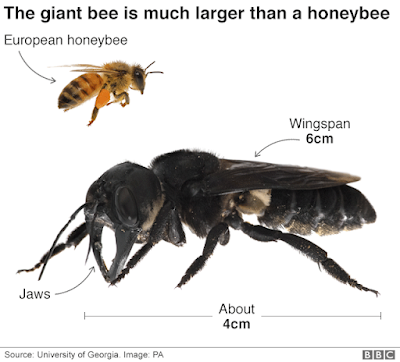
I was heartened to learn -- just a day or so after hearing the story above -- that an unusually large bee had been found in Indonesia, four decades after its presumed extinction. The rediscovery of the enormous Megachile pluto resulted from a very deliberate search that followed a rather accidental discovery of its nests. 

This part of the story exemplifies the attention to detail that has always fascinated me about entomologists. I used to go hiking and camping a lot with a friend who had studied entomology before becoming a geographer. (We did all of this travel in his VW Bugs, but that is another story.) Countless times, I would be walking along in almost complete oblivion to my surroundings when he would stop, gasp, and gesticulate wildly toward a smudge on a branch or fencepost or a bug that looked like all the other bugs to me. Invariably, it was a highly unusual bit of insect nest or food, or a bee disguised as a wasp disguised as a bee.


I hesitate to post this, because it is a hopeful anecdote that does negate the more systematic findings about the precipitous decline of insecta as a class. But we will take encouragement where we can find it, as we continue to work for the protection of all the remaining critters and the ecosystems of which they are a part.

Monday, January 17, 2022

Low Tide; High Wind

I am fortunate to row often -- usually more than once a week -- in the waters of New Bedford, Massachusetts. Sometimes this is in the ocean waters of Buzzards Bay or in Clark's Cove, but most often in the harbor formed between New Bedford and Fairhaven by the wide mouth of the Acushnet River. I often refer to harbor rowing as "inside" rowing because it takes place behind the protection of the New Bedford - Fairhaven Hurricane Barrier, by some measures the biggest structure of its kind on the planet. At 20 feet, it provides protection to both of the municipalities for which it is named and in extreme cases, for craft of all sizes that are kept -- sometimes just for the duration of a storm -- within its rocky embrace.

This makes the harbor a great place to observe ships resting between nautical ventures of work or play. We see refrigerated vessels carrying fruit, pleasure craft both ordinary and exceptional, barges and tugs engaged in decades-long cleanup efforts in the harbor itself, and of course the fishing boats that make this the most highest-value seafood harbor in these United States. 
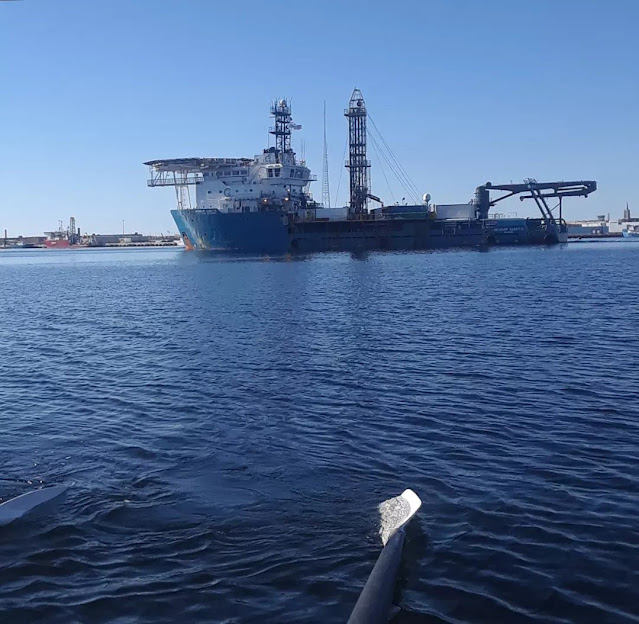
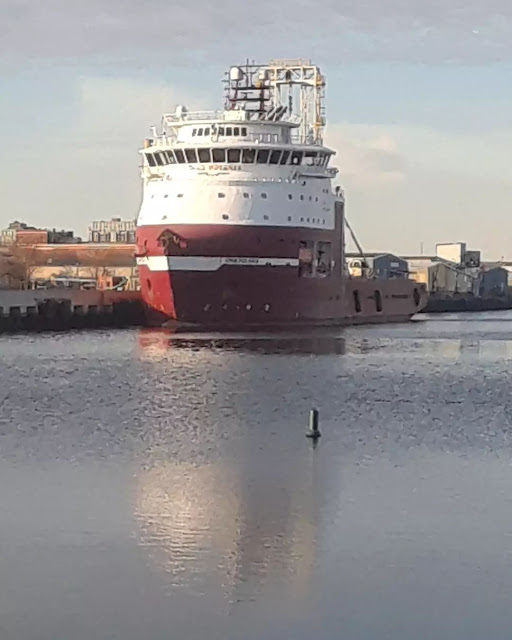
For the past several years, we have seen a whole new category of ships: a growing assortment of survey vessels -- a general term I use (somewhat correctly, I hope) for the ships that are berthed in New Bedford between periods of work offshore. The one photographed above started showing up just in the past few months. It is blue in color, huge in size, and features an enormous helipad (above the stern, which is left in this photo) for landing supplies when it is far from any harbor.  One of its towers is for pushing communication equipment as far above the horizon as possible. The other -- in the center of the ship -- is for drilling into the sea floor for survey and construction purposes. A geology colleague of mine spent a few months in the Indian Ocean on a vessel that was similarly equipped; I greatly enjoyed his stories.

On the first weekend in December, my spouse and I decided to take a long walk -- part of our ongoing preparation for our upcoming Vermont Inn to Inn Walk and an excuse to perhaps get a better view of some of these vessels. We checked a tide chart and parked our car on Rodney French Boulevard near the end of the Hurricane Barrier Walk, about an hour ahead of low tide. As the satellite image reveals, there is a sandbar connecting the hurricane barrier to Palmer Island. At high tide, there is just enough water for a skilled steerer and crew to guide a whaleboat through this gap; at low tide, we can walk. I later learned that it is generally walkable for a four-hour window around low tide, but I am a cautious sort, so we timed our walkabout such that we would be on the island for just the middle hour of that window. 

The walk afforded us a view of another of these engineering vessels, the Dina Polaris

The scale of the effort involved in developing offshore wind turbines is remarkable. Both the wharf and a deep channel have been built specifically for these ships, so that they can provide research and construction support for very large wind turbines being placed on the south side of Martha's Vineyard. The property was used for metal recycling during a long pause when the original Cape Wind project had been abandoned and Vineyard Wind was not yet underway. 

See the Vineyard Wind company site and an April 2021 news story for much more detail about the project. 

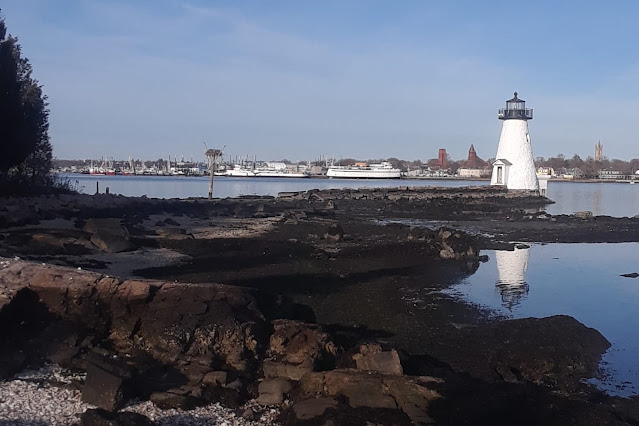
As we walked around the island, I looked for remnants of the hotel/brothel that had been there decades ago, but did not see any sign of the foundation. We did, however, have a nice view of the lighthouse and nearby osprey nest. We would not have walked this close to the osprey platform during nesting season. 


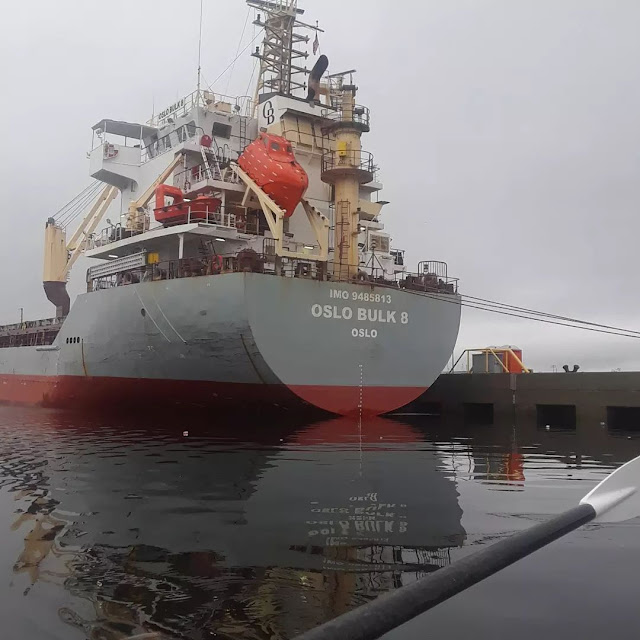
A few weeks after our hike, my fellow rowers and I started to notice some additional vessels, including a bulk carrier that I can only describe as humongous. The Oslo Bulk 8 measures 354 in length. The lifeboat stored above the stern looks like an amusement-park ride to me. We are not certain what this ship is used for, but it seems to me making regular passages from Limon, Costa Rica to New Bedford. I have been in Limon, where I saw thousands of containers of fruit ready for export, so I am going to be trying to find more information about the use of this vessel.
Update: While I have had a number of tabs open for this post, the Baker administration has been working toward even greater expansion of offshore wind. Read WBUR's update of December 17, 2021 for details. 

And further update: This story will continue to evolve and will warrant separate new posts in the coming year. It will also be a major part of my summer course New Bedford: Maritime City if I am able to offer in in 2022. The latest update (as of January 2022) is New Bedford says wind boundary changes just a start, which describes ongoing efforts to accommodate the commercial fishing industry as the wind farm develops.

June 2023 Addendum

This post should have had a map! Here it is, belatedly. I have never used the Gifford Street parking before, but it allows visitors to reach the harbor views much more quickly than the Rodney French Boulevard entrance I usually have used.


Sunday, January 16, 2022

(West) Liberty for All

Images: West Liberty, Iowa Town Website

In the United States, liberty for all and government of the people are ideals that are important in the abstract but sometimes met with resistance in real life. I was therefore heartened to hear the story of West Liberty, Iowa

Described as a "majority minority" town, it is an example of a changing rural landscape in the United States. The country has always been more diverse than some seem to imagine -- or prefer -- and not just in urban places. West Liberty is an example of a community whose political leadership is beginning to reflect its true demography. In other words, it embodies the American ideal of E pluribus unum

This is how it should be. I lived for seven years in border communities in Arizona and Texas where representation often did not reflect the makeup of the community. 

Lagniappe

The story discusses hardships that many in the community have overcome; it also mentions the importance of a local meat-packing plant as a reason many people have migrated to West Liberty. The 2006 film Fast Food Nation is a comedy/drama (very dark comedy, in my opinion) that describes some of the injustices associated with such plants that emerged throughout much of rural America in the late 20th century.

Thursday, January 13, 2022

Reflections of Richard Leakey

It seems that the past several weeks have featured more than the usual number of notable deaths, including Archbishop Desmond Tutu, E.O. Wilson, and Betty White. Just after the passing of these nonagenarians came news of the death at age 77 of a slightly younger fellow whose work I knew less well.

Word Art from the Ngaren Museum 
My favorite librarian and I both recall hearing anthropologist Richard Leakey in a lecture hall when we were students, though we cannot recall for certain when or where this was. I remember only that he was part of a noted family of anthropologists and that he had rather a cantankerous personality. As with many notables, I seem to have learned more about him after his death than I did when he was alive.

Vivienne Nunis interviewed Leakey for the BBC program Business Daily, in the context of a career changer. In just 18 minutes, they discuss several very different phases of his professional life, which really began when he was a child tagging along on archeological digs with his parents, anthropologists Louis and Mary Leakey. He lived his entire life in the English colonial territory that would become the country of Kenya.

In the first phase of his adult life, he reached into the distant past, literally uncovering the lives of humans who had lived in the Rift Valley 1.6 million years ago. He then became a noted conservationist whose audacious protests led to protection of elephants through restrictions on the trade in ivory (this benefited whales as well). His work as a conservationist was linked in complicated ways to his political life and other government service.

The most important part of the interview is the discussion of the work of what has turned out to be his sunset years. His understanding of humans across eons led him to fervent work on the problem of climate change. He sees the arc of human experience from deep prehistory to a precarious future from his lifetime in the Rift Valley, where we began and where our fate is clearly undecided. He and his colleagues have been working to capture that entire arc in the Ngaren Museum, where ground will be breaking soon on a project animated by this view of time.

Leakey was also profiled in a 2010 issue of Sierra, the magazine of the U.S.-based environmental organization. In Elephant Man, journalist Susan Zakin begins the story at the Peponi Hotel on the island of Lamu, where they were supposed to meet. His refusal to come ashore at the hotel becomes a metaphor for his uneasy status with fellow colonials. The profile she writes provides important details about the first two phases of the life Leakey discussed with Nunis last month, especially his work in environmental policy. 

Note: Their meeting took place at a time when many tourists were avoiding Kenya because of violence surrounding national elections. This coincided with my owned planned visit to the country. I had plane tickets and plans to meet a student and her family near Mount Kenya -- where both tea and coffee are produced. Just before the trip, she completely disappeared. I was never certain whether something had happened directly to her and her family or if she cut off contact to protect me.

Lagniappe 

Leakey's transition from renowned anthropologist to avid climate-change activist reminds me of a similar transition on the part of Jane Goodall, a protegée of Louis Leakey who thankfully is still with us. I point to some of her work in my 2020 post Jane Goodall: Climate, Community, Coffee. I have updated that post to include her January 2022 BBC interview, which pairs nicely with the Leakey interview above.

Friday, January 07, 2022

Crossing the Chaco

The Amazon rainforest is the largest ecosystem in South America; it is the one that drew me into the study of geography. I know quite a lot about it, though I still have plenty to learn. 

Three-banded armadillo is one of 150 mammal species
in the Gran Chaco. Image: WWF

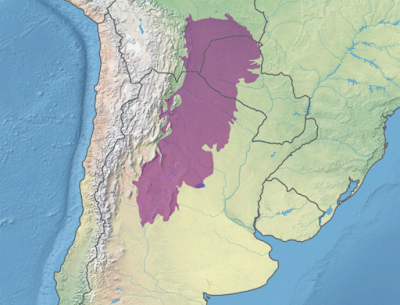
I know very little, however, about the second-largest ecosystem of South America: the Gran Chaco of Paraguay, Argentina, and Bolivia. It is also second in biodiversity, with over 500 species of birds alone. 

Map: Wikipedia. Chaqu is a Quechua word meaning 
"hunting land" and hinting at the region's diverse fauna.

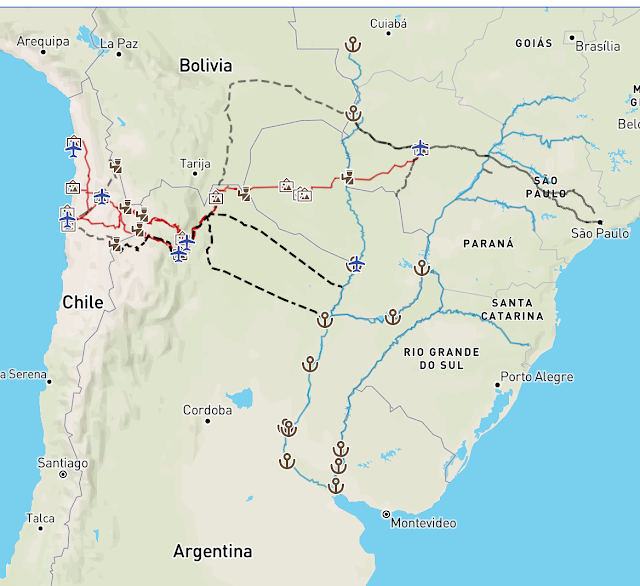
I have even more to learn about it, especially as both the land and the people of the Gran Chaco are threatened by rapid changes related to the opening of a bioceanic transportation corridor. The Amazon experience is, sadly, instructive -- rapid expansion of roads is bringing all manner of peril. In both cases, heretofore uncontacted civilizations are at greatest risk. 

Detail from an interactive map at Corredor Bioceanico, a website promoting the project.
The Gran Chaco is being traversed by road, rail, and river. 


Blog Ideas

coffee (25) GEOG381 (24) GEOG388 (23) GEOG470 (18) climate change (18) GEOG130 (16) geography (16) GEOG332 (13) GEOG431 (12) musica (11) GEOG 332 (9) GEOG 381 (9) Mexico (9) Brazil (8) GEOG286 (8) Texas (8) education (8) migration (8) GEOG298 (7) borderlands (7) GEOG199 (6) GEOG331 (6) Massachusetts (6) US-Mexico (6) deBlij04 (6) immigration (6) GEOG 130 (5) GEOG 286 (5) GEOG287 (5) climate justice (5) cultural geography (5) fair trade (5) food (5) geographic education (5) nicaragua (5) water (5) Arizona (4) GEOG 171 (4) GEOG171 (4) GEOG295 (4) Safina (4) africa (4) deBlij05 (4) land protection (4) music (4) politics (4) Bolivia (3) Boston (3) COVID-19 (3) Detroit (3) Ethiopia (3) Managua (3) Obama (3) border (3) cartography (3) drought (3) libraries (3) pesticides (3) suburban sprawl (3) trade (3) unemployment (3) Alaska (2) Amazon (2) Bridgewater (2) Canada (2) Chiapas (2) China (2) Colonialism (2) EPA (2) EarthView (2) Economy (2) Environment (2) GEOG 199 (2) GEOG 287 (2) GEOG 388 (2) Google Maps (2) Government (2) Hawaii (2) India (2) Lexington (2) Maldives (2) Mozambique (2) NOLA (2) NPR (2) National Monuments (2) National Parks (2) New Orleans (2) Religion (2) Rio Grande (2) Taunton River Wild and Scenic (2) Tex-Mex (2) The View from Lazy Point (2) United States (2) Venezuela (2) anthropocene (2) cape verde (2) censorship (2) central america (2) chocolate (2) corn (2) deBlij07 (2) deforestation (2) demographic transition (2) demography (2) education reform (2) employment (2) environmental geography (2) film (2) forest fire (2) global warming (2) islands (2) landscape ecology (2) librarians (2) maps (2) organic (2) peak oil (2) refugees (2) sense of place (2) soccer (2) sustainability (2) television (2) water rights (2) whales (2) #bbc (1) #nicaragua (1) #sosnicaragua (1) #sosnicaragua #nicaragua (1) 100 Years of Solitude (1) ACROSS Lexington (1) Accents (1) Adam at Home (1) Alice (1) Alt.Latina (1) American Hustle (1) April (1) Association of american Geographers (1) Audubon (1) Aunt Hatch's Lane (1) BBC (1) BSU (1) Baby Boomers (1) Banda Aceh (1) Bay Circuit Trial (1) Bechtel (1) Beleza Tropical (1) Belize (1) Beloit College (1) Ben Linder Cafe (1) Bet The Farm (1) Bhopal (1) Biafra (1) Bikeway (1) Bikini (1) Bill Gates (1) Bill Moyers (1) Boeing 777 (1) Brazilian (1) Brazilianization (1) Bridge (1) British Columbia (1) Brockton (1) Bus Fare (1) Bush (1) Cabo Verde (1) California (1) Cambridge (1) Cape Cod Bay (1) Carl Stafina (1) Catholic (1) Ceuta (1) Chalice (1) Chipko (1) Citgo (1) Climate risks (1) Cochabamba (1) Colombia (1) Common Core (1) Commuter (1) Computers (1) Cuba (1) Cups and Summits (1) Dallas (1) David Byrne (1) Deans Beans (1) Delaware Valley (1) Dunkin Donuts (1) Earth Day (1) Earth View (1) Easton (1) El Salvador (1) Elizabeth Warren (1) Ellicott City (1) Emilia Laime (1) English-only (1) Environmental History (1) Euphrates (1) European Union (1) Evo Morales (1) FIFA (1) FYS (1) Fades Out (1) Farms (1) First-Year Seminar (1) Food Trade (1) Frederick Kaufman (1) French press (1) Fresh Pond Mall (1) GEOG 431 (1) GEOG 441 (1) GEOG213 (1) GEOG490 (1) Gabriel GarcĂ­a MĂ¡rquez (1) Garden of Gethsemane (1) Gas wells (1) Gateway Cities (1) General Motors (1) Gini Coefficient (1) Girl in the Cafe (1) Google (1) Gordon Hempton (1) Gravina Island Bridge (1) Great Migration (1) Great Molasses Flood (1) Guy Lombardo (1) Haiti (1) Hawks (1) Heart (1) Higher Education (1) History (1) Holyhok Lewisville (1) Homogenous (1) Honors (1) How Food Stopped Being Food (1) Hugo Chavez (1) IMF (1) Iditarod (1) Imperial Valley (1) Income Inequality (1) Indonesia (1) Iraq (1) Irish (1) Japan (1) Junot Diaz (1) Kenya (1) Ketchikan (1) Key West (1) Kindergarden Students (1) King Corn (1) Kiribati (1) Latin America (1) Limbaugh (1) Literature (1) Living On Earth (1) Louisiana (1) Love Canal (1) Luddite (1) M*A*S*H (1) MCAS (1) MacArthur Genius (1) Maersk (1) Malawi (1) Malaysia (1) Malaysian Air Flight 370 (1) Mali (1) Manu Chao (1) Map (1) Marblehead (1) Mary Robinson Foundation (1) Maryland (1) Massachusetts Bay Colony (1) Math (1) Maxguide (1) May (1) Maya (1) Mayan (1) Mayan Gold (1) Mbala (1) McDonald's (1) Melilla (1) Mexicans (1) Michael Pollan (1) Michelle Obama (1) Micronesia (1) Military (1) Military Dictatorship (1) Minuteman Trail (1) Mongolia (1) Monsanto (1) Montana (1) Morocco (1) Mount Auburn Cemetery (1) Muslim (1) NPS (1) Nantucket (1) National Education Regime (1) Native American (1) Native Americans (1) New Bedford (1) New Hampshire (1) New York City (1) New York Times (1) Nigeria (1) No Child Left Behind Act (1) Norquist (1) North Africa (1) Nuts (1) Oakland (1) Oaxaca (1) Occupeligo (1) Occypy (1) Oklahoma (1) Oklahoma City (1) Oppression (1) PARCC (1) Pakistan (1) Pascal's Wager (1) Peanut (1) Pearson Regime (1) Philadelphia (1) Philippines (1) Pink Unicorns (1) Poland (1) Portuguese (1) Protest (1) Public Education (1) Puebla (1) Puritans (1) Quest University (1) Rachel Carson (1) Reading (1) Republican (1) Retro Report (1) Robert Reich (1) Rock Legend (1) Ronald Reagan (1) Rondonia (1) Rosa Parks (1) SEXCoffee (1) Safety (1) Samoza (1) Sandino (1) Sara Vowell (1) Save the Children (1) Scotch (1) Scotland (1) Seinfeld (1) Senegal (1) Sergio Mendes (1) Severin (1) Sharrod (1) Silent Spring (1) Sinatra (1) Slope (1) Smokey the Bear (1) Somalia (1) Sombra (1) Sonora (1) Sonoran desert (1) Sonoran hot dog (1) South America (1) Spain (1) Stairway to Heaven (1) Storm (1) Suare Inch of Silence (1) Sumatra (1) Swamp (1) Tacloban (1) Tanzania (1) The Amazon (1) The Amazon Trail (1) Tigris (1) Tucson (1) Tufts (1) U.S Federal Reserve (1) U.S Government (1) U.S. economy (1) USDA (1) USLE Formula (1) Uganda (1) Unfamiliar Fishes (1) Union Carbide (1) Vacation (1) Vexillology (1) Vietnam (1) ViralNova (1) WNYC Data News (1) Wall Street (1) Walsenburg (1) Walt Disney (1) Walt and El Grupo (1) Ward's Berry Farm (1) West (1) Whaling (1) Wilson (1) Winter Storm Saturn (1) Wisconsin (1) World Bank (1) Xingu (1) YouTube (1) Zombies (1) agriculture (1) antitrust (1) aspen (1) austerity (1) aviation (1) banned books (1) bark beetle (1) bean (1) beavers (1) bicycle (1) bicycling (1) bike sharing (1) binary (1) biodiversity (1) bioneers (1) books (1) boston globe (1) cacao (1) cafe (1) campaign (1) campus (1) cantonville (1) capitals (1) carbon dioxide (1) carbon offsets (1) carioca (1) cash (1) cashews (1) census (1) chemex (1) chemistry (1) chronology (1) churrasco (1) civil rights (1) coffee grounds (1) coffee hell (1) coffee prices (1) coffee quality (1) college (1) compost (1) computerized test (1) congress (1) conservation commission (1) corporations (1) countries (1) cubicle (1) dams (1) deBlij06 (1) deBlij08 (1) death (1) deficit (1) development (1) dictatorship (1) distracted learning (1) distraction (1) drug war (1) dtm (1) earth (1) economic diversification (1) economic geography (1) election (1) embargo (1) energy (1) enhanced greenhouse effect (1) environmentalist (1) ethnomusicology (1) exremism (1) failed states (1) farming (1) financial crisis (1) football (1) forestry (1) forro (1) fracking (1) free market (1) free trade (1) fuel economy (1) garden (1) genocide (1) geography education (1) geography games (1) geography of chocolate (1) geography of food (1) geologic time (1) geotechnology (1) gerrymandering (1) global pizza (1) globe (1) goodall (1) green chemistry (1) ground water (1) guacamole (1) guatemala (1) habitat (1) high-frutcose (1) home values (1) hospitality (1) hourglass (1) housing (1) hydrology (1) illegal aliens (1) income (1) indigenous (1) interfaith (1) journalism (1) kitchen garden (1) labor (1) language (1) libertarianism (1) library (1) linguistics (1) little rock (1) llorona; musica (1) macc (1) maccweb (1) magic realism (1) maple syrup (1) mapping (1) masa no mas (1) massland (1) medical (1) mental maps (1) mi nina (1) microlots (1) microstates (1) mining (1) mltc (1) monopoly (1) municipal government (1) nautical (1) neoclassical economics (1) new england (1) newseum (1) newspapers (1) noise pollution (1) pandas (1) petroleum (1) piracy (1) pirates (1) poison ivy (1) police (1) political geography (1) pollution (1) provincial government (1) proxy variables (1) public diplomacy (1) quesadilla (1) rabbi (1) racism (1) real food cafe (1) regulations (1) remittances (1) resilience (1) resistance (1) respect (1) rigoberta menchu (1) rios montt (1) romance (1) roya (1) runways (1) russia (1) satellites (1) science (1) sea level (1) selva negra (1) sertao (1) sertĂ£o (1) sex (1) sex and coffee (1) simple (1) sin (1) smokey (1) solar (1) solar roasting (1) south africa (1) sovereignty (1) species loss (1) sporcle (1) sports (1) state government (1) taxes (1) tea party (1) teaching (1) textile (1) texting (1) tortilla (1) training (1) transect; Mercator (1) travel (1) triple-deckers (1) tsunami (1) urban geography (1) utopia (1) vermont (1) vice (1) video (1) wall (1) water resources (1) water vapor (1) whiskey (1) whisky (1) widget (1) wifi (1) wild fire (1) wildfire (1) wildlife corridor (1) wto (1)