Monday, March 18, 2013

Smashing Hand

I look to Jim Meddick's Monty for clever insights, but not often is it as political as it is clever. Today I was thus very pleased to see him take on the mythical, invisible hand of the market.
Monty, March 18, 2013

I have written earlier about the nefarious doings of this hand under the sheets of unbridled capitalism, and of the Ayn-Rand Right's obsession with the twin fetishes of privatization and limited taxation.

Today's Monty eschews perversion tropes in favor of puerile violence fantasies about the destruction of the icons of civic-minded progress. To great effect, I would say.

A World of Food


This map is a beautiful example from a multilingual compendium of excellent cartographic design. Many of the maps, including this one, are available in several languages, so the collection is well worth browsing. This particular map is elegant in its simple presentation of a wealth of information about the geography of food.

Saturday, March 16, 2013

Serving Justice


As someone who writes earnestly about the geography of food and the preparation of food, I have enjoyed this satire of over-wrought locavores. The piece is a good send-up of my own approach to coffee, for instance, since I am only completely comfortable drinking a cup if I have been to the farm.

Writing for Salon, Matt Frassica suggests that diners concerned about justice might do well to think of some questions much closer to home. In Restaurant Horror Show, he explains how restaurant companies that are trying "to compensate low-wage back-of-house employees without actually paying them enough to live on ... often reach into the pockets of the underpaid waitstaff to do it."

Just as Walmart makes its profits by having the taxpayer subsidize workers, some restaurants have the workers subsidize each other. The article reminds me that I should follow my father's example more often. Even when paying a restaurant bill by credit card, he always pays the tip in cash.

The article also examines tip refusal:
The reasons put forth for withholding tips for service are varied but fall into a few general categories. There are the ideological objections, often with a  libertarian slant. There’s the  misanthropic cheapskate defense. There are studies showing the influence of subliminal factors like  music choice, the customer’s genes, the weather, the proximity of the server or size of her breasts.
It is not fair that the printed menu prices include food, rent, utilities, marketing, and profit, but only a small fraction of labor costs. Until the restaurant business is reformed, however, conscientious diners should plan to take up some of the slack. As I have written previously, the situation in hotels is not any better. It seems that even as $100 became the new minimum for a decent (or even less-than-decent) hotel room, the cost of labor is no longer included.

Tuesday, March 12, 2013

Golpeachment?

NOTE: In March 2013, I realized that I had not finished this post, most of which I wrote in June 2012, at the time of the coup in Paraguay. I rediscovered the draft as I searched my blog after reading Simon Romero's rather odd interpretation of Brazil's response to the coup, which contrasts strongly with his article cited below.


This cartoon is currently circulating through social media in Brazil (where I am fortunate to have quite a few friends, mostly geographers) and may be a bit perplexing for most U.S. observers. It will be all the more perplexing because it expresses indignation about the U.S. role in events that took place just a few days ago, but far from the attention of most people in the United States.

Aside from a very lucid description by Simon Romero of the New York Times (and a few stories on NPR, to be fair), last Friday's ouster of Paraguay's first democratically-elected president was widely unnoticed. Two days after events that many in the region are comparing to the 2009 coup in Honduras, the U.S. State Department web site has no indication of the U.S. position, aside from the brushing aside of a reporter's question during the daily State Department briefing on Friday. Neither the Miami Herald nor the Los Angeles Times include any mention of the crisis at all, even though both of these papers usually cover Latin America in some depth.

Several factors explain the vast differences in attention. First, U.S. economic interests in Paraguay are comparable to the interest we would have had in Kuwait, had its chief export been broccoli. That is, Paraguay does not have vital strategic resources for the United States, though its water and hydroelectric resources are tremendously important with the Southern Cone. Second, although Brazilian observers have coined the term "golpeachment" (from golpe for coup) in reference to last Friday's events, it can be plausibly argued that the removal of Paraguay's president proceeded within the requirements of the laws that provide checks and balances over the president. As Romero points out, enhanced oversight of presidents was actually a requirement for democratic progress following the very long tenure of Stroessner.


Two articles (in Portuguese) on the Brazilian political site Passa Palavra explain some of the Brazilian connections to the conflict that precipitated the impeachment. The articles -- Massacre de camponeses no Paraguai  (Massacre of farmers in Paraguay) and Guerra no Paraguai, um conflito brasileiro (War in Paraguay, a Brazilian conflict) explain that Brazilians own many of the very large estates that peasants have tried to occupy.

More commentary on the geography and politics of Lugo's ouster from COHA, BBC, and NY Times:

Land Reform Issues Intensify as Paraguay Enters Into a Political Crisis » Council on Hemispheric Affairs

BBC News - Removal of Paraguay's President Lugo draws strong reactions

In Paraguay, Democracy’s All-Too-Speedy Trial - NYTimes.com

Paraguay’s Nascent Occupy Movement Cut Short by Political Crisis » Council on Hemispheric Affairs

Friday, March 08, 2013

A Park in the Walk


About a decade ago, I was involved in helping to develop management plans for parks and open space in my town. One of the biggest surprises for me was the importance of providing for the parking of cars in such spaces. After all, we were trying to protect space for walking, wildlife, water protection, and the like, so automobiles seemed a strange thing to worry about.

A key goal, however, was ensuring that people would actually have the opportunity to get to know the parks so that they could better value all the other things we were trying to do with the land. Bicycling in our town -- like most others in our region -- is fairly dangerous and General Motors saw to it that trolleys were ripped out decades ago. Most people do not own horses any more, and only a few of our parks are accessible by canoe. For parks more than a brief walking distance from someone's home, therefore, parking the car is an essential part of enjoying nature.

I was reminded of this when I went online to plan an anniversary hike on part of the Appalachian Trail with my sweetheart. She had recently read a book about the AT, and we decided we should go back on the trail! We did quite a bit of hiking when we lived in Arizona, and we like to walk in parks near home now. But real hiking lately has been limited to my Nicaragua study tours.

One of the first things I found on the interactive map provided by the Appalachian Trail Conservancy was the availability of parking. In addition to identifying parking spots for two different segments to hike on the weekend, I was able to go online to reserve a Zipcar to serve as our shuttle, to let a friend know we would be stopping by her roastery before the hike, and to inquire about lodging options.

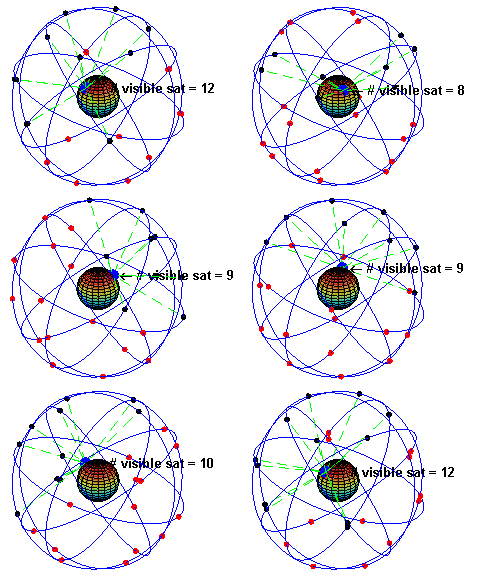
After the hike, not only will I be able to blog about it, I will be able to log about it. That is, I will be able to post a video showing our exact path -- including an elevation profile -- thanks to the wonders of GPS.

How things have changed! The last time I was on the Appalachian Trail itself, incidentally, my buddy (and fellow geographer) Mike and I used paper maps only. "Online" was not yet an option, and hardly even a word.

UPDATE (March 14, 2020): Despite the great anticipation with which we were approaching this brief Appalachian hike, our original plan was not to be. I had some sort of leg injury that resulted in us taking a very short back-and-forth hike, and we did not record it. We did not get to my friend's roastery, either. But we did have our only visit (so far) to the amazing MassMoCa.

Friday, February 22, 2013

Privates Exposed


The Colbert Report Feb 21, 2013

The GEO Group naming of a public-university stadium is a true story that exceeds the kinkiest fantasies of Grover Norquist's twin fetishes of low taxes and privatization.

A public university is underfunded, so it turns to a private company for funds. It allows it to put the private company's name on a public building in return for providing funds that should have come from tax revenues in the first place. And where does the private company get all this money? From tax revenues that now add a layer of private profit to the public expenditure that would normally go to fund prisons directly.

The myth of privatization is that it creates efficiencies. The opposite is true, of course, since both services and profits must be funded, with money once used only for the services. In this case, so much profit was taken that it flowed into an increasingly common form of corruption -- the private naming of public properties.

I am usually pleased to see references to geography,
but in this case it is creepy.
Lagniappe

July 23, 2015: The GEO group is in the news again. Alexandra Starr reports on Morning Edition that GEO Group is the largest employer of undocumented workers in the United States. It pays them to operate the prisons in which they are held, maximizing the profits it makes from their detention..

Monday, February 18, 2013

Google In Google Out

GIGO is a term that goes back to the earliest lessons of life with computers: Garbage In, Garbage Out. It is a warning not to trust computers too much, and it is as true now as it was when Hal nearly did in the crew of the S.S. Discovery.

I am a big fan and avid user of Google Maps, but when I look at places I know, I sometimes find either a lack of detail or outright errors. In Matagalpa, Nicaragua, for instance, many of the places I visit each January are nearly impossible to find, so that I am working with a student -- and a GPS unit -- to map our most recent journey.


And as I wrote in September, a routing error puts the town of San Ignacio, Belize (where I will be teaching a course on chocolate in June 2013) many hours farther from neighboring towns (and potential tourists) than it really is. The problem seems to relate to a bridge that was washed out on the main highway but subsequently repaired. The map (as shown above in a screen capture just taken) continues to include an unneeded diversion, but it an improvement from the time of my original report.
Click to expand
I was reminded of this while preparing for a possible return to Cape Verde next year. During my 2006 study tour, I had visited only two islands, and plan to visit more on my second study tour. Looking at the northern islands, I was confused, because sites I planned to visit seemed to be on an island that was not in our preliminary plans. I worked for about a half hour in this confused state before consulting another map. Of course two of the three islands shown above do not have the same name! The middle of these three islands is actually São Vicente, and does not share its name with Santa Luzia.


View Larger Map

I have advised Google of this error, but I am not optimistic of a rapid response. When the problem is resolved, the dynamic map above will show three islands with three names. Meanwhile, the NationMaster map is far more reliable than Google, when it comes to planning a tour of Cape Verde. The islands in question are in the northwest corner of this map.

Saturday, February 16, 2013

Vertical Katrina

Thanks to my favorite librarian for sharing the Occupy Sandy video, which comes from Bill Moyers (whom I recently described as one of my favorite Baptists) by way of Upworthy contributor Carolyn Silveira. This rich video documents the community-based responses of Occupy participants to the ongoing calamity of Super Storm Sandy. This video is eight minutes well spent, as it is full of lessons about environmental geography and the political ecology of disaster.


Occupy Sandy from BillMoyers.com on Vimeo.

The first geographic lesson occurs early in the segment, when a group of Occupy Wall Street participants use geographic skills to decide where to focus their efforts to help people who might still be suffering the affects of Sandy after the initial recovery period had ended. Since the question of where to reach out was a geographic question, they used a geographic strategy to answer it. Overlaying a map of storm surges with a map of relative wealth, they chose Coney Island as a place where high water and low income meet.

This methodology led them to a surprise -- beyond the carnival rides and boardwalk, Coney Island is home to many high-rise apartment complex in which thousands of people experiencing poverty live in great numbers. And since these neighborhoods had been low on the priority list for governments and utilities, the discomfort and suffering were as severe as the resources were limited. In fact, one of the volunteers declared the disaster to be a "vertical Katrina" and a reminder that the lessons of that travesty have not yet really been learned.

The volunteers exhibit all that has been most positive about the Occupy movement. Among these is a recognition that economic privilege or lack thereof is fleeting, and is contingent on circumstances beyond the control of individuals. Still, privilege does insulate some of us against hardship more than others, and those with privilege -- even modest privilege -- should share those benefits. The horizontal nature of the the movement is also exemplified by this effort, as is the ability to match rhetoric and ideology with tangible action for the good of an entire community. One of the political ecology observations in the video is that the Coney Island neighborhood in which it takes place is a food desert, where the "free market" does not provide the range of foods to which more affluent communities in the United States are now accustomed.

Epilogue: This video was made when people were still wearing sweaters and light jackets. When winter storms began to strike the region in subsequent months, some homes were still without power. It goes without saying that these were not the homes of the wealthy or even the middle class.

Further epilogue: I saw this video as news included not only the recovery of my own neighborhood from a winter storm that left us without power for almost four days (some shorter, some longer), and as the Carnival Cruise ship Triumph ended its ordeal at sea with 4,200 people with limited power. Both of these events have many middle-class people -- myself included -- thinking carefully about both our vulnerabilities and the resilience that is afforded by financial resources and social connections that are not be available to all.

Some have critical of the Triumph passengers for complaining and the media for covering their plight. (And some of them -- such as Ben Vogelzang -- actually did not complain.) I would not go that far, as I do think that so many people on a disabled ship is a genuine humanitarian concern, even if the people involved are relatively wealthy and the discomforts are short-lived. It was a worthwhile reminder, however, that not all such crises come to a happy conclusion, as this one eventually did.

Friday, February 15, 2013

Fluvial Geography of Whiskey


In the second hour (wisely chosen) of today's program, Tom Ashbrook and his guests explored the many tributaries that comprise the great river of whiskey so celebrated by Professor Willie Nelson. Although the word "history" was used several times during the discussion, this was a great example of the importance of geography behind history of all kinds.

Michael Veach, Joy Richard, and a slew of interesting callers discuss the revival of interest in fine whiskeys as well as the geographic differences in such things as the use of barrels. Trade along a literal river -- the Mississippi -- helps to explain the distinctive use of charred barrels in Kentucky. Some mention was made, of course, of Scotch, the history and geography of which I discussed in some detail on this blog last year.

I highly recommend the On Point discussion in its entirety, as well as the many interesting comments posted by users. Among them is a hint that my ambitions of distilling my own whiskey (or whisky) might be harder to attain than I had imagined.

Sunday, February 10, 2013

Nicaragua Memories 2013

I have not blogged much in the past few weeks, as I was quite busy during my seventh Geography of Coffee study tour in Nicaragua, and have been very busy with a new semester since then. My photographs from the trip are on Flickr, and I expect to be able to share more from my students soon.


Learn about GPS

Meanwhile, a student has posted the first of several video montages I expect to see from this group of very engaged students. This is really a mood piece of a memorable journey.

Nick was also carrying a GPS unit throughout the tour, partly to do some benchmark research on climate change at various farms and also to help document the journey.

He has started to put the data together in a very artful way, focused on the first half of our travels, in and around Matagalpa. Enjoy.

Blog Ideas

coffee (25) GEOG381 (24) GEOG388 (23) GEOG470 (18) climate change (18) GEOG130 (16) geography (16) GEOG332 (13) GEOG431 (12) musica (11) GEOG 332 (9) GEOG 381 (9) Mexico (9) Brazil (8) GEOG286 (8) Texas (8) education (8) migration (8) GEOG298 (7) borderlands (7) GEOG199 (6) GEOG331 (6) Massachusetts (6) US-Mexico (6) deBlij04 (6) immigration (6) GEOG 130 (5) GEOG 286 (5) GEOG287 (5) climate justice (5) cultural geography (5) fair trade (5) food (5) geographic education (5) nicaragua (5) water (5) Arizona (4) GEOG 171 (4) GEOG171 (4) GEOG295 (4) Safina (4) africa (4) deBlij05 (4) land protection (4) music (4) politics (4) Bolivia (3) Boston (3) COVID-19 (3) Detroit (3) Ethiopia (3) Managua (3) Obama (3) border (3) cartography (3) drought (3) libraries (3) pesticides (3) suburban sprawl (3) trade (3) unemployment (3) Alaska (2) Amazon (2) Bridgewater (2) Canada (2) Chiapas (2) China (2) Colonialism (2) EPA (2) EarthView (2) Economy (2) Environment (2) GEOG 199 (2) GEOG 287 (2) GEOG 388 (2) Google Maps (2) Government (2) Hawaii (2) India (2) Lexington (2) Maldives (2) Mozambique (2) NOLA (2) NPR (2) National Monuments (2) National Parks (2) New Orleans (2) Religion (2) Rio Grande (2) Taunton River Wild and Scenic (2) Tex-Mex (2) The View from Lazy Point (2) United States (2) Venezuela (2) anthropocene (2) cape verde (2) censorship (2) central america (2) chocolate (2) corn (2) deBlij07 (2) deforestation (2) demographic transition (2) demography (2) education reform (2) employment (2) environmental geography (2) film (2) forest fire (2) global warming (2) islands (2) landscape ecology (2) librarians (2) maps (2) organic (2) peak oil (2) refugees (2) sense of place (2) soccer (2) sustainability (2) television (2) water rights (2) whales (2) #bbc (1) #nicaragua (1) #sosnicaragua (1) #sosnicaragua #nicaragua (1) 100 Years of Solitude (1) ACROSS Lexington (1) Accents (1) Adam at Home (1) Alice (1) Alt.Latina (1) American Hustle (1) April (1) Association of american Geographers (1) Audubon (1) Aunt Hatch's Lane (1) BBC (1) BSU (1) Baby Boomers (1) Banda Aceh (1) Bay Circuit Trial (1) Bechtel (1) Beleza Tropical (1) Belize (1) Beloit College (1) Ben Linder Cafe (1) Bet The Farm (1) Bhopal (1) Biafra (1) Bikeway (1) Bikini (1) Bill Gates (1) Bill Moyers (1) Boeing 777 (1) Brazilian (1) Brazilianization (1) Bridge (1) British Columbia (1) Brockton (1) Bus Fare (1) Bush (1) Cabo Verde (1) California (1) Cambridge (1) Cape Cod Bay (1) Carl Stafina (1) Catholic (1) Ceuta (1) Chalice (1) Chipko (1) Citgo (1) Climate risks (1) Cochabamba (1) Colombia (1) Common Core (1) Commuter (1) Computers (1) Cuba (1) Cups and Summits (1) Dallas (1) David Byrne (1) Deans Beans (1) Delaware Valley (1) Dunkin Donuts (1) Earth Day (1) Earth View (1) Easton (1) El Salvador (1) Elizabeth Warren (1) Ellicott City (1) Emilia Laime (1) English-only (1) Environmental History (1) Euphrates (1) European Union (1) Evo Morales (1) FIFA (1) FYS (1) Fades Out (1) Farms (1) First-Year Seminar (1) Food Trade (1) Frederick Kaufman (1) French press (1) Fresh Pond Mall (1) GEOG 431 (1) GEOG 441 (1) GEOG213 (1) GEOG490 (1) Gabriel García Márquez (1) Garden of Gethsemane (1) Gas wells (1) Gateway Cities (1) General Motors (1) Gini Coefficient (1) Girl in the Cafe (1) Google (1) Gordon Hempton (1) Gravina Island Bridge (1) Great Migration (1) Great Molasses Flood (1) Guy Lombardo (1) Haiti (1) Hawks (1) Heart (1) Higher Education (1) History (1) Holyhok Lewisville (1) Homogenous (1) Honors (1) How Food Stopped Being Food (1) Hugo Chavez (1) IMF (1) Iditarod (1) Imperial Valley (1) Income Inequality (1) Indonesia (1) Iraq (1) Irish (1) Japan (1) Junot Diaz (1) Kenya (1) Ketchikan (1) Key West (1) Kindergarden Students (1) King Corn (1) Kiribati (1) Latin America (1) Limbaugh (1) Literature (1) Living On Earth (1) Louisiana (1) Love Canal (1) Luddite (1) M*A*S*H (1) MCAS (1) MacArthur Genius (1) Maersk (1) Malawi (1) Malaysia (1) Malaysian Air Flight 370 (1) Mali (1) Manu Chao (1) Map (1) Marblehead (1) Mary Robinson Foundation (1) Maryland (1) Massachusetts Bay Colony (1) Math (1) Maxguide (1) May (1) Maya (1) Mayan (1) Mayan Gold (1) Mbala (1) McDonald's (1) Melilla (1) Mexicans (1) Michael Pollan (1) Michelle Obama (1) Micronesia (1) Military (1) Military Dictatorship (1) Minuteman Trail (1) Mongolia (1) Monsanto (1) Montana (1) Morocco (1) Mount Auburn Cemetery (1) Muslim (1) NPS (1) Nantucket (1) National Education Regime (1) Native American (1) Native Americans (1) New Bedford (1) New Hampshire (1) New York City (1) New York Times (1) Nigeria (1) No Child Left Behind Act (1) Norquist (1) North Africa (1) Nuts (1) Oakland (1) Oaxaca (1) Occupeligo (1) Occypy (1) Oklahoma (1) Oklahoma City (1) Oppression (1) PARCC (1) Pakistan (1) Pascal's Wager (1) Peanut (1) Pearson Regime (1) Philadelphia (1) Philippines (1) Pink Unicorns (1) Poland (1) Portuguese (1) Protest (1) Public Education (1) Puebla (1) Puritans (1) Quest University (1) Rachel Carson (1) Reading (1) Republican (1) Retro Report (1) Robert Reich (1) Rock Legend (1) Ronald Reagan (1) Rondonia (1) Rosa Parks (1) SEXCoffee (1) Safety (1) Samoza (1) Sandino (1) Sara Vowell (1) Save the Children (1) Scotch (1) Scotland (1) Seinfeld (1) Senegal (1) Sergio Mendes (1) Severin (1) Sharrod (1) Silent Spring (1) Sinatra (1) Slope (1) Smokey the Bear (1) Somalia (1) Sombra (1) Sonora (1) Sonoran desert (1) Sonoran hot dog (1) South America (1) Spain (1) Stairway to Heaven (1) Storm (1) Suare Inch of Silence (1) Sumatra (1) Swamp (1) Tacloban (1) Tanzania (1) The Amazon (1) The Amazon Trail (1) Tigris (1) Tucson (1) Tufts (1) U.S Federal Reserve (1) U.S Government (1) U.S. economy (1) USDA (1) USLE Formula (1) Uganda (1) Unfamiliar Fishes (1) Union Carbide (1) Vacation (1) Vexillology (1) Vietnam (1) ViralNova (1) WNYC Data News (1) Wall Street (1) Walsenburg (1) Walt Disney (1) Walt and El Grupo (1) Ward's Berry Farm (1) West (1) Whaling (1) Wilson (1) Winter Storm Saturn (1) Wisconsin (1) World Bank (1) Xingu (1) YouTube (1) Zombies (1) agriculture (1) antitrust (1) aspen (1) austerity (1) aviation (1) banned books (1) bark beetle (1) bean (1) beavers (1) bicycle (1) bicycling (1) bike sharing (1) binary (1) biodiversity (1) bioneers (1) books (1) boston globe (1) cacao (1) cafe (1) campaign (1) campus (1) cantonville (1) capitals (1) carbon dioxide (1) carbon offsets (1) carioca (1) cash (1) cashews (1) census (1) chemex (1) chemistry (1) chronology (1) churrasco (1) civil rights (1) coffee grounds (1) coffee hell (1) coffee prices (1) coffee quality (1) college (1) compost (1) computerized test (1) congress (1) conservation commission (1) corporations (1) countries (1) cubicle (1) dams (1) deBlij06 (1) deBlij08 (1) death (1) deficit (1) development (1) dictatorship (1) distracted learning (1) distraction (1) drug war (1) dtm (1) earth (1) economic diversification (1) economic geography (1) election (1) embargo (1) energy (1) enhanced greenhouse effect (1) environmentalist (1) ethnomusicology (1) exremism (1) failed states (1) farming (1) financial crisis (1) football (1) forestry (1) forro (1) fracking (1) free market (1) free trade (1) fuel economy (1) garden (1) genocide (1) geography education (1) geography games (1) geography of chocolate (1) geography of food (1) geologic time (1) geotechnology (1) gerrymandering (1) global pizza (1) globe (1) goodall (1) green chemistry (1) ground water (1) guacamole (1) guatemala (1) habitat (1) high-frutcose (1) home values (1) hospitality (1) hourglass (1) housing (1) hydrology (1) illegal aliens (1) income (1) indigenous (1) interfaith (1) journalism (1) kitchen garden (1) labor (1) language (1) libertarianism (1) library (1) linguistics (1) little rock (1) llorona; musica (1) macc (1) maccweb (1) magic realism (1) maple syrup (1) mapping (1) masa no mas (1) massland (1) medical (1) mental maps (1) mi nina (1) microlots (1) microstates (1) mining (1) mltc (1) monopoly (1) municipal government (1) nautical (1) neoclassical economics (1) new england (1) newseum (1) newspapers (1) noise pollution (1) pandas (1) petroleum (1) piracy (1) pirates (1) poison ivy (1) police (1) political geography (1) pollution (1) provincial government (1) proxy variables (1) public diplomacy (1) quesadilla (1) rabbi (1) racism (1) real food cafe (1) regulations (1) remittances (1) resilience (1) resistance (1) respect (1) rigoberta menchu (1) rios montt (1) romance (1) roya (1) runways (1) russia (1) satellites (1) science (1) sea level (1) selva negra (1) sertao (1) sertão (1) sex (1) sex and coffee (1) simple (1) sin (1) smokey (1) solar (1) solar roasting (1) south africa (1) sovereignty (1) species loss (1) sporcle (1) sports (1) state government (1) taxes (1) tea party (1) teaching (1) textile (1) texting (1) tortilla (1) training (1) transect; Mercator (1) travel (1) triple-deckers (1) tsunami (1) urban geography (1) utopia (1) vermont (1) vice (1) video (1) wall (1) water resources (1) water vapor (1) whiskey (1) whisky (1) widget (1) wifi (1) wild fire (1) wildfire (1) wildlife corridor (1) wto (1)