Showing posts with label Texas. Show all posts

Monday, November 27, 2017

ESRI: Envisioning the Embattled Borderlands

PLEASE CLICK MAP for a BETTER VIEW
The map (above) that ESRI geographer Krista Schlyer chose for the top of her photo-map essay response to the so-called border wall is indicative of the care she and the rest of the ESRI team have taken with this entire exhibit. As a geographer who lived in this map for seven years (1990-1994 in Tucson and 1994-1997 in Pharr), I notice a few important things that this map captures nicely.

First, the borderlands are identified by the border, but not strictly defined by it. As Oscar Martinez argues in Border People, it is a zone that extends approximately 100 miles in each direction from the line that gives the region its identity. In every sense except strict legalities, this region is neither the United States nor Mexico. It is a third entity that is both divided and united by a line that meanders through its center. In addition to Border People, I recommend Tom Miller's On the Border as an introduction to the place; I had the privilege of knowing both writers during our Tucson years.

Second, the United States of America and the United States of Mexico are both federal republics comprising a number of states (50 and 31, respectively, plus a federal district in each). For people living in the border region, connections between neighboring states are important. Residents of California, Arizona, New Mexico, and Texas become familiar with Baja California, Sonora, Chihuahua, Coahuila, and Tamaulipas.

The cultural and environmental landscape of the border is not well understood by pundits and demagogues who make their living from caricatures of it. The misguided policies that result threaten real damage and will deliver no benefits.

ESRI's Krysta Schlyer has made an important contribution with this well-researched borderlands geography project.


The embedded version of this project condensed -- see the full Embattled Border story map here.

More about borders and The Border from this Environmental Geography blog

The threats posed to the people and environments of the border by outside demagoguery have certainly increased under the current administration, but in many ways are a continuation of a militarization of the border that was under way when I was living in Arizona. Although my own writing on the topic has become more focused in 2017, my earlier writing could also be instructive. I think that my "human sieve" metaphor is especially important, and that the wall is part of a broader effort by politicians who prefer to choose their voters, rather than to allow the opposite to transpire.

Each of these posts includes links and images to the work of many journalists, artists, and geographers.

Take Our Jobs, Please (June 2010)
The Border: A Human Sieve (June 2010)
Murder City (November 2010)
Where Are the Humans? (November 2011)
No se olviden Mexico (June 2012)
Precious Progress (November 2012)
Economic Baggage (April 2014)
Why Walls Won't Work (November 2014)
Not One Human (August 2015)
Hiring Humans (February 2016)
Borders: What's Up With That (August 2016)
Border IRL (November 2016) -- includes a map of all of my border crossings
Bridges and Habilitation (July 2017)
Through the Wall (October 2017) 

Monday, August 04, 2014

Redemption at Alice


For the three years before we moved to Bridgewater in 1997, Pam and I lived in the Rio Grande Valley of Texas. It is not a valley, and the rio at that point is not grande. The river that rises in the mountains of New Mexico forms the border between arid parts of the former Republic of Texas and Old Mexico, and is rather tired by the time it reaches the delta in which we lived. But it is recognized as "The Valley" throughout Texas, and it is relatively lush compared to the deserts and grasslands that surround it.

Yes, the mascot is a scorpion!
Near the end of our stay there, I taught geography in the Valley, at a campus that is formally known as The University of Texas at Brownsville in Partnership with Texas Southmost College. Some of my students were international students living it home -- they walked over the river for class, just as I sometimes walked over the same river for lunch and shopping. Teaching there was invaluable in preparing me for the teaching I have been doing in Bridgewater ever since.

Prior to the UTB-TSC gig, though, I taught way outside the Valley, at what seems to have been the periphery of the periphery of higher education in Texas,

Texas & M University at Kingsville, Alice Extension. TAMU-K itself had been remade from Texas A &I, following a lawsuit that had failed in courts of law but succeeded in the court of public opinion.

That is to say, a class-action suit had been filed against the state of Texas over the lack of four-year universities in the area south of San Antonio. This area is just a little corner of Texas, of course, but bigger than many of the other 49 states, and home to millions of people whose access to higher education was seriously limited by the absence of the big two -- University of Texas and Texas A & M. The courts did not force the creation of new schools, but the legislature was sufficiently embarrassed to act, and each of the two big state universities created three new campuses, building on existing schools. In Kingsville, this led to a conversion of the two-year Agricultural & Industrial College into a four-year Agricultural & Mechanical University. When I visited campus, "A & I" was still on the water tower. The professor who hired me said that tradition was such that nobody would be brave enough to climb up and paint the new name, for fear of being shot at. He was joking, of course. Sort of.

All of this background is by way of explaining how we came to watch All She Can -- a movie well outside our usual range of interests -- and some of the reasons we found it so satisfying. According to an informative interview with writer-director Amy Wendel, the film was inspired by a 60 Minutes story about military recruiting in the nearby town of San Diego, Texas, where deep patriotism and limited options are equally important sides of the story of service. (My 2010 post on the belated recognition of Felix Longoria explores the legacy of military service in the region in more detail.)

Although the filmmakers come from far outside the region, they bring the viewer very close to the ground because they began the project with extensive listening. The main plotline was inspired by the very first interview with local youth -- like us, Wendel had not really heard of powerlifting as a sport for high-school girls, and was intrigued by this. Casting included a local actress in the main role, and writing avoided the cliched sequence of hardship-to-victory that makes many sports movies hard to take. The protagonist is complex, makes mistakes, and manages to make this story place-specific and universal at the same time.


The reason we found this film so effective is that it really conveys what geographers call "sense of place" -- those characteristics that people use to build identity of and around the places they live. The soundtrack features a "Benavides Born" -- a song that condenses many of these themes in just a few minutes of music. Originally the title of the film itself, the signature song has been produced with a video montage that deepens many of those connections. What is most interesting about the song -- especially as it is represented in the music video -- is that it perfectly balances pride in the place with a strong desire to get out of the place.


It was from the film that we learned of a significant upgrade in the educational landscape of Alice. Texas A&M-Kingsville was reaching out to this part of King Ranch country through a very modest extension program in which I played a very modest part; the arrival of a branch of Coastal Bend (Community) College is surely an improvement for the town, and is part of what makes it a relative metropolis.


From the film it was clear to us that the campus is housed in a former WalMart store. It is part of WalMart's scorched-earth approach to retailing that after its "regular" stores eliminate local competition, its "super" stores eliminate them. From the point of view of WalMart, it does not matter what happens to those abandoned boxes, as long as they do not become retail space. They can sit empty for years, or they can be leased or sold to local governments. One of the most storied examples has been the recent move of the McAllen Public Library (where my favorite librarian was once Head of Reference) into an abandoned WalMart. Coverage in Slate, Huffington Post, New York Times and American Libraries emphasize the creativity of the architecture -- which is indeed impressive -- rather than the overall strategy of wage suppression of which this story is a part.

Lagniappe

Just as I was finally posting this review, I found this brief audio story about the exhumation of human remains in Falfurrias, through which I drove each week that I taught in Alice. A secondary border crossing was a small annoyance for me, but for many making the journey north, it is one obstacle too many, and some do not survive their efforts to detour around it. A recent graduate in forensic science applied her skills to the removal of bodies buried anonymously in the scrublands, and shares what she learned from the experience.

Friday, April 18, 2014

Ideologies of Destruction

Which has killed more Texans: Muslim extremism or libertarianism?

Photo: LM Otero/AP

This week marked the one-year anniversary of two deadly bombings, both ultimately the result of deadly ideologies. The best-known of these was the cowardly detonation of two home-made devices at the finish line of the Boston Marathon, killing three and grievously injuring many more. As with most people in my region, I was stunned and offended, have followed the case closely, and have contributed to the fund for victims.

Two days after the bombing in Boston, a much larger explosion took place in the town of West, Texas (located in central Texas). As with any story from Texas, Wade Goodwyn best tells the story of the explosion and of the rollercoaster year that followed. Nearly 20 years after Timothy McVeigh destroyed the Federal Building in Oklahoma City with 500 pounds of ammonium nitrate, Don and Wanda Adair stored 100 times that amount of the bomb-making material in a wooden shed. As his report makes clear, ideology may prevent the prevention of future such disasters. Even residents of the town victimized by the explosion are loathe to blame the couple who put them at risk.

Back in Boston, the anniversary of the West explosion was recognized in a report on Here & Now that asked What's Being Done to Prevent Another Fertilizer Plant Explosion? Sadly, the answer is very little. Perhaps if the Adairs were from another religion, the response would have been more decisive, but free-market fetishism continues to thrive, and will continue to kill.

April, by the way, is a very tough month for ammonium nitrate explosions in Texas and Oklahoma:

April 16, 1947: Texas City, Texas -- 581 killed, including most of the fire department
April 19, 1985: Oklahoma City, Oklahoma -- 168 killed, including most of a preschool
April 17, 2013: West, Texas -- 15 killed, including 13 firefighters

Wednesday, March 19, 2014

Resisting the Education Oligarchy

NOTE: This is no ordinary blog post. It has two action items, a provocative video, and an uplifting radio piece.

Faced with a national education regime that is increasingly hostile to teachers, students, and learning itself, a growing number of parents are pushing back. Among the recent resisters is Ricardo D. Rosa of New Bedford, Massachusetts, who is opting out of state-mandated testing. His letter to the school committee was published in the Washington Post and reads in part:
Any administrator, school committee member, or school functionary still standing before students, teachers, and families touting the virtues of high-stakes testing should be ashamed. -- Ricardo D. Rosa
He is absolutely right, of course. The "reform" movement is a well-funded, bipartisan movement to centralize public education in the United States to a level that is difficult to believe possible in a democracy.

(Note: at the time I wrote this, I do not think I realized who Dr. Rosa was. I now count him and his brother -- also Dr. Rosa -- among my friends and among the educators I admire most.)

It sounds shrill to blame "corporate interests," but it is the case that Bill Gates, the Waltons (of WalMart fame), and Pearson Publishing are both paying the piper and calling the tune. Contributing generously to media and elected officials of all political persuasions, they are creating an entirely new educational ecosystem. As I have written previously, those calling for accountability for nickels and dimes are not held accountable for millions nor billions.
Critical thinking is being removed from the airwaves as quickly as it is from the classroom.
A puff piece on the Common Core is but the latest in a growing number of examples of what generous donations can buy. Contrast the "reporting" with the responses from educators to see that NPR's usual rigor seems to have gone missing. (Within hours, comments were curtailed at a few dozen.)

An Accountability Challenge 

Fortunately, Dr. Rosa is not alone. The kind of resistance that he exhibits and challenges others to undertake is growing. On the same day that I learned of his challenge, I saw this cartoon ...
... and I learned that some educators are trying to make this teachers' fantasy a reality. In February, Bret Wooten of Lewisville, Texas began a petition to require the governor of Texas and its legislators and education officials to pass the tests that they require of students, and to publicize their scores. His effort grew slowly within Texas for a few weeks, but in the past couple of days, a growing number of petitioners from other states have signed on. If you are reading this, consider adding your name, as I have done (#116).

In Holyoke, Massachusetts, teacher Augusto Morales has recently spoken out against the humiliation and disruption caused by extreme testing in his school. It is no coincidence that the strongest resistance is emerging in low-income, urban areas. The very students who were the purported beneficiaries of No Child Left Behind are the ones most likely to be left behind by high-stakes testing, nonsensical curricula from Pearson, and inappropriate pedagogy from Bill Gates.

I read similar anguish in reports from teachers throughout the United States, many of whom report absurdly intrusive regimes of testing and test preparation. Even the bodily functions of teachers and students are increasingly likely to be regulated by local officials trying to please distant educational bureaucracies.I admire Mr. Morales for bringing that widely-felt pain directly to the attention of some of those responsible.

Higher Education Connections

I teach at the university level and my own daughter has so far attended private schools (in large part because of what NCLB has done to public schools), so I could easily ignore all of this. But I would do so at great peril. For one thing, those who are orchestrating destructive reforms in K12 are working to dis-empower university faculty through various means -- from the elimination or reduction of tenure to cryptofascist accountability regimes.

Moreover, those of us who enjoy teaching at the university level are now confronted with the first wave of students who have never known anything but NCLB levels of testing, and it shows. Just today I had students -- very bright students -- absolutely panicked about a very modest mid-term I am giving them later this week. They expect detailed reviews not only of the content but also of the exact format of the exam -- and the strongest students are fretting just as much as the weaker ones. Sadly, it is warped visions of "college
readiness" that instills approaches to learning that are not at all collegiate.

Finally, many professors are teaching future educators and some of us provide ongoing professional development to in-service teachers. If we care at all about the effectiveness of the work that our students are going to be doing, we cannot ignore policies that will prohibit many of the best practices we teach. It is for this reason that I am grateful to fellow Massachusetts academics who have prepared a detailed critique of the MCAS/PARCC/Pearson regime, and presenting it to the education policymakers in the state. I am proud to join professor Rosa (like me, he is both a father and a professor) and many others in endorsing that statement.

A Better Way

I need to end this post with something positive, and I am fortunate that my favorite librarian -- with whom I discuss these issues often -- today shared this story of a very different kind of higher education. This is eleven minutes of delightful audio about Quest University in Canada. Just listening to this positive report about education is something every teacher should do as a treat to the self. The report is at once an eloquent description of what has gone wrong in education and a glimpse into what happens when teachers and learners are enabled to flourish.

Saturday, November 16, 2013

Internal Borders

As many readers of this space know, my favorite librarian and I spent three years in the mid-1990s living in Pharr, Texas, about as close as one can live to the U.S. border with Mexico. The town is in the center of the Rio Grande Valley, a term that could refer to much of Texas, New Mexico, and Old Mexico, but which really refers to the delta area of the river that forms much of the boundary between our two countries. The Valley itself is a bit of both lands, and living there was really a privilege and an important part of my education as a geographer.

A couple of hours ago I was pleasantly surprised to hear the Valley town of Raymondville mentioned by someone recounting a personal story on This American Life. It is rare to hear a story from the Valley on National Public Radio, and even more rare to hear it in the first person. Compounding my surprise was the proper use of the term Whataburger -- a Valley institution frequently used in giving directions (as DD is here in the Bay State).

As fans of the program know -- and we are definitely fans in Casa Hayes-Boh -- each week the producers select a theme, and bring listeners stories related to that them. The theme of today's show (originally aired in October 2012) was "Getting Away With It." In this case, it is a story about the running of illicit drugs, but it is told from a point of view that is not sensational, and mostly about family dynamics that could play out anywhere.


The yellow balloons on the map below indicate places mentioned in the story -- the Raymondville balloon will guide readers directly to the Whataburger -- including one mentioned erroneously. The border patrol station on Route 281 is not in Hebronville (shown with a dotted balloon), but rather in Falfurrias.


That station is quite familiar to me, as I frequently stopped there on my weekly travels from our home in Pharr to Alice High School (both shown with blue balloons). I taught an evening course there for several semesters, in return for a small stipend and gas money (which was almost as much as the stipend), and mainly for the opportunity to continue gaining teaching experience. I taught at Alice High School, but it was actually an extension program of Texas A&M University-Kingsville. When driving to campus, I always had to stop, just as if I were entering the United States from abroad. I was annoyed, but tried not to show it. I eventually learned that a necktie and a Texas A&M parking permit on the front of the car would get me through much more quickly.

For the narrator in the story above, it is clear that although the contraband to be trafficked was already in the United States, it could not get to market without going through one of the interior "crossings" in Falfurrias or Sarita.


View Take Your Kid to Work Day in a larger map

In preparing this post, I got an interesting lesson in social media. When I asked a friend in the Valley to help me confirm the location of the Falfurrias station (which I had on the wrong stretch of road), she looked it up on the Migra's Facebook page! I would never have thought of that.

Saturday, June 09, 2012

ACK: A Whole 'Nother (Island) Country

As I wrote very recently, Texas is in many ways a whole other country. The travel bureaus boast as much, and living there for three years we really experienced it. We even subscribed to the national magazine for a while after we left, and we had the great pleasure of spending this past Thursday evening in the company of the "governor of the heart of Texas" during his tour of the Northeast. (Note: I thought I made up the "national magazine" quip, but it is prominent on the web site for Texas Monthly.)
But this is a post about our next destination, Yesterday's Island (ACK). The only place in the United States in which a town, an island, and a county are coterminous, Nantucket is just a lovely whiff of glacial deposits out in the ocean, as close to Bermuda as one can get in the Bay State, and as far from North Adams.

Just as we were preparing for a few days of quiet enjoyment on the island,  I noticed a photo essay on Geography@About.com, regarding the ten smallest countries of the world. As part of my preparation for the EarthView project, I have spent a fair amount of time recently playing online geography games that are helping me to keep track of many of these microstates, and I am very concerned about the future of several that are quite vulnerable to climate change.

None of the countries is quite as small as the very cute first image in the collection, but most are quite small indeed, and six of the ten are islands (all of the rest are in Europe, within or very close to Italy, as it turns out). I was wondering about Nantucket's place in such a listing, and found that if it were an independent country, it would just make the list, in ninth place.

Country
Maldives
sq mi
110
         population
         400,000
Seychelles
107
           88,000
Nantucket
105
           10,172
St. Kitts & Nevis
104
           50,000
Marshall Islands
70
           68,000
Liechtenstein
62
           36,000
San Marino
24
           32,000
Tuvalu
9
           12,000
Nauru
8.5
             9,322
Monaco
0.77
           33,000
Vatican
0.44
                800


(At 270 acres, my campus is just 10 acres shy of Vatican-sized.)

At 30 feet, the highest point on Nantucket stands at double the elevation of the highest point in Tuvalu, and towers nearly four times the 8-foot peak in the Maldives. Most of the small islands of the world are quite vulnerable to storms and tsunamis, all the more so as their margin of safety is removed by melting ice and expanding seas. Nantucket has the added vulnerability of highly erodible parent material, deposited as debris a few short millennia ago.

And what about Texas? At 268,820 square miles, it would rank as the 76th largest country, after Burkina Faso and ahead of New Zealand.

Wednesday, June 06, 2012

A Whole 'Nother Country

Writing for Slate, Gail Collins offers an entertaining if somewhat frightening essay about my former home state. As she describes it, Texas is "a fast-growing, increasingly urban place whose citizens have nevertheless managed to maintain the conviction that they’re living in the wide open spaces."


In Everything's Bigger in Texas, she writes about the contradictions rampant in a state that is equally likely to draw the rest of the country into its orbit, or to cut ties and become its own country. Again. It is, after all, the only state to have had six national flags (those of Spain, France, Mexico, Texas, the United States, and the Confederacy).
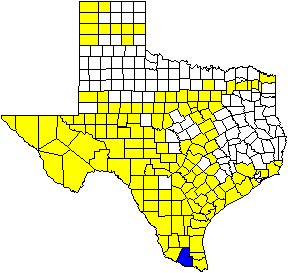
Texas counties I have visited

Sunday, June 07, 2009

Costly Care

If anybody still doubts that the United States needs single-payer health care, this story might close the case. What we see as "freedom" is fundamentally and increasingly flawed. I worked for three years in McAllen, Texas, and thought I understood many of the unusual things about this border city. Even I was surprised to find that it ranks near the top in per-capita medical spending. Since it ranks near the bottom in terms of income, this is especially problematic.

I do recall that my first doctor in neighboring Pharr was exceedingly fixated on money and not focused on understanding what patients needed. I later found a better doctor in McAllen, and my wife also had some good doctors there. But in a city with very high drop-out and illiteracy rates, we were better prepared than most to ask the right questions.

Blog Ideas

coffee (25) GEOG381 (24) GEOG388 (23) GEOG470 (18) climate change (18) GEOG130 (16) geography (16) GEOG332 (13) GEOG431 (12) musica (11) GEOG 332 (9) GEOG 381 (9) Mexico (9) Brazil (8) GEOG286 (8) Texas (8) education (8) migration (8) GEOG298 (7) borderlands (7) GEOG199 (6) GEOG331 (6) Massachusetts (6) US-Mexico (6) deBlij04 (6) immigration (6) GEOG 130 (5) GEOG 286 (5) GEOG287 (5) climate justice (5) cultural geography (5) fair trade (5) food (5) geographic education (5) nicaragua (5) water (5) Arizona (4) GEOG 171 (4) GEOG171 (4) GEOG295 (4) Safina (4) africa (4) deBlij05 (4) land protection (4) music (4) politics (4) Bolivia (3) Boston (3) COVID-19 (3) Detroit (3) Ethiopia (3) Managua (3) Obama (3) border (3) cartography (3) drought (3) libraries (3) pesticides (3) suburban sprawl (3) trade (3) unemployment (3) Alaska (2) Amazon (2) Bridgewater (2) Canada (2) Chiapas (2) China (2) Colonialism (2) EPA (2) EarthView (2) Economy (2) Environment (2) GEOG 199 (2) GEOG 287 (2) GEOG 388 (2) Google Maps (2) Government (2) Hawaii (2) India (2) Lexington (2) Maldives (2) Mozambique (2) NOLA (2) NPR (2) National Monuments (2) National Parks (2) New Orleans (2) Religion (2) Rio Grande (2) Taunton River Wild and Scenic (2) Tex-Mex (2) The View from Lazy Point (2) United States (2) Venezuela (2) anthropocene (2) cape verde (2) censorship (2) central america (2) chocolate (2) corn (2) deBlij07 (2) deforestation (2) demographic transition (2) demography (2) education reform (2) employment (2) environmental geography (2) film (2) forest fire (2) global warming (2) islands (2) landscape ecology (2) librarians (2) maps (2) organic (2) peak oil (2) refugees (2) sense of place (2) soccer (2) sustainability (2) television (2) water rights (2) whales (2) #bbc (1) #nicaragua (1) #sosnicaragua (1) #sosnicaragua #nicaragua (1) 100 Years of Solitude (1) ACROSS Lexington (1) Accents (1) Adam at Home (1) Alice (1) Alt.Latina (1) American Hustle (1) April (1) Association of american Geographers (1) Audubon (1) Aunt Hatch's Lane (1) BBC (1) BSU (1) Baby Boomers (1) Banda Aceh (1) Bay Circuit Trial (1) Bechtel (1) Beleza Tropical (1) Belize (1) Beloit College (1) Ben Linder Cafe (1) Bet The Farm (1) Bhopal (1) Biafra (1) Bikeway (1) Bikini (1) Bill Gates (1) Bill Moyers (1) Boeing 777 (1) Brazilian (1) Brazilianization (1) Bridge (1) British Columbia (1) Brockton (1) Bus Fare (1) Bush (1) Cabo Verde (1) California (1) Cambridge (1) Cape Cod Bay (1) Carl Stafina (1) Catholic (1) Ceuta (1) Chalice (1) Chipko (1) Citgo (1) Climate risks (1) Cochabamba (1) Colombia (1) Common Core (1) Commuter (1) Computers (1) Cuba (1) Cups and Summits (1) Dallas (1) David Byrne (1) Deans Beans (1) Delaware Valley (1) Dunkin Donuts (1) Earth Day (1) Earth View (1) Easton (1) El Salvador (1) Elizabeth Warren (1) Ellicott City (1) Emilia Laime (1) English-only (1) Environmental History (1) Euphrates (1) European Union (1) Evo Morales (1) FIFA (1) FYS (1) Fades Out (1) Farms (1) First-Year Seminar (1) Food Trade (1) Frederick Kaufman (1) French press (1) Fresh Pond Mall (1) GEOG 431 (1) GEOG 441 (1) GEOG213 (1) GEOG490 (1) Gabriel García Márquez (1) Garden of Gethsemane (1) Gas wells (1) Gateway Cities (1) General Motors (1) Gini Coefficient (1) Girl in the Cafe (1) Google (1) Gordon Hempton (1) Gravina Island Bridge (1) Great Migration (1) Great Molasses Flood (1) Guy Lombardo (1) Haiti (1) Hawks (1) Heart (1) Higher Education (1) History (1) Holyhok Lewisville (1) Homogenous (1) Honors (1) How Food Stopped Being Food (1) Hugo Chavez (1) IMF (1) Iditarod (1) Imperial Valley (1) Income Inequality (1) Indonesia (1) Iraq (1) Irish (1) Japan (1) Junot Diaz (1) Kenya (1) Ketchikan (1) Key West (1) Kindergarden Students (1) King Corn (1) Kiribati (1) Latin America (1) Limbaugh (1) Literature (1) Living On Earth (1) Louisiana (1) Love Canal (1) Luddite (1) M*A*S*H (1) MCAS (1) MacArthur Genius (1) Maersk (1) Malawi (1) Malaysia (1) Malaysian Air Flight 370 (1) Mali (1) Manu Chao (1) Map (1) Marblehead (1) Mary Robinson Foundation (1) Maryland (1) Massachusetts Bay Colony (1) Math (1) Maxguide (1) May (1) Maya (1) Mayan (1) Mayan Gold (1) Mbala (1) McDonald's (1) Melilla (1) Mexicans (1) Michael Pollan (1) Michelle Obama (1) Micronesia (1) Military (1) Military Dictatorship (1) Minuteman Trail (1) Mongolia (1) Monsanto (1) Montana (1) Morocco (1) Mount Auburn Cemetery (1) Muslim (1) NPS (1) Nantucket (1) National Education Regime (1) Native American (1) Native Americans (1) New Bedford (1) New Hampshire (1) New York City (1) New York Times (1) Nigeria (1) No Child Left Behind Act (1) Norquist (1) North Africa (1) Nuts (1) Oakland (1) Oaxaca (1) Occupeligo (1) Occypy (1) Oklahoma (1) Oklahoma City (1) Oppression (1) PARCC (1) Pakistan (1) Pascal's Wager (1) Peanut (1) Pearson Regime (1) Philadelphia (1) Philippines (1) Pink Unicorns (1) Poland (1) Portuguese (1) Protest (1) Public Education (1) Puebla (1) Puritans (1) Quest University (1) Rachel Carson (1) Reading (1) Republican (1) Retro Report (1) Robert Reich (1) Rock Legend (1) Ronald Reagan (1) Rondonia (1) Rosa Parks (1) SEXCoffee (1) Safety (1) Samoza (1) Sandino (1) Sara Vowell (1) Save the Children (1) Scotch (1) Scotland (1) Seinfeld (1) Senegal (1) Sergio Mendes (1) Severin (1) Sharrod (1) Silent Spring (1) Sinatra (1) Slope (1) Smokey the Bear (1) Somalia (1) Sombra (1) Sonora (1) Sonoran desert (1) Sonoran hot dog (1) South America (1) Spain (1) Stairway to Heaven (1) Storm (1) Suare Inch of Silence (1) Sumatra (1) Swamp (1) Tacloban (1) Tanzania (1) The Amazon (1) The Amazon Trail (1) Tigris (1) Tucson (1) Tufts (1) U.S Federal Reserve (1) U.S Government (1) U.S. economy (1) USDA (1) USLE Formula (1) Uganda (1) Unfamiliar Fishes (1) Union Carbide (1) Vacation (1) Vexillology (1) Vietnam (1) ViralNova (1) WNYC Data News (1) Wall Street (1) Walsenburg (1) Walt Disney (1) Walt and El Grupo (1) Ward's Berry Farm (1) West (1) Whaling (1) Wilson (1) Winter Storm Saturn (1) Wisconsin (1) World Bank (1) Xingu (1) YouTube (1) Zombies (1) agriculture (1) antitrust (1) aspen (1) austerity (1) aviation (1) banned books (1) bark beetle (1) bean (1) beavers (1) bicycle (1) bicycling (1) bike sharing (1) binary (1) biodiversity (1) bioneers (1) books (1) boston globe (1) cacao (1) cafe (1) campaign (1) campus (1) cantonville (1) capitals (1) carbon dioxide (1) carbon offsets (1) carioca (1) cash (1) cashews (1) census (1) chemex (1) chemistry (1) chronology (1) churrasco (1) civil rights (1) coffee grounds (1) coffee hell (1) coffee prices (1) coffee quality (1) college (1) compost (1) computerized test (1) congress (1) conservation commission (1) corporations (1) countries (1) cubicle (1) dams (1) deBlij06 (1) deBlij08 (1) death (1) deficit (1) development (1) dictatorship (1) distracted learning (1) distraction (1) drug war (1) dtm (1) earth (1) economic diversification (1) economic geography (1) election (1) embargo (1) energy (1) enhanced greenhouse effect (1) environmentalist (1) ethnomusicology (1) exremism (1) failed states (1) farming (1) financial crisis (1) football (1) forestry (1) forro (1) fracking (1) free market (1) free trade (1) fuel economy (1) garden (1) genocide (1) geography education (1) geography games (1) geography of chocolate (1) geography of food (1) geologic time (1) geotechnology (1) gerrymandering (1) global pizza (1) globe (1) goodall (1) green chemistry (1) ground water (1) guacamole (1) guatemala (1) habitat (1) high-frutcose (1) home values (1) hospitality (1) hourglass (1) housing (1) hydrology (1) illegal aliens (1) income (1) indigenous (1) interfaith (1) journalism (1) kitchen garden (1) labor (1) language (1) libertarianism (1) library (1) linguistics (1) little rock (1) llorona; musica (1) macc (1) maccweb (1) magic realism (1) maple syrup (1) mapping (1) masa no mas (1) massland (1) medical (1) mental maps (1) mi nina (1) microlots (1) microstates (1) mining (1) mltc (1) monopoly (1) municipal government (1) nautical (1) neoclassical economics (1) new england (1) newseum (1) newspapers (1) noise pollution (1) pandas (1) petroleum (1) piracy (1) pirates (1) poison ivy (1) police (1) political geography (1) pollution (1) provincial government (1) proxy variables (1) public diplomacy (1) quesadilla (1) rabbi (1) racism (1) real food cafe (1) regulations (1) remittances (1) resilience (1) resistance (1) respect (1) rigoberta menchu (1) rios montt (1) romance (1) roya (1) runways (1) russia (1) satellites (1) science (1) sea level (1) selva negra (1) sertao (1) sertão (1) sex (1) sex and coffee (1) simple (1) sin (1) smokey (1) solar (1) solar roasting (1) south africa (1) sovereignty (1) species loss (1) sporcle (1) sports (1) state government (1) taxes (1) tea party (1) teaching (1) textile (1) texting (1) tortilla (1) training (1) transect; Mercator (1) travel (1) triple-deckers (1) tsunami (1) urban geography (1) utopia (1) vermont (1) vice (1) video (1) wall (1) water resources (1) water vapor (1) whiskey (1) whisky (1) widget (1) wifi (1) wild fire (1) wildfire (1) wildlife corridor (1) wto (1)