Showing posts with label immigration. Show all posts

Saturday, August 11, 2012

Immigrants Should Learn the Language

This a complaint I often hear from xenophobes who make a lot of unsubstantiated assumptions about those who have migrated to the United States. Just a week ago -- as we were getting ready to send our daughter to China -- I heard a father whining to his daughter in the waiting room of our physician's office. 

"We're in America, right? Just checking, because this is the only magazine in here in English." Setting a fine example for his daughter, he complained that the issue of Time he picked up was the only thing he could read on that particular table. He did not check the magazine rack, nor did he notice that all of the other magazines were the exact same issue of a new, Spanish-language publication, which had clearly been dumped in the office as a way to get quick attention. And of course he did not see the problem in terms of his own limitations, as in "I wish I had studied more languages."

"We're not in Spain," said he. "Or Mexico," she added. As our daughter approaches fluency in four languages, this young lady is learning to avoid knowing more than one.

I was reminded of this scene when I found the map below among the files in my "to-be-blogged" folder. It is essentially a 1491 linguistic map of North America. Some of these language groups persist at some level, but most of the linguistic diversity of the continent has been lost in the "long night of these 500 years," as Manu Chao and Bidji have called the colonial and post-colonial period.

Lost details of the credit for this map -- feel free to inform me!
Even thinking about the post-conquest period, the English-only crowd suffers from some problematic misconceptions. In South Texas I once heard a winter visitor from Nebraska complain that "these people move here without bothering to learn the language." Aside from the basic rudeness of the "these people" nomenclature, the comment ignored the fact that Texas was Spanish-speaking for the majority of the past 500 years, and that she and I were more recent migrants than many of "these people."

She also repeated a common error, which is that whenever people are speaking a language other than English, it is because they cannot speak English, or because they are somehow conspiring against any English speakers in the room. Sadly, many of my fellow citizens just have too little experience in multilingual environments to understand how rarely either of these conditions holds true.

When my own ancestors arrived on these shores -- in 1609 Virginia and 1620 Plymouth -- they did not learn Algonquin languages, preferring to bring English with them. By the time the first Bohanan landed in Boston in 1734, he presumably had to adjust from Gaelic to English, but he had surely picked up some of that already from his shipmates/captors.

While working on this post, I also had the pleasure of watching a movie that is already one of my favorites -- The Topp Twins: Untouchable Girls. Among the many other virtues of these witty Kiwi entertainers is their embrace of the Maori language in their performances.

I close this post with a map that is a bit better known among geographers. It depicts political boundaries in continental Africa (prior to the formation of South Sudan) and the languages and language groups of the continent prior to European invasions. Since many boundaries were set by people who had not even visited the places they were ruling, cultural geography was rarely reflected in the lines that were drawn. I cannot help but notice that the dividing line for the current division in Mali is corresponds precisely with linguistic boundaries.


Compare this map to that of the division of lands among European colonizers that was established at the Berlin Conference of 1884-1885.


Tuesday, June 26, 2012

Status Check

Cartoon: Lalo Alcarez
When I first saw this map online, I commented, "Wow. I would love to have my old Arizona back."


When asked to explain, I responded that the image reflects the Supreme Court's temporary approval of the new show-your-papers law in Arizona. Police officers there are now REQUIRED to check the documentation of anybody suspected of not being a citizen or otherwise authorized visitor. For example, if a person is beaten or raped and comes to the police station and "seemed" foreign, the police would be required to investigate that victim's status, as well as the crime itself.


I then explained that my comment refers to four years that I enjoyed living in the state. It was very conservative, of course, in many ways the most conservative politics in the country. But it was not a xenophobic place in those days, and freedom of movement and expression were valued. I think they still are by many Arizonans, but a tight economy (exacerbated by true Wild West banking and realty industries in the state) brings out the worst in people.

Finally, I noted that the Supreme Court decision was not final -- the way police actually use their new powers can be examined to modify the decision. In fact, as Jacques Billeaud explains in an AP article, the Court Ruling Leaves Arizona to Rely on Feds. This is a cogent explanation of exactly what the Supreme Court ruling does and does not do. Law Professor Margaret Stock provides a more detailed and expert -- but still readable -- explanation of this aspect of the decision as part of a symposium on the SCOTUS blog.

The decision does, as I mention above, leave in place the requirement that police check the status of people they encounter, but the court will monitor whether this is done in a racially biased way. Moreover, the police will have very limited ability actually to hold people once they are apprehended. This may be a proverbial distinction without a difference, however, as both the law itself and yesterday's decision convey a harsh antipathy to migrants that (and those who "seem" like migrants) that will frighten many people -- including both victims of and witnesses to crimes -- into avoiding police.


I close this post with a second Alcarez cartoon that I noticed while seeking to credit the artist for the map at the top of the post. The image is jarring because it contradicts the widespread assumption that President Obama is not winning the immigration debate. This is perhaps because the constancy of attacks from the most xenophobic wing of the political right cause the media and other observers to overestimate the importance of the President's most ardent critics.

As I mention in the "Immigration" section of my resent post entitled No se olviden Mexico, the President's handling of certain aspects of immigration policy is actually close to what a majority of U.S. citizens would advocate. Moreover, as the President has actually implemented policies that reduce the volume of extra-legal migrations, it is occurring to a growing number of people that this is not nearly as important an area of debate as are some others.

Depending on how the summer and early autumn unfold, this might become an increasingly positive issue for the president -- even though he is likely never to mention Mitt Romney's hiring of undocumented workers.

Thursday, June 21, 2012

No se olviden Mexico


No se olviden Mexico, Mexico, mi Mexico
Mi Mexico

This is the plaintive cry as the music fades in Carlos Santana's Africa Bamba, his celebration of the rich diversity of the Americas: "Do not forget Mexico, my Mexico."
Mexico is the first place I visited in Latin America, and I was a close neighbor throughout most of the 1990s, first in southern Arizona and then in WAY southern Texas. I have since spent more time in Nicaragua and Brazil and elsewhere, but Mexico is never far from my mind, particularly over the past week or two. It has actually been impossible to forget, as the country has been in the news in so many important ways over the past week or two.
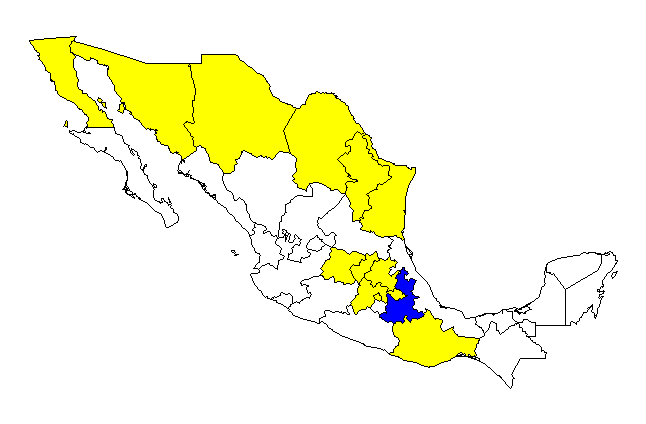
The states of Mexico I have visited, beginning with a quick
trip to Ensenada circa 1985.
This post is an attempt to bring together several disparate threads relating to a country whose fate -- whether any of us wishes this or not -- is interwoven with that of the United States. The far right in the United States has managed to paint Mexico as the root of financial devastation that began much farther north, while Mexico itself continues to derive both much of its pain and much of its gain from proximity to a northern neighbor that views it mostly in terms of well-worn stereotypes.

The Summit
When world leaders met in 1944 to write the rules for the world economy, they gathered at the Mt. Washington Hotel in New Hampshire in a conference known as Bretton Woods. (Readers can decide for themselves whether this intercourse was more or less transgressive than that of Rob Lowe and Jodie Foster in the other Hotel New Hampshire). All 44 of the Allied countries that had opposed Germany, Japan, and Italy in World War II agreed at that point to create the World Bank, the International Monetary Fund, and the General Agreement on Tariffs and Trade (GATT, which would eventually spawn the World Trade Organization, WTO).
Both Mexico and Brazil were represented in that initial meeting, but in subsequent decades such important matters were discussed in much narrower circles, often excluding those most affected. Both G7 and G8 (Group of 7 or 8, depending on whether the Russians were invited) drove the proverbial bus for many years, until they landed it in a colossal ditch of bank deregulation in 2008. At that time, the fig leaf of eight-country consensus was inadequate to the exposure, so a broader group of leaders was called together -- the G20 included such emerging economies as Mexico, Brazil, India, and China in a meeting that is sometimes called Bretton Woods II. Depending on one's point of view, the summit averted financial catastrophe or perpetuated an imbalance of power in favor of banks, or perhaps both.
Leaders of the G20 met in Mexico last week, with very low expectations and the predictable meager achievement of minimizing the damage thought likely to emanate from Europe. The kinds of crises that once threatened collapse only from the periphery now routinely infect the core, but no challenge to economic orthodoxies are yet forthcoming. Even Mexico, which was the host country and nominal "president" of the meeting, made only the feeblest of entreaties for IMF support of debt relief. The outcome was a predictably vague commitment to fostering growth, with no clear vision of how to do this or even whether it is desirable.


Clarification: Although 2008 marked a dramatic expansion in the importance of the G20, it had in fact first met in 1999. Geographer Matt Rosenberg describes the group's evolution in more detail on his What is the G-20? He mentions several other economic groupings and lists the five countries invited to this year's meeting by Mexico.


Chiapas and Greenwash
The latest G20 meeting took place almost simultaneously with a United Nations summit in Rio de Janeiro (described in more detail in a Brazil post I completed earlier today). Again, expectations were low, as leaders focus on short-term crises in the world's financial apparatus, to the exclusion of far deeper crises in the biosphere itself. And those expectations were met, with countries trumpeting environmental euphemisms rather than grappling with environmental realities.Writing for Triple Crisis, Timothy Wise charges that many of the food-security programs trumpeted by Mexico's at G20 are far less than real.
A further coincidence is that this all takes place just as two young friends have headed to Chiapas for a documentary film project that delves into the very real costs of empty environmental promises. Their blog CO2lonialism and the Green Economy examines the sometimes false promise of carbon offsets. Even when working honestly, these arrangements assuage first-world guilt by protecting forests to absorb carbon equivalent to that emitted by our own profligacy. But in Chiapas --- home both to Mexico's most marginalized indigenous communities and its most abundant biodiversity -- even that promise is not met.
Incidentally, as I discuss these and other matters with students in my Geography of Latin America course, I offer them two relevant coffees from Deans Beans, a genuine fair-trade company here in Massachusetts. One is Dean's NOCO2 from Peru, a delicious coffee whose carbon offsets are fully reliable; the other is Birdwatcher's Blend, which comes from certified bird habitat in Chiapas and Guatemala.

Drug War
We recently marked the 40th anniversary of President Nixon's declaration of war on drugs, a misnamed and misguided effort that has been as devastating abroad as it has been ineffective at home. I will not rehearse the many geographic implications that I have previously covered in this space, but again, a few stories are both relevant and quite recent.
It is in this context that Caravana por La Paz a USA (Caravan for Peace to the USA) is being organized, to begin later this summer. Activists from both countries will cross the United States from California to Washington, DC to bring attention to the brutal price ordinary Mexicans continue to pay for living adjacent to a country with such peculiar approaches to guns and drugs. It is difficult to know what to make of the current Fast and Furious scandal -- a weapons sting operation gone horribly wrong -- but it highlights the role of U.S.-origin weapons in the horrendous violence sweeping some of my favorite old haunts in northern Mexico. The degree of violence is brought home by the fact that the McAllen Monitor -- a paper to which I once subscribed -- recently carried a recommendation that diners tip their tables as shields in an event that a restaurant meal is interrupted by a tossed grenade. Yes, GRENADES are now part of the complex landscape of violence where the most heinous crimes are committed by those who were formerly the most elite police units.

Immigration
Regarding immigration, Mitt Romney
is running for Hypocrite-in-Chief
 
Immigration is not, of course, synonymous with Mexico, as thousands of people enter the country legally and illegally -- or overstay legal entries -- every year, from many parts of the world. In Boston, undocumented Irish are part of the social fabric. But no land border in the world joins two countries with a wider wealth disparity than that between the United States and Mexico, so it is natural that labor would be traded across it. As I explained in The Border: Human Sieve, much of the debate about immigration centers around a desire to bring the labor without the humans.
Meanwhile, contrary to the wailing of nativists on the racist right,
President Obama has served as Deporter-in-Chief, sending more
undocumented people out of the country than any other president.
The question of migration has been very much in the news lately, largely because President Obama has responded to courageous and well-organized young Americans who have been living in limbo because they moved to the United States as children. Unable to become fully established in the country they consider home but also lacking roots in their countries of birth, many have risked deportation by speaking out for a compromise. Last week, the president issued a ruling that will allow young adults brought here as children to avoid deportation and gain the ability to work and study legally, though the benefits of the ruling are not as robust as many assume.
One very encouraging bit of news amid all the election-year noise on this subject is that people in the United States -- outside of the more demented segments of talk radio and Fox "News" -- are starting to put the question of immigration in a more realistic perspective than had been the case. Deportations are up, illegal crossings are down, and most people realize by now that the real threats to employment do not come from poor immigrants. As reported on Market Place, immigration is not a top priority for most Democratic or Republican voters, and those who do express an opinion generally support the accommodations the president has made for U.S.-raised migrants.
A related story that appeared in the New York Times represents a very large group of children who will not be helped at all by this week's decision: it describes the difficult adjustment faced by American-born children who join deported parents.

Walmart
And as if Mexico were not putting up with enough, the invasive retail species known as Walmart continues to encroach. Just this morning, I learned that Walmart is slowing its expansion in Mexico, meaning that it is still expanding plenty. Over 6 percent of the world's largest retailer's revenues already come from Mexico, but more than 300 new stores will soon be added. Outside sources link slightly reduced pace of expansion to past bribery scandals, but Walmart simply asserts a desire to ensure proper business practices in its real estate transactions. 
Walmart infection poised to spread.
Map: William & Mary
AMST 370 students
In other words, the expansion is expected to be carried out legally, though the impacts will be criminal in a very real sense. Employment will be created, of course, but as in the United States, for every "real" Walmart job there are 100 menial jobs in which people will gain only slightly, and for each one of those, there will be an untold number of job losses in existing retail and manufacturing firms. As if Mexico did not have enough problems, the Walton family will be feeding on Mexico like a mosquito for years to come.

Election
Last but certainly not least, Mexico will continue to be in the news as a presidential election is taking place there on July 1. After decades of essentially meaningless elections, the past few cycles have been very interesting, as power shifts among three major parties. NPR's Morning Edition reports that Mexican youth are expected to figure prominently in the upcoming decision.

The protester shown here objects to a possible return to rule by the PRI -- the Institutional Revolutionary Party, and oddly-named coalition that ruled Mexico longer than any other political party in modern history -- over seventy years -- before its power was eroded from both the left (PRD) and the right (PAN).

Tuesday, November 02, 2010

Murder City

Photo: NPS
Ciudad Juarez was once one of my favorite places. Many years ago, I read Tom Miller's On the Border, about a journey in which he traversed every border crossing, from Tijuana to Matamoros, from Brownsville to San Diego. After years living in the Gasden Purchase section of Arizona -- where my wife Pamela actually got to work with Tom on one of his books --  and in the southmost tip of Texas, I realized that I had been through most of the border crossings. Los Ebanos with its hand-drawn ferry was a favorite, but so, too, was through the Chamizal Peace Park between El Paso and Ciudad Juarez.

Almost all of the cities on the Mexican side of the border are bigger than their U.S. counterparts, and Juarez is no exception. It is the largest border city in the world, with 2/3 of the population on the Chihuahua side. Despite its sprawling size, I enjoyed several visits in the 1990s, and walked around comfortably in the sunshine and even in the evenings. In those days, even the crossing back into the U.S. was simple and easy.

View Larger Map


In the 13 years since we left the borderlands, Juarez has become a tragic place -- one of the few I would rather not visit for a while. Jennifer Lopez has told the story -- at some risk to her own safety -- in Bordertown. I highly recommend both the fictionalized account (see trailer) and the DVD extra feature that explains how the film came to be made. The otherwise infamous narcocorrido singers Los Tigres del Norte told the story in the CD Pacto de Sangre. Both of these refer to the hundreds of young women who have been kidnapped, raped, killed, and left in the deserts surrounding Juarez over the past decade or more. Many of them have been attracted to the area for maquila manufacturing jobs, working long hours for low pay in factories that do not provide them adequate protection. It is thought that a conspiracy among very elite men is responsible for the failure to solve these crimes -- about two thousand women who have disappeared. The image at left is from a blog post called ¡Feminicidios sin resolver! -- one of many that expresses outrage and sorrow about the loss of innocent young lives in this once beautiful city. This particular image is remarkable for the way it integrates motifs representing femininity and veneration of the dead at one level, along with representations of crime scenes and of the border itself. The accompanying narrative is focused on the fact that many of the victims were killed going home from jobs that they were far too young to hold legally.


Pam reminded me that the first time we heard about the Juarez killings was through a performance of Eve Ensler's Vagina Monologues (an important program that is put on each February at BSU). Each year, the VDAY show focuses on a cause, and in 2004 the women of Juarez were that focus. One of the monologues, The Memory of Her Face, honors women victims of violence in Islamabad, Baghdad, and Ciudad Juarez, with a stanza of the reading representing a woman in each of these cities in which violence against women has become a consequence of wars -- declared and undeclared. Read more about the Women in Juarez Spotlight and about the 5,000 shows performed in Mexico City in support of Juarez women (second item on this news page).

In the past couple of years, this already tragic and violent story has gotten much worse -- probably ten times worse. The murder rate in Mexico as a whole remains relatively low, in part because firearms are very difficult to procure. But the murder rate in Ciudad Juarez has become much higher, as it has in other border towns. The reason: the Sinaloa drug cartel, which formerly operated with impunity throughout the northwest of the country, is in a battle over territory with a group called the Zetas in the northeast. I met a few of the Zetas during an inspection stop near Monterrey in the 1990s, when they were legitimate narcotics police. They eventually cooperated with the Gulf Cartel, and still later took it over. Now shootouts are so common in Matamoros, across the river from my former job at UT-Brownsville/Texas Southmost College that the campus has actually been hit by stray bullets.
Borderland journalist Charles Bowden describes the killing in Juarez in his book Murder City, which is at the same time compelling and unbearable. He explores the dynamics I outline above, but goes beyond this to put the brutality in the context of even larger forces related to economic exploitation. He discusses his claims -- and explains why he keeps going back to Juarez -- in an interview with NPR's Mary Louise Kelly that was recorded after three people affiliated with the U.S. consulate were killed last April.

View full gallery at
MexConnect
I argue, with Bowden, that  is not possible to understand violence on the border without acknowledging the transformation of the border itself from an edge situated within a bicultural zone of transition to an increasingly impersonal sieve that separates humans from their labor. It is also not possible, however, to understand death along the border without understanding the distinctive attitude toward death in Mexico, as exemplified by the Dia de los Muertos. November 1 is a colorful holiday -- as suggested below -- in which the dead are honored, celebrated, visited, and consulted.

As reported last spring in a fascinating article in National Geographic, the increasing brutality of the drug war has created a class of wealthy and youthful criminal class who are full of both bravado and fear and at the same time increasingly status-conscious. In this context, graves -- while always important -- have become sites of obsessive competition among traffickers. The focus of the article -- Troubled Spirits -- is on the veneration of Santa Muerte, literally Saint Death. Even in the panoply of images that embrace the figure of the skull, the imagery of Santa Muerte is remarkably chilling. Whether standing in a gown in a tiny living room or being carried on the shoulders of mourners at a gangster funeral, figures of Santa Muerte are arresting. Although not sanctioned by the Catholic Church, Santa Muerte is an increasingly important object of adoration and supplication, as traffickers seek both protection and riches through her. And although many assume Santa Muerte to be a very recent phenomenon, at least one Hoodoo practitioner claims several generations of veneration of Santa Muerte.

See the amazing, complete photo gallery at NGS Magazine

Lagniappe

In a late 2023 post, I cite New York Times reporting from our part of the borderlands in Texas, which highlights traditional, non-criminal associations with Santa Muerte. 

Saturday, August 14, 2010

Immigrant bashing is, sadly, nothing new


This week I found two stories -- one on the radio and one online -- marking the anniversary of the 1834 destruction of the Ursuline Convent in Charlestown (near Boston) by an angry mob. Fueled by rumors and stereotypes, a mob vented its hostility toward the newly-emerging Irish community by burning down the convent and surrounding buildings. Punishment of the perpetrators was minimal: one conviction, followed by a pardon.

I recommend listening to the Megna Chakrabarti's interview with Salem State University professor Nancy Lusignan Shultz. One of the listener comments posted online provides an overview of anti-Catholic violence that continued in the region for another century. The stories are important for understanding why some members of the now dominant Catholic community in the region continue to view themselves as a persecuted minority. The account from Mass Moments provides more details of how the events unfolded on August 11 and 12, 1834.

For me, the episode is a tragic reminder that immigrants have always borne the brunt of societal stresses, and that pretexts can always be found to justify their ill treatment.

Thursday, April 16, 2009

U.S.-Mexico Economic Relationship

It has been a century since President Porfirio Díaz lamented, "Poor Mexico, so far from God and so close to the United States!" Indeed, nowhere in the world do two countries share such strong connections and disparate economies.

The connections are physical, economic, cultural, and even familial. At the same time, differences in income, opportunity, and in the concentration of wealth are great. Across one of the world's longest and most important land borders, misconceptions abound in both directions.

I have had the opportunity to travel in several parts of Mexico and to live from 1990 to 1997 in the border zone (Tucson, Arizona and Pharr, Texas). Recent stories, especially from some areas of the border, have left me sad and worried. On the occasion of President Obama's visit with President Felipe Calderon, Kai Ryssdal's interviews Council of Foreign Relations expert Shannon O'Neil. Describing the many dimensions of the binational relationship, she helps to keep the current turmoil -- important though it is -- in perspective.

Blog Ideas

coffee (25) GEOG381 (24) GEOG388 (23) GEOG470 (18) climate change (18) GEOG130 (16) geography (16) GEOG332 (13) GEOG431 (12) musica (11) GEOG 332 (9) GEOG 381 (9) Mexico (9) Brazil (8) GEOG286 (8) Texas (8) education (8) migration (8) GEOG298 (7) borderlands (7) GEOG199 (6) GEOG331 (6) Massachusetts (6) US-Mexico (6) deBlij04 (6) immigration (6) GEOG 130 (5) GEOG 286 (5) GEOG287 (5) climate justice (5) cultural geography (5) fair trade (5) food (5) geographic education (5) nicaragua (5) water (5) Arizona (4) GEOG 171 (4) GEOG171 (4) GEOG295 (4) Safina (4) africa (4) deBlij05 (4) land protection (4) music (4) politics (4) Bolivia (3) Boston (3) COVID-19 (3) Detroit (3) Ethiopia (3) Managua (3) Obama (3) border (3) cartography (3) drought (3) libraries (3) pesticides (3) suburban sprawl (3) trade (3) unemployment (3) Alaska (2) Amazon (2) Bridgewater (2) Canada (2) Chiapas (2) China (2) Colonialism (2) EPA (2) EarthView (2) Economy (2) Environment (2) GEOG 199 (2) GEOG 287 (2) GEOG 388 (2) Google Maps (2) Government (2) Hawaii (2) India (2) Lexington (2) Maldives (2) Mozambique (2) NOLA (2) NPR (2) National Monuments (2) National Parks (2) New Orleans (2) Religion (2) Rio Grande (2) Taunton River Wild and Scenic (2) Tex-Mex (2) The View from Lazy Point (2) United States (2) Venezuela (2) anthropocene (2) cape verde (2) censorship (2) central america (2) chocolate (2) corn (2) deBlij07 (2) deforestation (2) demographic transition (2) demography (2) education reform (2) employment (2) environmental geography (2) film (2) forest fire (2) global warming (2) islands (2) landscape ecology (2) librarians (2) maps (2) organic (2) peak oil (2) refugees (2) sense of place (2) soccer (2) sustainability (2) television (2) water rights (2) whales (2) #bbc (1) #nicaragua (1) #sosnicaragua (1) #sosnicaragua #nicaragua (1) 100 Years of Solitude (1) ACROSS Lexington (1) Accents (1) Adam at Home (1) Alice (1) Alt.Latina (1) American Hustle (1) April (1) Association of american Geographers (1) Audubon (1) Aunt Hatch's Lane (1) BBC (1) BSU (1) Baby Boomers (1) Banda Aceh (1) Bay Circuit Trial (1) Bechtel (1) Beleza Tropical (1) Belize (1) Beloit College (1) Ben Linder Cafe (1) Bet The Farm (1) Bhopal (1) Biafra (1) Bikeway (1) Bikini (1) Bill Gates (1) Bill Moyers (1) Boeing 777 (1) Brazilian (1) Brazilianization (1) Bridge (1) British Columbia (1) Brockton (1) Bus Fare (1) Bush (1) Cabo Verde (1) California (1) Cambridge (1) Cape Cod Bay (1) Carl Stafina (1) Catholic (1) Ceuta (1) Chalice (1) Chipko (1) Citgo (1) Climate risks (1) Cochabamba (1) Colombia (1) Common Core (1) Commuter (1) Computers (1) Cuba (1) Cups and Summits (1) Dallas (1) David Byrne (1) Deans Beans (1) Delaware Valley (1) Dunkin Donuts (1) Earth Day (1) Earth View (1) Easton (1) El Salvador (1) Elizabeth Warren (1) Ellicott City (1) Emilia Laime (1) English-only (1) Environmental History (1) Euphrates (1) European Union (1) Evo Morales (1) FIFA (1) FYS (1) Fades Out (1) Farms (1) First-Year Seminar (1) Food Trade (1) Frederick Kaufman (1) French press (1) Fresh Pond Mall (1) GEOG 431 (1) GEOG 441 (1) GEOG213 (1) GEOG490 (1) Gabriel García Márquez (1) Garden of Gethsemane (1) Gas wells (1) Gateway Cities (1) General Motors (1) Gini Coefficient (1) Girl in the Cafe (1) Google (1) Gordon Hempton (1) Gravina Island Bridge (1) Great Migration (1) Great Molasses Flood (1) Guy Lombardo (1) Haiti (1) Hawks (1) Heart (1) Higher Education (1) History (1) Holyhok Lewisville (1) Homogenous (1) Honors (1) How Food Stopped Being Food (1) Hugo Chavez (1) IMF (1) Iditarod (1) Imperial Valley (1) Income Inequality (1) Indonesia (1) Iraq (1) Irish (1) Japan (1) Junot Diaz (1) Kenya (1) Ketchikan (1) Key West (1) Kindergarden Students (1) King Corn (1) Kiribati (1) Latin America (1) Limbaugh (1) Literature (1) Living On Earth (1) Louisiana (1) Love Canal (1) Luddite (1) M*A*S*H (1) MCAS (1) MacArthur Genius (1) Maersk (1) Malawi (1) Malaysia (1) Malaysian Air Flight 370 (1) Mali (1) Manu Chao (1) Map (1) Marblehead (1) Mary Robinson Foundation (1) Maryland (1) Massachusetts Bay Colony (1) Math (1) Maxguide (1) May (1) Maya (1) Mayan (1) Mayan Gold (1) Mbala (1) McDonald's (1) Melilla (1) Mexicans (1) Michael Pollan (1) Michelle Obama (1) Micronesia (1) Military (1) Military Dictatorship (1) Minuteman Trail (1) Mongolia (1) Monsanto (1) Montana (1) Morocco (1) Mount Auburn Cemetery (1) Muslim (1) NPS (1) Nantucket (1) National Education Regime (1) Native American (1) Native Americans (1) New Bedford (1) New Hampshire (1) New York City (1) New York Times (1) Nigeria (1) No Child Left Behind Act (1) Norquist (1) North Africa (1) Nuts (1) Oakland (1) Oaxaca (1) Occupeligo (1) Occypy (1) Oklahoma (1) Oklahoma City (1) Oppression (1) PARCC (1) Pakistan (1) Pascal's Wager (1) Peanut (1) Pearson Regime (1) Philadelphia (1) Philippines (1) Pink Unicorns (1) Poland (1) Portuguese (1) Protest (1) Public Education (1) Puebla (1) Puritans (1) Quest University (1) Rachel Carson (1) Reading (1) Republican (1) Retro Report (1) Robert Reich (1) Rock Legend (1) Ronald Reagan (1) Rondonia (1) Rosa Parks (1) SEXCoffee (1) Safety (1) Samoza (1) Sandino (1) Sara Vowell (1) Save the Children (1) Scotch (1) Scotland (1) Seinfeld (1) Senegal (1) Sergio Mendes (1) Severin (1) Sharrod (1) Silent Spring (1) Sinatra (1) Slope (1) Smokey the Bear (1) Somalia (1) Sombra (1) Sonora (1) Sonoran desert (1) Sonoran hot dog (1) South America (1) Spain (1) Stairway to Heaven (1) Storm (1) Suare Inch of Silence (1) Sumatra (1) Swamp (1) Tacloban (1) Tanzania (1) The Amazon (1) The Amazon Trail (1) Tigris (1) Tucson (1) Tufts (1) U.S Federal Reserve (1) U.S Government (1) U.S. economy (1) USDA (1) USLE Formula (1) Uganda (1) Unfamiliar Fishes (1) Union Carbide (1) Vacation (1) Vexillology (1) Vietnam (1) ViralNova (1) WNYC Data News (1) Wall Street (1) Walsenburg (1) Walt Disney (1) Walt and El Grupo (1) Ward's Berry Farm (1) West (1) Whaling (1) Wilson (1) Winter Storm Saturn (1) Wisconsin (1) World Bank (1) Xingu (1) YouTube (1) Zombies (1) agriculture (1) antitrust (1) aspen (1) austerity (1) aviation (1) banned books (1) bark beetle (1) bean (1) beavers (1) bicycle (1) bicycling (1) bike sharing (1) binary (1) biodiversity (1) bioneers (1) books (1) boston globe (1) cacao (1) cafe (1) campaign (1) campus (1) cantonville (1) capitals (1) carbon dioxide (1) carbon offsets (1) carioca (1) cash (1) cashews (1) census (1) chemex (1) chemistry (1) chronology (1) churrasco (1) civil rights (1) coffee grounds (1) coffee hell (1) coffee prices (1) coffee quality (1) college (1) compost (1) computerized test (1) congress (1) conservation commission (1) corporations (1) countries (1) cubicle (1) dams (1) deBlij06 (1) deBlij08 (1) death (1) deficit (1) development (1) dictatorship (1) distracted learning (1) distraction (1) drug war (1) dtm (1) earth (1) economic diversification (1) economic geography (1) election (1) embargo (1) energy (1) enhanced greenhouse effect (1) environmentalist (1) ethnomusicology (1) exremism (1) failed states (1) farming (1) financial crisis (1) football (1) forestry (1) forro (1) fracking (1) free market (1) free trade (1) fuel economy (1) garden (1) genocide (1) geography education (1) geography games (1) geography of chocolate (1) geography of food (1) geologic time (1) geotechnology (1) gerrymandering (1) global pizza (1) globe (1) goodall (1) green chemistry (1) ground water (1) guacamole (1) guatemala (1) habitat (1) high-frutcose (1) home values (1) hospitality (1) hourglass (1) housing (1) hydrology (1) illegal aliens (1) income (1) indigenous (1) interfaith (1) journalism (1) kitchen garden (1) labor (1) language (1) libertarianism (1) library (1) linguistics (1) little rock (1) llorona; musica (1) macc (1) maccweb (1) magic realism (1) maple syrup (1) mapping (1) masa no mas (1) massland (1) medical (1) mental maps (1) mi nina (1) microlots (1) microstates (1) mining (1) mltc (1) monopoly (1) municipal government (1) nautical (1) neoclassical economics (1) new england (1) newseum (1) newspapers (1) noise pollution (1) pandas (1) petroleum (1) piracy (1) pirates (1) poison ivy (1) police (1) political geography (1) pollution (1) provincial government (1) proxy variables (1) public diplomacy (1) quesadilla (1) rabbi (1) racism (1) real food cafe (1) regulations (1) remittances (1) resilience (1) resistance (1) respect (1) rigoberta menchu (1) rios montt (1) romance (1) roya (1) runways (1) russia (1) satellites (1) science (1) sea level (1) selva negra (1) sertao (1) sertão (1) sex (1) sex and coffee (1) simple (1) sin (1) smokey (1) solar (1) solar roasting (1) south africa (1) sovereignty (1) species loss (1) sporcle (1) sports (1) state government (1) taxes (1) tea party (1) teaching (1) textile (1) texting (1) tortilla (1) training (1) transect; Mercator (1) travel (1) triple-deckers (1) tsunami (1) urban geography (1) utopia (1) vermont (1) vice (1) video (1) wall (1) water resources (1) water vapor (1) whiskey (1) whisky (1) widget (1) wifi (1) wild fire (1) wildfire (1) wildlife corridor (1) wto (1)