Tuesday, March 13, 2012

Hemispheres of Influence

I spent my spring break on train and automobile travel, but a student who traveled by air found this treasure at 36,000 feet. Hemispheres magazine. The article is brief, and does not go as far as Black Gold in explaining the life-and-death stakes involved. But Rachel Slade does give United Airlines customers a glimpse into the human story that is behind each cup of coffee.

Coffee Concerned

When I visit coffee farmers in Nicaragua, they sometimes ask me, "What are you doing about climate change?" The do this because they know I am from the United States, which is both a democracy and a leading contributor to the problem of climate change. They also ask because they are already seeing the effects of climate change on their crops.

For two decades, the specialty-coffee movement has been helping farmers to improve the quality of their coffee, not only so consumers can enjoy a better cup, but also so that farmers could earn a better living. With climate change, all of that progress is severely threatened. Quality coffee is highly dependent on intricate combinations of factors coming together in particular places, generally at high elevations in the tropics.

The Union of Concerned Scientists is answering the question that my friends have been asking -- it is putting pressure on President Obama to enact new clean-air regulations that would reduce carbon emissions, thereby slowing the rate of climate change, perhaps saving coffee, among other things.


Watching this video with students today, we noticed three difficulties, two of which I have mentioned to the UCS through its web site. First, and most importantly: the red berries shown in the opening frames are not coffee. Second, the video indicates that "we" drink 2.25 billion cups of coffee per day. Because the video is focused on the U.S. president, viewers may infer that this refers to the United States, but this is in fact a worldwide total. Third, at 1:20 into the video, a sign asks for legislation to be passed, when in fact the campaign is intended to encourage the EPA to interpret existing legislation -- the Clean Air Act -- in a way that would require the regulation of carbon emissions.

Map of Flags


BSU EarthView is a blog I maintain as part of our Project EarthView outreach program, which mainly reaches middle-school students. Among other things, I use the blog to share resources I find appropriate to learning geography at K-12 levels, especially grades 4-8. Many of the things I post, however, are good for learners of all ages, such as the recent Vexillology Map post! It points to a ChartsBin map that includes a description of every national map in the world, as well as the maps of some territories.

Monday, March 12, 2012

Geography of Coffee Habits


Writing for Budget Travel magazine, Nicholas DeRenzo describes the geography of coffee in terms of  consumption habits representing various countries. In his article A Coffee Addict's Guide to the World, he describes close to two dozen ways to serve and prepare coffee. Sadly, only one country is represented by a single corporation, the highest possible caloric impact, and a plastic serving container. Guess which one.

Tuesday, March 06, 2012

Looking Inward then Outward

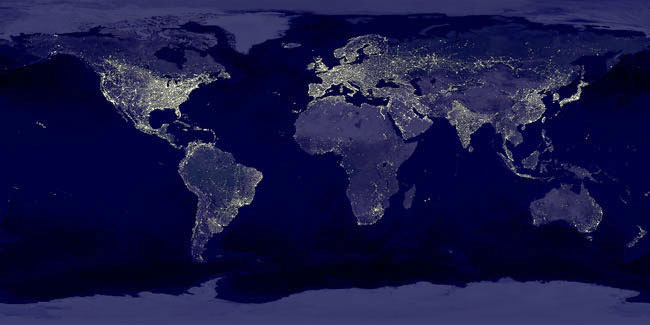
The Astronomy Picture of the Day (APOD) is a long-standing educational project by which NASA provides examples of the benefits -- from the practical to the sublime -- of space exploration. I use a November 2000 image -- Earth at Night -- on my home page and in many of my classes, as the lights shown in this image mosaic are a reasonable but imperfect proxy for human population patterns.

Profligate users of electricity, for example, are over-represented while the rural poor are invisible -- as they too often are in real life. Still, it is clear from this image that the majority of people live in the mid-latitudes of the northern hemisphere, that more people live near water than in the interiors of continents, and that population densities are still low in places that are extremely cold, dry, wet, or high. (The "too wet" category surprises people, but the nutrients are often so thoroughly leached from tropical soils that although they are found under lush forests, they cannot support settled agriculture -- only low-density shifting cultivation.)

CLICK to ENLARGE
Better yet, visit original APOD post to really enlarge.
This image has a lot of detail that is not visible at even double this scale.
I was pleasantly surprised to hear APOD mentioned on the radio yesterday, as one WBUR broadcaster was exclaiming how cool the image was. The image, as it turns out, was actually a time-lapse series of images (that is, an accelerated video) from the International Space Station. Set to a lively musical score, Flying Over the Earth at Night fills the screen with imagery of lights that originate from human and natural sources. We are reminded of how common lightning is, for example. We see large areas of dense human settlement but even larger areas where humans are relatively few and generally far between.


Watch this sequence a few times, looking for patterns and familiar coastlines or other locations. You can share your reactions with the "comments" button below, or on the NASA site itself.

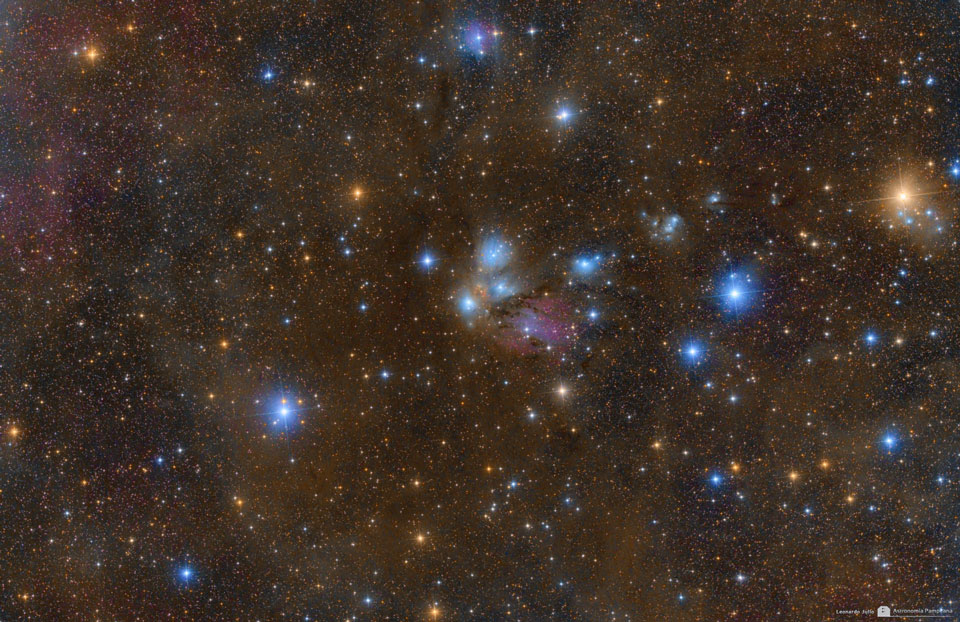
At first glance, today's APOD image seems similar to yesterday's sequence. It is mostly dark, with some scattered blues and oranges. But as the notes for Celestial Still Life make clear, these colored lights reflect (pun intended) patterns on a much vaster scale than anything on our planet could do.
CLICK TO ENLARGE --
THIS IS REALLY BIG STUFF!

Happy Steps

Eric Weiner is a self-described grump who decided that happiness must have a geography. The Geography of Bliss describes his journey to figure out whether people in some places are happier than those in others and if so, why. Pam wrote about our reading of this book as part of her Year of Reading project.

I was thinking of all this when I found a piece of paper floating around in my murse and realized that I need to put its contents in a permanent -- which for me means electronic -- place before I can recycle the paper. The notes were scribbled at the end of a recent service at my church, when our minister suggested we write down a few steps to happiness. I wrote the following mini-couplets, one of which I added an hour or so later, while lunching at the Rockin' K Cafe with the recorder ensemble that had played that morning.
Gain learning & share it.
Honor work do it.  
Eat good food & prepare it. 
Spend time in the outdoors protect it.
Listen to music & make it.
I will leave it for readers to decide what to do with these suggestions, as they are intended to describe how I pursue happiness rather than to prescribe how others should do it. I will also leave to my readers the question of what if anything is geographic about them.

Maphattan

Click to Enlarge
Living south of Boston with most of our family in Maryland, we drive through or around New York City much more often than we go to it. But I have found myself here in the City (yes, I am writing this from Midtown) twice in as many weeks. Last week, as mentioned on our department blog, I was one of more than 8,000 geographers attending our national meeting here. Today, I came -- again via Amtrak -- to give a talk on coffee at Yeshiva University. The train is the way to go: scenery, legroom, and wifi without any traffic or terrible drivers.

Because of shows like FriendsSeinfeld, Manhattan, and countless others, many Americans -- and fans of television and film throughout the world -- have at least some basic understanding of the geography of New York, particularly of the borough of Manhattan. The web site Time Formations is an interesting opportunity to explore Geographic Information Systems (GIS), building on the basics to explore an endless array of potential combinations of spatial variables.

For the image above, I chose to click "on" every data layer available -- great fun and colorful, if not particularly useful for analysis. In reality, geographers can use tools like this to look systematically at relationships among many spatially-variable conditions. Prior to GIS, it was often difficult to compare variables that were mapped in different ways or at different scales. Analysis in such situations still requires some professional care, but GIS does facilitate many novel approaches to spatial research.

December 10, 2012 Update 1: Artist and cartographer Jenni Sparks has brought her skills to a different kind of map of the city -- a hand drawing of the iconic island at a delightfully detailed scale. Like a modern, urban Erwin Raisz, she brings the landscape to life and invites exploration. The relatively small-scale overview below is posted along with several larger-scale samples on her blog, which includes a link for purchasing the entire map. I join Sparks in being grateful that New York has survived (for the most part) Super Storm Sandy.

December 10, 2012 Update 2: In Mapping Sandy's Reach, I point to an interactive map that allows users to find out which of these familiar places were recently flooded. Some of them still struggle with recovery five weeks after the storm dissipated.

Monday, March 05, 2012

Me Me Me Meme

A few weeks ago, I noticed a little chart like the one to the left. A friend had posted it about her own profession, and I thought it was clever. Within a couple of days, I noticed quite a few more online, and another friend declared that this meme had gone from unheard-of to overdone in record time. I agreed, but a few days later felt compelled to jump on board.

I had to admit that I did not exactly know what a meme was -- I thought it referred to this particular style of graphic. As I started to investigate, I learned that a meme is similar to internet viral content, except that each user changes it as he or she copies it, adapting it to individual messages. A meme, then, is like a micro-genre or a heuristic devise that can convey a wide variety of ideas in broadly similar packaging.

I learned the distinction from the Know Your Meme web site, where I also found an interesting article about what this particular meme with a cumbersome name tells us about the way we view ourselves and the what we think about the way others view us.

I made my own version using simple cut-and-paste methods with my browser and PowerPoint (and shirking my usually scrupulous academic habits to get the photos quickly, losing the attributions in the process). A few days later I learned that this particular meme can now be spread using a simple utility at UthinkIdo.com, which now hosts my Teaching Geography graphic. (2023 UPDATE: That site is gone, but I captured the image and am reposting it now.)


This little fad has been particularly interesting for me as a geographer, because I teach two senior-level university courses -- one for geographers in general and another specifically for teachers -- in which I push students to examine what it means to be a geographer, and in particular a geography teacher. Some of the ideas in the graphic I eventually created arose from discussions with students in the teaching class (thanks!).

The meme phenomenon is certainly facilitated by internet technology, but memes circulated quickly and widely in an earlier generation via office photocopiers, as documented in  When You're Up to Your Ass in Aligators (1987) by Alan Dundes and Carl Pagter. The term meme predates this work, having been introduced by biologist Richard Dawkins in 1976 in The Selfish Gene.


One Shot Coffee Education

To learn about coffee, you can take one or both of my classes, come to one of my public lectures, explore my coffee web site, browse the coffee holdings in the Maxwell library, or sign up for classes through the Barista Guild of a America. Or you can just study the infographic below, lifted shamelessly from Daily Shot of Coffee. Which raises one more possibility: subscribe to Daily Shot for ongoing coffee education.


I would quibble with only two items in this graphic. One is the suggestion that arabica and robusta are the only species of coffee (genus Cofea). In reality, robusta is the most common varietal of canephora. Two other species are grown commercially, though the amounts are tiny and some experts consider liberica and conillon further varietals of robusta. Most agree that these are terrible coffees! My friend Freddy in Nicaragua informs us that there are about two dozen species, most of which are not commercial, some of which are found wild in the Americas, indicating that the genus was present prior to the emergence of the Atlantic Ocean.

The other is the rather confused terminology used for civet or Kopi Luwak coffee. These are not varietals, but rather a very rare method of harvesting and processing coffee -- using the palm civet digestive tract. Almost all of the 500-600 pounds of coffee collected in this manner each year comes from Indonesia.

Thursday, March 01, 2012

Safe Zone

One of the privileges of working at Bridgewater State College (now University) has been learning about -- and participating in some small ways -- in the Pride movement. We have tried to create a campus on which students and employees of all genders, gender expression, and sexual orientations are free to work, study, and participate fully in campus life. We have, for example, provided scholarships for students whose families have cut them off financially because of sexual orientation or gender expression.

I know that this work has been worthwhile, because students and even visitors have told me so. I know that students have completed their education here who might not have been able to at other schools, and I am proud of that.

Last month, an out lesbian student was assaulted for having written an editorial against California's Proposition 8. The crime remains unsolved, so it has not yet been determined the extent to which this was a crime motivated by her words or by her identity, but in either case, it was a serious affront to a community that has prided itself as a safe and affirming campus. I was offended by that action, as it threatened to undermine what we have done so much to create. I was ultimately gratified to see the way in which student leaders were able to rally the campus and surrounding community.

Those who carried out the assault could have had no idea what their cowardice would unleash. Rather than creating an unsafe space in the center of our campus, as they had hoped, they motivated the rest of us to reaffirm the entire campus as a place of safety and even affirmation.


Blog Ideas

coffee (25) GEOG381 (24) GEOG388 (23) GEOG470 (18) climate change (18) GEOG130 (16) geography (16) GEOG332 (13) GEOG431 (12) musica (11) GEOG 332 (9) GEOG 381 (9) Mexico (9) Brazil (8) GEOG286 (8) Texas (8) education (8) migration (8) GEOG298 (7) borderlands (7) GEOG199 (6) GEOG331 (6) Massachusetts (6) US-Mexico (6) deBlij04 (6) immigration (6) GEOG 130 (5) GEOG 286 (5) GEOG287 (5) climate justice (5) cultural geography (5) fair trade (5) food (5) geographic education (5) nicaragua (5) water (5) Arizona (4) GEOG 171 (4) GEOG171 (4) GEOG295 (4) Safina (4) africa (4) deBlij05 (4) land protection (4) music (4) politics (4) Bolivia (3) Boston (3) COVID-19 (3) Detroit (3) Ethiopia (3) Managua (3) Obama (3) border (3) cartography (3) drought (3) libraries (3) pesticides (3) suburban sprawl (3) trade (3) unemployment (3) Alaska (2) Amazon (2) Bridgewater (2) Canada (2) Chiapas (2) China (2) Colonialism (2) EPA (2) EarthView (2) Economy (2) Environment (2) GEOG 199 (2) GEOG 287 (2) GEOG 388 (2) Google Maps (2) Government (2) Hawaii (2) India (2) Lexington (2) Maldives (2) Mozambique (2) NOLA (2) NPR (2) National Monuments (2) National Parks (2) New Orleans (2) Religion (2) Rio Grande (2) Taunton River Wild and Scenic (2) Tex-Mex (2) The View from Lazy Point (2) United States (2) Venezuela (2) anthropocene (2) cape verde (2) censorship (2) central america (2) chocolate (2) corn (2) deBlij07 (2) deforestation (2) demographic transition (2) demography (2) education reform (2) employment (2) environmental geography (2) film (2) forest fire (2) global warming (2) islands (2) landscape ecology (2) librarians (2) maps (2) organic (2) peak oil (2) refugees (2) sense of place (2) soccer (2) sustainability (2) television (2) water rights (2) whales (2) #bbc (1) #nicaragua (1) #sosnicaragua (1) #sosnicaragua #nicaragua (1) 100 Years of Solitude (1) ACROSS Lexington (1) Accents (1) Adam at Home (1) Alice (1) Alt.Latina (1) American Hustle (1) April (1) Association of american Geographers (1) Audubon (1) Aunt Hatch's Lane (1) BBC (1) BSU (1) Baby Boomers (1) Banda Aceh (1) Bay Circuit Trial (1) Bechtel (1) Beleza Tropical (1) Belize (1) Beloit College (1) Ben Linder Cafe (1) Bet The Farm (1) Bhopal (1) Biafra (1) Bikeway (1) Bikini (1) Bill Gates (1) Bill Moyers (1) Boeing 777 (1) Brazilian (1) Brazilianization (1) Bridge (1) British Columbia (1) Brockton (1) Bus Fare (1) Bush (1) Cabo Verde (1) California (1) Cambridge (1) Cape Cod Bay (1) Carl Stafina (1) Catholic (1) Ceuta (1) Chalice (1) Chipko (1) Citgo (1) Climate risks (1) Cochabamba (1) Colombia (1) Common Core (1) Commuter (1) Computers (1) Cuba (1) Cups and Summits (1) Dallas (1) David Byrne (1) Deans Beans (1) Delaware Valley (1) Dunkin Donuts (1) Earth Day (1) Earth View (1) Easton (1) El Salvador (1) Elizabeth Warren (1) Ellicott City (1) Emilia Laime (1) English-only (1) Environmental History (1) Euphrates (1) European Union (1) Evo Morales (1) FIFA (1) FYS (1) Fades Out (1) Farms (1) First-Year Seminar (1) Food Trade (1) Frederick Kaufman (1) French press (1) Fresh Pond Mall (1) GEOG 431 (1) GEOG 441 (1) GEOG213 (1) GEOG490 (1) Gabriel García Márquez (1) Garden of Gethsemane (1) Gas wells (1) Gateway Cities (1) General Motors (1) Gini Coefficient (1) Girl in the Cafe (1) Google (1) Gordon Hempton (1) Gravina Island Bridge (1) Great Migration (1) Great Molasses Flood (1) Guy Lombardo (1) Haiti (1) Hawks (1) Heart (1) Higher Education (1) History (1) Holyhok Lewisville (1) Homogenous (1) Honors (1) How Food Stopped Being Food (1) Hugo Chavez (1) IMF (1) Iditarod (1) Imperial Valley (1) Income Inequality (1) Indonesia (1) Iraq (1) Irish (1) Japan (1) Junot Diaz (1) Kenya (1) Ketchikan (1) Key West (1) Kindergarden Students (1) King Corn (1) Kiribati (1) Latin America (1) Limbaugh (1) Literature (1) Living On Earth (1) Louisiana (1) Love Canal (1) Luddite (1) M*A*S*H (1) MCAS (1) MacArthur Genius (1) Maersk (1) Malawi (1) Malaysia (1) Malaysian Air Flight 370 (1) Mali (1) Manu Chao (1) Map (1) Marblehead (1) Mary Robinson Foundation (1) Maryland (1) Massachusetts Bay Colony (1) Math (1) Maxguide (1) May (1) Maya (1) Mayan (1) Mayan Gold (1) Mbala (1) McDonald's (1) Melilla (1) Mexicans (1) Michael Pollan (1) Michelle Obama (1) Micronesia (1) Military (1) Military Dictatorship (1) Minuteman Trail (1) Mongolia (1) Monsanto (1) Montana (1) Morocco (1) Mount Auburn Cemetery (1) Muslim (1) NPS (1) Nantucket (1) National Education Regime (1) Native American (1) Native Americans (1) New Bedford (1) New Hampshire (1) New York City (1) New York Times (1) Nigeria (1) No Child Left Behind Act (1) Norquist (1) North Africa (1) Nuts (1) Oakland (1) Oaxaca (1) Occupeligo (1) Occypy (1) Oklahoma (1) Oklahoma City (1) Oppression (1) PARCC (1) Pakistan (1) Pascal's Wager (1) Peanut (1) Pearson Regime (1) Philadelphia (1) Philippines (1) Pink Unicorns (1) Poland (1) Portuguese (1) Protest (1) Public Education (1) Puebla (1) Puritans (1) Quest University (1) Rachel Carson (1) Reading (1) Republican (1) Retro Report (1) Robert Reich (1) Rock Legend (1) Ronald Reagan (1) Rondonia (1) Rosa Parks (1) SEXCoffee (1) Safety (1) Samoza (1) Sandino (1) Sara Vowell (1) Save the Children (1) Scotch (1) Scotland (1) Seinfeld (1) Senegal (1) Sergio Mendes (1) Severin (1) Sharrod (1) Silent Spring (1) Sinatra (1) Slope (1) Smokey the Bear (1) Somalia (1) Sombra (1) Sonora (1) Sonoran desert (1) Sonoran hot dog (1) South America (1) Spain (1) Stairway to Heaven (1) Storm (1) Suare Inch of Silence (1) Sumatra (1) Swamp (1) Tacloban (1) Tanzania (1) The Amazon (1) The Amazon Trail (1) Tigris (1) Tucson (1) Tufts (1) U.S Federal Reserve (1) U.S Government (1) U.S. economy (1) USDA (1) USLE Formula (1) Uganda (1) Unfamiliar Fishes (1) Union Carbide (1) Vacation (1) Vexillology (1) Vietnam (1) ViralNova (1) WNYC Data News (1) Wall Street (1) Walsenburg (1) Walt Disney (1) Walt and El Grupo (1) Ward's Berry Farm (1) West (1) Whaling (1) Wilson (1) Winter Storm Saturn (1) Wisconsin (1) World Bank (1) Xingu (1) YouTube (1) Zombies (1) agriculture (1) antitrust (1) aspen (1) austerity (1) aviation (1) banned books (1) bark beetle (1) bean (1) beavers (1) bicycle (1) bicycling (1) bike sharing (1) binary (1) biodiversity (1) bioneers (1) books (1) boston globe (1) cacao (1) cafe (1) campaign (1) campus (1) cantonville (1) capitals (1) carbon dioxide (1) carbon offsets (1) carioca (1) cash (1) cashews (1) census (1) chemex (1) chemistry (1) chronology (1) churrasco (1) civil rights (1) coffee grounds (1) coffee hell (1) coffee prices (1) coffee quality (1) college (1) compost (1) computerized test (1) congress (1) conservation commission (1) corporations (1) countries (1) cubicle (1) dams (1) deBlij06 (1) deBlij08 (1) death (1) deficit (1) development (1) dictatorship (1) distracted learning (1) distraction (1) drug war (1) dtm (1) earth (1) economic diversification (1) economic geography (1) election (1) embargo (1) energy (1) enhanced greenhouse effect (1) environmentalist (1) ethnomusicology (1) exremism (1) failed states (1) farming (1) financial crisis (1) football (1) forestry (1) forro (1) fracking (1) free market (1) free trade (1) fuel economy (1) garden (1) genocide (1) geography education (1) geography games (1) geography of chocolate (1) geography of food (1) geologic time (1) geotechnology (1) gerrymandering (1) global pizza (1) globe (1) goodall (1) green chemistry (1) ground water (1) guacamole (1) guatemala (1) habitat (1) high-frutcose (1) home values (1) hospitality (1) hourglass (1) housing (1) hydrology (1) illegal aliens (1) income (1) indigenous (1) interfaith (1) journalism (1) kitchen garden (1) labor (1) language (1) libertarianism (1) library (1) linguistics (1) little rock (1) llorona; musica (1) macc (1) maccweb (1) magic realism (1) maple syrup (1) mapping (1) masa no mas (1) massland (1) medical (1) mental maps (1) mi nina (1) microlots (1) microstates (1) mining (1) mltc (1) monopoly (1) municipal government (1) nautical (1) neoclassical economics (1) new england (1) newseum (1) newspapers (1) noise pollution (1) pandas (1) petroleum (1) piracy (1) pirates (1) poison ivy (1) police (1) political geography (1) pollution (1) provincial government (1) proxy variables (1) public diplomacy (1) quesadilla (1) rabbi (1) racism (1) real food cafe (1) regulations (1) remittances (1) resilience (1) resistance (1) respect (1) rigoberta menchu (1) rios montt (1) romance (1) roya (1) runways (1) russia (1) satellites (1) science (1) sea level (1) selva negra (1) sertao (1) sertão (1) sex (1) sex and coffee (1) simple (1) sin (1) smokey (1) solar (1) solar roasting (1) south africa (1) sovereignty (1) species loss (1) sporcle (1) sports (1) state government (1) taxes (1) tea party (1) teaching (1) textile (1) texting (1) tortilla (1) training (1) transect; Mercator (1) travel (1) triple-deckers (1) tsunami (1) urban geography (1) utopia (1) vermont (1) vice (1) video (1) wall (1) water resources (1) water vapor (1) whiskey (1) whisky (1) widget (1) wifi (1) wild fire (1) wildfire (1) wildlife corridor (1) wto (1)