Showing posts sorted by relevance for query dunkin. Sort by date Show all posts

Monday, December 13, 2010

Mitt Dunkin

As a lover of coffee and coffee farmers as well as good food and supporting local businesses, I have found a lot not to like about Dunkin' Donuts. The Rachael Ray fiasco in 2008 was the last straw, pushing me to create the Coffee Hell page in honor of the company's religious intolerance.

 The purpose of this post, however, is to document some of the negative business practices of the company, to which I've referred only in passing in other posts. In 2005 Dunkin' Brands was purchased from the French company Pernot Ricard SA by a consortium of three venture-capital firms. The "our owners" page on DunkinBrands.com focuses exclusively on the size and financial power of these firms (except for a sidebar with a trivium about pralines and cream). 

Of the three owners, the largest by far is Bain Capital, which also owns substantial shares of Burger King, Domino's, Staples, and the presidential ambitions of its senior partner, Mitt Romney. I first became acquainted with Mitt when he decided to add the governorship of Massachusetts as a key purchase on the way to his bid for the U.S. presidency. Among his several home states, he chose to declare political residency here, where he could most effectively combat public servants and the poor.
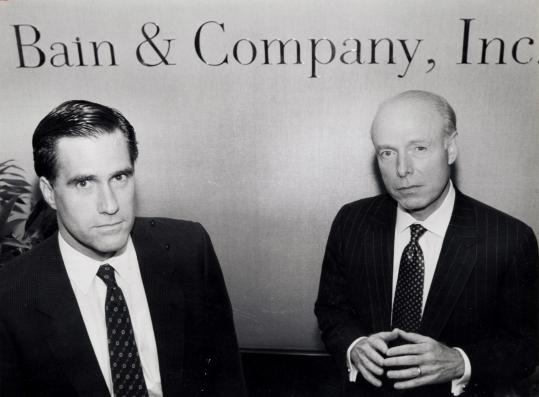
Every cup lines these pockets!
In his presidential bid, Romney had a difficult task. Although clearly only interested in putting government in the service of the super-rich, he had to make some sort of a case that his experience in business would somehow benefit other people, because voters at his income level comprise a fairly small percentage of the electorate. He emphasized the creation of private-sector wealth, counting on voters to equate this with jobs. In some cases -- as with Staples -- his investments actually have created employment. This has never been a priority for Romney, however, as Robert Gavin explains in a 2008 Boston Globe article on Bain's job cuts.

Romney also famously campaigned against undocumented workers while repeatedly relying on them to keep landscaping costs low at his Belmont estate. They were employed through a contractor, of course, giving him both the financial benefit and plausible deniability. The vulnerability of undocumented workers at Dunkin' franchises was great prior to the Bain/Carlyle/Lee purchase, but can only be greater as Dunkin' Brands increases pressure on the franchise owners through nuisances lawsuits that have turned brand enforcement into a profit center. Dilution of the franchise value has also been a concern, as the corporation has pushed sales into the interstitial spaces among an already dense network of franchises.

In early 2010, DD franchisees in Massachusetts formed a political action committee to support "free enterprise" against "big labor," having identified government regulation as the main enemy of small business. Similarly, the Dunkin' Donuts Independent Franchise Owners Association appears to be more concerned about taxes and competitors than about any abuses by Dunkin' Brands. The (DDIFO) provides insight into the priorities of the operators; coffee quality does not seem to be a major concern.

Wednesday, September 23, 2009

More Trouble from Dunkin'

Under Mitt Romney's leadership (through Bain Capital), Dunkin' Donuts is pursuing a strategy that uses its legal department as a profit center. Having squeezed the farmers, the land, and customers, the franchise owners themselves are now the target of DD greed.

Wednesday, December 03, 2014

Gentrifeination


Just as Only a Game is the only sports show I listen to regularly, Marketplace is my sole business program, since most business-oriented journalism embraces too many of the simplifying assumptions of neoliberal economics. Even Marketplace was testing my patience in recent days, ending a recent segment with "Buy Early, Buy Often" uttered without irony.

 But my Marketplace is back this week, redeeming itself with thoughtful and creative journalism about economic geography at a very local scale. And as if to welcome me back into the fold personally, its series on gentrification begins in ... wait for it .. a Latin-themed coffee shop.

For the series York & Fig, Marketplace has actually set up an office in the Highland Park area of Los Angeles, where the intersection of York Boulevard and Figueroa Street ten miles north of its main office and right in the middle of a rapidly changing neighborhood. The purpose is to investigate the process of gentrification, with a focus on exactly what indicates that a neighborhood is beginning a process of rapid economic and social change.

The first indicator: coffee. In this case, Café de Leche is a local establishment that has been gaining a lot of positive attention, and whose very presence is seen as a bellwether of changes that are underway. For those who care more about coffee than economic geography, this story is a great hook -- come for the coffee, and learn just how interesting urban geography can be!

The café that drew me into this series is actually about a mile ENE of the intersection that is the hub of this changing neighborhood. The next time I am in LA (it has been close to thirty years, so I'm overdue), I'll visit so that I can review it for GeoCafes.


Lagniappe

While I was thinking about these stories, my favorite librarian shared another story about a very different kind of change in the economic geography of Los Angeles. The article LA's Mom & Pop Donut Shops Have Harsh Words for Dunkin' Donuts gives hope that the City of the Angels might be able to resist the sweet temptations of Coffee Hell.

DK Donuts owner Mayly Tao says, "Dunkin' is the McDonald's of donuts. I haven't tried their donuts, but I hear they're stale."

Thursday, October 20, 2011

Jockeying for Advantage on Immigration


The subtitle of Globe cartoonist Dan Wasserman's "Out of Line" series is "A notebook of graphic disobedience," a distinction that is well-earned in this doubly transgressive send-up of the discourses surrounding immigration in the current presidential debate.

With Pavlovian precision, much of the political center has moved to the fringes on immigration. During boom years, nobody cares, but scapegoating the poor inches up quite predictably with each downward stumble of the national economy. Political survival in down times requires candidates to pretend that immigrants -- documented and otherwise -- did not contribute to prosperity in previous times.

For a candidate who is also a venture capitalist at the very top of the economy, this is especially challenging. His rhetoric needs to be insistent and fiery enough to overshadow what he has gained from migrants, which has come in several forms. In addition to the generalized benefits we all gain from migrants -- legal and otherwise -- Romney derives several specific benefits as a major player in Dunkin' Donuts coffee. Commodity coffee is often exported at prices very close to -- or even below -- the cost of production. In conventional trading systems, individual farmers are likely to receive far less than the export price, driving migration from coffeelands, first into nearby cities and later into other countries. A majority of Nicaraguan families, for example, now have at least one family member working abroad, and many of these are people who would work in coffee if they could earn enough to survive.

During the most recent candidate's debate, Gov. Rick Perry called out Romney for his previous employment of undocumented workers through a landscaping contractor. His denial was interesting in several ways. First, he said that he personally had not directly hired anybody. This is both specifically true in the case of hiring a landscaping contractor and generally true among the truly powerful, whose hiring practices are often buffered by layers of contracts and subcontracts. This means that not only can Romney deny responsibility for the legal status of his gardener, but he can also deny it for hourly workers at Dunkin' Donuts, who are hired by franchise owners who under enormous pressure from their "investors" at Bain Capital.

Romney's reply to Rick Perry centered on the claim that he "fired" the landscaping company as soon as he found out about its hiring of undocumented workers. In describing the termination of the contract, he admitted mentioning his own status as a political candidate to the contractor. He failed to mention, however, that he did not terminate the relationship the first time he learned of the hiring, but only after the second Boston Globe story on the subject, a full year after the first!

I conclude this post with a comment on the Wasserman cartoon itself, and my use of the word "transgressive," which I usually use to refer to artistic license that is taken at the expense of societal norms that I think deserve to be challenged. In this case, however, the art transgressed against two of my own norms. First, as someone who grew up on the spatial and temporal edges of the Old South, I find so-called "lawn jockeys" a disturbing symbol of white privilege. Second, the word "illegal" is problematic even when used as an adjective, and doubly so when used as a noun to refer to a person. It is not generally applied to those who commit other crimes, so that a murder is illegal, but the murderer is not, so why does it apply to those who cross borders, overstay visas, or violate the terms of visas?

Monday, September 10, 2012

Sortin' for Dunkin'

From my travels to the coffeelands of Nicaragua, I have learned that there is a market for every bean. From planting to pruning to harvest, and through the many stages of drying, milling, and roasting, coffee beans in are sorted.

Several years ago, I was with students on a sorting area at Selva Negra when a student asked what would happen to the rejected beans. "Dunkin' Donuts" was he answer, only half in jest. This came to mind while I was hand-milling pergamino coffee that was from Finca Mil Flores in Nicaragua. Among the many excellent beans, I noticed one inferior bean, enough to ruin a batch -- or to start a perfectly normal batch at DD.

Wednesday, April 13, 2011

Will Convenience Kill Coffee?

When people find out that I am a coffee enthusiast, they are often led to ask one of a few common questions. The most common used to be, "What do you think of Starbucks?" (I few of my blog posts have mentioned the company in various contexts, but I do not have a single answer.) Almost as common is "What do you think of Dunkin' Donuts?" (Here I have both a smattering of blog posts and a standard answer.)

In recent months, these questions have been replaced by "What do you think of the Keurig?" Initially, I tried to be positive, because Keurig is owned by Green Mountain Coffee Roasters, a growing regional roaster that I believe to be committed to ethical sourcing of coffee. I have met GMCR employees in Nicaragua, and one of my best coffee-farmer friends routinely wears a GMCR hat. (It is not just the hat -- I've met GMCR people in his house.) Besides, the Keurig provides flexibility, and gives people the option of fair-trade coffee at their local hairdresser or garage. What could be wrong with that?

Still, I had misgivings about the waste and the cost. An article on the blog of North Carolina-based Muddy Dog Roasting helped me turn the corner. Muddy Dog argues persuasively that the Keurig could be the beginning of the end for great coffee. I hope this is wrong, but we are moving rapidly beyond the slippery slope, as I am now seeing Dunkin' Donuts and even Folger's in materials from Green Mountain. These are not good signs, especially as the convenience of the machine is lulling people into a willingness to pay $20 to $30 a pound for mediocre or even bad coffee.

NOTE: Right after I posted this in April, an online Keurig retailer offered to commercialize my main coffee page. I would not and could not have done it anyway, but I found it amusing that the offer came right after I had finally come down from my Keurig fence-sitting. More recently, the blogger Caffeinated Calm -- who has considerably more coffee experience than I do -- offered a deeper critique of both Keurig and its parent company.

November 2011 update: Back in March the blog Dear Coffee, I Love you has provided an even more detailed critique, entitled Love Keurig? Nope.


Wednesday, October 28, 2015

Something About the Coffee ...

At one point in our lives we were reading a lot of Dave Barry, the Miami-based humorist. (Humorist means a comedian who is only somewhat funny, or funny to older people.) Our favorite essay is "Some of the Pluses of Having a Pet..." in which he describes the exploits of his "auxiliary dog" Zippy. Read the essay now if you want to avoid the spoiler below.

Dot... dot... dot...

While you are gone I'll mention that this post is really about Facebook, not Dave Barry. Specifically, it is about the placement of ads, which show that so far we have little to worry about from whatever algorithms bring us those ads. "We think you'd like a blue bathrobe!" is not very brilliant insight if I have just bought one. Which I have.

You're back? If so, you know that Zippy destroyed a rug despite being admonished not to. Repeatedly. In the tiny dog's tiny brain, all it could remember was "something about the rug." Leading him to rush to the rug with no clear idea what they had been saying about it.

And thus it is with Facebook, coffee and me. The tiny brain of its ad algorithm sees a lot about coffee on my feed, and therefore decides I will want opportunities such as this one:


Yes, indeed: I have the opportunity to buy the "highest rated K-Cups" and I must be interested, because I seem to have a thing about coffee. Heck, I even have a thing about K-Cups, though not exactly as a fan of the technology.

Aside from the ecological concerns, clearly the algorithm has not caught on to my concern for coffee care and the impossibility of getting good quality from this technology. As the ad indicates, the coffee will have been ground a week before it reaches a customer.

I have seen the nitrogen-flush packaging machines that fill the K-Cups, and they are indeed impressive. We used a similar process when I was in the rations business, and we could keep foods shelf-stable for up to three years. But coffee acts as a sponge, and fine grinding makes it stale quite quickly. This does not matter much for mediocre coffee like Dunkin' Donuts, but for "gourmet" coffee it does make a difference.

And any coffee that costs $23 a pound should be a specialty coffee, though I have my doubts about these. The offer above is equivalent to paying $23 for a $10 bottle of champagne, but having it opened and recapped a week ahead of time. Not quite a bargain.

I know these will sell, though, perhaps to people in offices on my own campus, where the coffee "bargains" are even less favorable. Keurigs and vending machines have been placed throughout so-called "green" buildings, even as students have worked with me to propose a much better alternative.

Wednesday, April 18, 2012

Know-Nothing Coffee


This would be humorous were there not so many livelihoods at stake. It is meant to be "just an ad" but it reveals a breath-taking lack of coffee knowledge at Maxwell House. Not everyone need be a coffee snob, but this is a company that revels in the bad treatment of bad coffee. I buy Maxwell House once a year to show students what really bad coffee is like, but perhaps I can just show them this video from now on. (Thanks to one of those students, by the way, for finding this for me.)

This video makes the choice even more difficult: which is the worse coffee company, Maxwell House or Dunkin' Donuts?

Thursday, July 01, 2010

Coffee Good

Thanks to my friend Ed for pointing me to this coffee article on Live Science. I had read some of this before, but the article introduces some research I had not seen, regarding coffee's seeming benefits with respect to cancer and heart disease.

As a couple of readers have suggested in the comments section, most of these benefits would accrue only to the consumption of organic, black coffee. The fat and sugar bombs that are the vehicle for much of the coffee consumed these days would certainly have offsetting risks. And of course, conventional coffee grown with pesticides is not at all healthy for the planet or the farmers, and not much good for consumers, either.

Bottom line: Coffee still good; Dunkin' Donuts still bad.

Wednesday, September 09, 2009

Not Made in the Shade

The blogger and fellow coffee enthusiast who runs Coffee Habitat recently contacted me to see if I knew anything about Dunkin' Donuts environmental claims. Specifically, she had read that DD brews mainly shade-grown coffee, and as an expert on shade-grown, she was highly skeptical. Rightly so, as it turns out! See "No proof of shade coffee" for her exhaustive research, which includes a lot that I did not know about DD, its suppliers, and even its finances and franchisee relations. Hint: the story does not include anything flattering.

See my Coffee Hell page for my admittedly off-the-cuff musings about the company.


The Coffee Habitat article mentions DD's connections to Sara Lee and Procter & Gamble, the latter of which formerly owned Folger's. Sadly, my wife Pam and I played a small part in the growth of Folger's, by participating in a marketing study they it conducted in the 1980s. I also learned that DD is backed in part by Bain Capital, a.k.a. Mitt Romney, nemesis of public education. It is indeed a small world of coffee.

Monday, December 20, 2010

Have Nots and Do Nots

One thing (maybe the only thing) I have in common with Winston Churchill is that when I open a newspaper, the first thing I read is the editorial page. I am actually more interested in the letters to the editor than in the editorials from the staff of the paper. It is a strange habit, since I am often astounded at what I read, and usually not in a good way.

The letters in yesterday's Boston Globe included one such astonishing piece. Fred Bement of Boxborough wrote to defend the wealthy against covetous tax policies. In so doing, he repeats a common fallacy, which is that the rich are rich because they deserve it. He rightly points out that many rich people got rich through hard work; he wrongly attributes economic inequality to a differential work ethic. I recommend the online comments, even though most are anonymous, because several are eloquent in their rebuttal of Mr. Bement's letter.

Of the many fallacies he packs into his short letter, the most offensive is the assumption that anybody can get rich through hard work. If this were the case, then all of the coffee farmers I know would be wealthier than anybody in Mr. Bement's gilded ZIP code. Closer to home, as many readers have pointed out, jobs are scarce and the jobs that are available -- at any level of education -- often do not pay as well as the same jobs did a generation ago.

Some people become wealthy, it is true, through a combination of hard work and clever thinking. Most of them, however, would admit that a certain amount of luck is involved, and part of that luck is being born in a location where the infrastructure exists to pursue wealth. Much of the supporting infrastructure that is required to pursue and attain wealth is provided publicly. Even if one pursues a "private" education, one is likely to hire workers who receive a public education. Workers and capitalists alike get to work on public roads and sidewalks, and depend on publicly-funded police and fire protection, as well as publicly-funded courts to protect property rights. As the disparity between rich and poor grows, quite frankly, the entire country depends on publicly-funded national defense to maintain the disparity. (This is not a comfortable thought, but a small nation that consumes a third of the world's resources relies on more than cleverness and hard work to maintain those material flows.)

If even the hard-working among the wealthy are not self-made, how much truer is it of those who inherit wealth? Messrs. Buffett and Gates have recognized the problems of unearned wealth, as I have recently written. It is interesting that the aspiring wealthy do not understand this as well as the accomplished wealthy.

A final problem with the concept of the "deserving rich" is that so much wealth is gained by those who are more willing than others to impoverish others. The billionaires behind WalMart and Dunkin Donuts are the most obvious examples, but throughout our economy, the ruthless are rewarded. It is bad enough that they earn their money on the backs of the poor; smugness should not be added to their ill-gotten gains!

Friday, August 27, 2010

Target Targeted

This brilliant bit of political theater has been getting a lot of attention among supports of GLBT rights and opponents of corporate financing of political campaigns. Reacting to Target's $150,000 donation to the political campaign a "pro-business" opponent of gay rights, this stunt is part of a small but vocal campaign to boycott Target stores:

Target Ain't People -- MoveOn ad @ Yahoo! Video

Some of my friends have asked why this contribution stirred such a reaction, and others have questioned the effectiveness of this video in particular and of the boycott movement in general. I have a few thoughts to share as a result of these very good questions. (See my Pride page to learn why I am so passionate about GLBT rights.)

First, regarding boycotts in general. These are actions intended to induce a change in corporate or government behavior by refusing to buy their products or products produced within their borders. Government examples have included at least two campaigns against the state of Arizona -- in the 1980s when it was the last state to declare a Martin Luther King Holiday and currently as it imposes a host of dubious immigration-control measures. It is difficult to say how many boycotts I have supported, though I think it is really only one: for years I did not buy anything made by Nestle, as part of a world-wide boycott related to its milk-marketing practices in developing countries. I was surprised to learn just now that the Nestle boycott continues.

I count Nestle because I really did strive to avoid their products, and let the company know why. Several aspects of that experience, however, have made me a reluctant boycotter, at best. I eventually learned that a company such as Nestle is too big for my trade or lack thereof to mean much, I also found that it had too many branches for me to keep track of, so I could not be sure when I was withholding money. More to the point, I learned that a lot of corporations do a lot of pretty terrible stuff, and that by diverting my business from one, I might be funneling toward one that is as bad or worse. I guess this is what eventually drove me toward fair trade and local food and shopping, where I have a chance of making positive purchases, rather than just trying to avoid negative ones.

Still, a few companies have earned my ire so that although I'm not exactly boycotting them, I cannot bring myself to buy from them. These include Coors (helps that their beer tastes awful), Dunkin' Donuts, and WalMart. In the case of the latter two, I like to hope that my writings have some impact, but I know that my funds are hardly missed.

A boycott of Target at this juncture is particularly problematic, because it would be aimed at punishing a single incident already in the past, rather than trying to affect ongoing or future corporate behavior.

My inability to darken the door of a WalMart is part of what makes the Target story so interesting for me. I prefer to shop locally, but WalMart has systematically leveled much of the retail landscape (apparently employing expert, if evil, locational geographers), so for many purchases, I do turn to box stores, and Target has impressed me as the less evil of my options. Its 100% approval rating from the Human Rights Campaign helped make the case, as did its charitable giving and related programs (modest, but far more than WalMart).

Which brings us to the case at hand: Target's contribution to the campaign of Rep. Tom Emmer, an anti-gay candidate for governor of Minnesota. The $150,000 donation caused HRC to drop Target from its Equality Buying Guide. This story answers the question of why the contribution has created a response that some might find disproportionate: because of its previous track record, the Emmer contribution is seen as a  betrayal. Our friends can hurt us in ways that our enemies cannot, after all.

Shortly after the story broke in late July, Target's CEO Gregg Steinhafel apologized for the contribution. His response reads like one of those "I'm sorry you were offended" apologies, but in the full text of the apology he promises both a thorough review and some kind of summit with other business leaders in the fall, so the final outcome of this controversy remains to be seen. Stockholders were outraged by the contribution and are demanding reforms in the company's approach to political giving. Stockholders do not seem to be complaining so much about the particular politics of the donation; rather, they are complaining that Target did not account for the controversy that would ensue.

This is an encouraging sign that stockholders might effectively do what the Supreme Court would not: the court rules that direct contributions from corporations to campaigns are legally unlimited, but for many publicly-traded companies, shareholders may impose very real limitations. Target is trying to tread a middle ground of bipartisan political activity, but it remains the case that Target is not a person. The fundamental issue raised in the video at the top of this post is that humans have both rights and responsibilities, whereas a couple of key court decisions have allowed corporations to have just rights. In the logo for the film The Corporation, notice that the "suit" has both a devil's tail and a halo. The problem is not that corporations are evil, it is that they are amoral, which is not a good characteristic for entities with growing political power to have. As one of my friends pointed out, the current controversy is not about Target having power in the sense of actual control over policy. It has, however, been granted the same right of expression that the founders originally intended only for actual humans with a pulse.

Part of the ire surrounding the contribution comes from Rep. Emmer's association with -- and contributions to -- a more radically anti-gay Christian rock band. Bradlee Dean, the leader of You Can Run But You Cannot Hide, in turn, has suggested that Muslims who execute homosexuals are morally superior to Christians who do not. He later tried to back away from those statements, but clearly Emmer's association with Dean increases the level of concern people have about him. His own stated positions may be run-of-the-mill homophobic, but his close association with Bradlee raises concerns about radical -- even homicidal -- homophobia.

This story broke just as journalist Jeff Sharlet has been exposing the U.S. roots of murderous anti-gay movements in Uganda and elsewhere in Africa. His work has recently been presented on NPR's Fresh Air and published in Harper's and elsewhere. It is tragically ironic that the "war on terror" has conflated Islam with Islamic fundamentalism, even as its most ardent exponents are Christian fundamentalists who have much in common with the most theocratic mullahs, ayatollahs, and Taliban.

Fortunately, leaders have emerged in Uganda, Kenya, and Malawi, where the Advocate has identified four strong organizations worthy of support.

Friday, August 12, 2011

Redeeming Rachael Ray

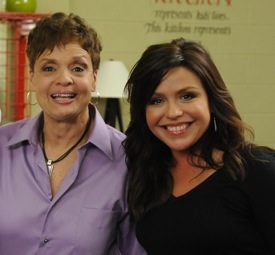
As a foodie without cable TV, I was only vaguely aware of Rachael Ray before she became embroiled in a brief scandal related to Dunkin' Donuts. I describe her inaction on my Coffee Hell page, and I remain convinced that she should have taken a stand against xenophobia in that incident.

Recently, however, I learned of a project she undertook that reflects her involvement not only with food, but also with education and to social justice. When researching the work of food educator Wilma Stephenson for our Nueva Receta blog, I found that she appeared on Rachael Ray's show, and that the appearance went far beyond a simple interview: Stephenson's beloved Room 325 was made over for the show, and a bistro was added so that students could practice serving in an elegant environment. I am not the only one to have had a change of heart -- I first learned of the RR-DD scandal from the Huffington Post, a site that now carries a glowing description of Rachael Ray's projects with Wilma Stephenson (although some user comments reflect a reasonable dose of skepticism).

Sunday, May 16, 2010

Right Down the Street

My interest in the geography of coffee began about a decade ago, and was focused -- as it should be -- on the farmers who grow it, and the economic and environmental conditions in which it is grown. Eventually, though, my interest expanded to include coffee shops, particularly to independent coffee shops that compete in the shadows of the big chain outlets.

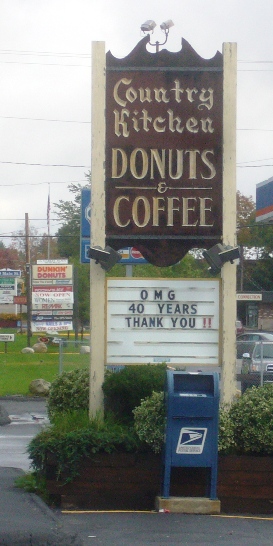
I know exactly where I was when this new interest began to emerge in 2006: Country Kitchen Donuts in Walpole, Massachusetts. I sat in the place for close to an hour as Pam was meeting with students at nearby Norfolk Aggie. The coffee was quite decent -- not specialty or fair trade, but better than most. After a while, I realized that the place had quite a loyal following. A bunch of guys chatting in a nearby booth seemed right at home, and commuters lined up to the door to get coffee, donuts, and little rectangular muffins. Without a drive-through and with a DD right next door, this place was holding its own.

At that moment, I conceived of an assignment that is now standard in my coffee seminar -- students do a bit of field research by visiting independent coffee shops. They report on the experience, the atmosphere, the customers, the coffee, and the proximity to competing national chains. Invariably, any coffee shop that is surviving in Massachusetts is doing so in direct competition with DD, which is very thick on the ground, and perhaps also with Starbucks. Reflecting on what leads to such successes is a really good part of this assignment. In 2010, I created a Yelp account for students in the class, so that the whole world (including me!) can find their reviews easily, and benefit from their insights.

So, now I can have a lot of reasons to love a coffee shop -- a commitment to socially and environmentally friendly coffee sourcing, excellent coffee preparation, decent treatment of customers and employees, decor, and friend service are among them. (Dunkin Donuts -- aka Coffee Hell -- is nearly perfect in missing on ALL counts, by the way.) Of course, I love a shop best that makes a strong effort on all of these fronts. Many of those gems can be found among my own Yelp reviews -- which include only shops that offer at least some fair trade or organic coffee.

All of this was in the back of my mind when my favorite librarian read the following passage to me:

"Omaha  has been able to absorb influences both cosmopolitan and homogenizing wihtout losing its essence. Omaha is still Omaha, perhaps more than ever.... When Starbucks came to Omaha just six years ago [ca. 2003], opening its first store, in typically predatory fashion, a few doors down from a locally owned coffeehouse called the Village Grinder, patronage of the latter increased."

It is from the article "Nebraska" by film director Alexander Payne (of Sideways fame), in a book entitled State by State, which Pam and I are reading as part of the Celebrating the States blog project. Loving a good story about underdog local businesses, I decided to look up the shop. Starbucks did, indeed, open a store on the same side of the same street, less than 500 feet away.

Source: maps.google.com

I could not find a web site for the shop, but it has a loyal following on Facebook. (Someone should review it on Yelp!) From the postings and photos, it seems that creativity and spontaneity are key elements of this cafe's success.

Payne's comments and the experience of the Village Grinder notwithstanding, Starbucks seems to have taken hold in Omaha -- each red dot on the map below represents a site. I'm not sure whether this map has kept up with the 2008 closing of 600 Starbucks shops nationwide, seven of which were in Nebraska, two of these in Omaha.

Source: maps.google.com

I'm happy that the Village Grinder seems to be thriving -- it must be a good shop. I cannot help but hope that in addition to serving its customers well, it is treating the farmers and the land fairly as well. For this reason, I posted a question about the coffee itself on the Village Grinder's Facebook Wall, and it disappeared. I hope that was a Facebook failure, rather than a reluctance to discuss the coffee. I tried a different approach, and will amend this post when I find out more.

Friday, October 29, 2010

Squeamish about Good Coffee?

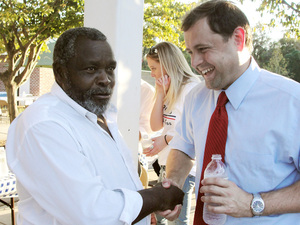
In a report on the final week of campaigning for mid-term elections, Melissa Block indicates that candidate Tom Perriello was understandably squeamish about being seen purchasing a "fancy latte." He was buying it from a locally-owned business that promotes literacy and buys its coffee from roaster that supports -- to a considerable degree -- fair trading practices and sustainable economic development approaches in coffee-growing communities. That "fancy latte" has more potential to support working people than does more ordinary coffee.

If he should be squeamish about anything, it should be the bottled water he is carrying. More to the point, candidates think nothing of buying low-grade, commodity coffee in diners from coast-to-coast, most of which is grown by people living in poverty, sometimes at the very edge of survival. A cup of Dunkin' Donuts coffee -- which promotes poverty and lines the pockets of investor Mitt Romney -- should get more negative attention.

By purchasing a quality latte, Rep. Perriello is supporting the economy of central Virginia and doing more to address illegal migration than all of the grand-standing and wall-building that his opponents can muster.

Friday, September 26, 2014

How Germy is that Keurig?

In just a few years, the Keurig has become a wildly popular way to brew coffee. Relative to other methods, it offers slightly more convenience in exchange for extremely high costs, poor quality, and excessive packaging.

I have been unable to wrap my head around a central paradox of the rise of Keurig, which  has been contemporaneous with my own development as a coffee maven. That paradox is that shortly after it was launched, Keurig was purchased by Green Mountain Coffee Roasters, which was still a mid-sized coffee roaster in our region. I have meet Green Mountain staff on several occasions while exploring socially and environmentally sustainable coffee in Matagalpa, and I know the company does a lot of good. Even though a lot of that good work continues, by growing its business around convenience at all costs, that work is diluted -- as diluted as the coffee itself. For every partnership with a halo brand such as Newman's Own, there is a dalliance with such perditious brands as the dreaded Dunkin Donuts. With Keurig, GMCR has lost its way.

The power of convenience is so strong, however, that Keurig continues to grow. Even if they eschew the overpriced pods from the manufacturer (I had the privilege of watching these get filled at the factory -- truly amazing, but not worth $40-$70 per pound), people find a way to keep using their Keurigs. Even if they know about the waste and the poor quality (even the best coffee cannot stand up to the Keurig treatment), they embrace these machines. (For alternatives, see my Coffee Care page.)

But perhaps the latest news will change that .What if the Keurig is just disgusting? When microbiologist Erin Chamberlik found that she could not get the inside of the Keurig dry, she started a little investigation, and concluded that she had no choice but to Kick the Keurig to the Curb.

I am reminded that in my own building -- a $100,000,000 science facility -- we have no real coffee source, though students, faculty, and staff have proposed a world-class café. So in addition to the unsustainable vending machines in the lobby, the offices of scientists are gradually filling with unsustainable -- and unhealthy -- coffee machines.

Note: To learn more about efforts to change the coffee culture at BSU, visit the Ben Linder Cafe page on Facebook.

Thursday, January 01, 2009

Coffee Hell

This is my own page about a local company that has become one of my least favorite. Dunkin Donuts has given lip service to fair trade and quality coffee, but has really done next to nothing to help farmers. It is a successful brand with incredible loyalty in its home region, though: my small town has eight places to buy the stuff, and it is impossible to go to a Saturday morning gathering of any kind without finding that a lot of people have stopped at DD on the way.

All of this was gradually growing as an annoyance for me until the early summer of 2008, when the company pushed me over the proverbial edge by caving in to a xenophobic attack on one of its marketing campaigns. I tried communicating with the company directly, but the corporate response actually deepened my concern, so I created this page: COFFEE HELL. And as prolific as the brand is, I have managed to avoid it ever since.

Blog Ideas

coffee (25) GEOG381 (24) GEOG388 (23) GEOG470 (18) climate change (18) GEOG130 (16) geography (16) GEOG332 (13) GEOG431 (12) musica (11) GEOG 332 (9) GEOG 381 (9) Mexico (9) Brazil (8) GEOG286 (8) Texas (8) education (8) migration (8) GEOG298 (7) borderlands (7) GEOG199 (6) GEOG331 (6) Massachusetts (6) US-Mexico (6) deBlij04 (6) immigration (6) GEOG 130 (5) GEOG 286 (5) GEOG287 (5) climate justice (5) cultural geography (5) fair trade (5) food (5) geographic education (5) nicaragua (5) water (5) Arizona (4) GEOG 171 (4) GEOG171 (4) GEOG295 (4) Safina (4) africa (4) deBlij05 (4) land protection (4) music (4) politics (4) Bolivia (3) Boston (3) COVID-19 (3) Detroit (3) Ethiopia (3) Managua (3) Obama (3) border (3) cartography (3) drought (3) libraries (3) pesticides (3) suburban sprawl (3) trade (3) unemployment (3) Alaska (2) Amazon (2) Bridgewater (2) Canada (2) Chiapas (2) China (2) Colonialism (2) EPA (2) EarthView (2) Economy (2) Environment (2) GEOG 199 (2) GEOG 287 (2) GEOG 388 (2) Google Maps (2) Government (2) Hawaii (2) India (2) Lexington (2) Maldives (2) Mozambique (2) NOLA (2) NPR (2) National Monuments (2) National Parks (2) New Orleans (2) Religion (2) Rio Grande (2) Taunton River Wild and Scenic (2) Tex-Mex (2) The View from Lazy Point (2) United States (2) Venezuela (2) anthropocene (2) cape verde (2) censorship (2) central america (2) chocolate (2) corn (2) deBlij07 (2) deforestation (2) demographic transition (2) demography (2) education reform (2) employment (2) environmental geography (2) film (2) forest fire (2) global warming (2) islands (2) landscape ecology (2) librarians (2) maps (2) organic (2) peak oil (2) refugees (2) sense of place (2) soccer (2) sustainability (2) television (2) water rights (2) whales (2) #bbc (1) #nicaragua (1) #sosnicaragua (1) #sosnicaragua #nicaragua (1) 100 Years of Solitude (1) ACROSS Lexington (1) Accents (1) Adam at Home (1) Alice (1) Alt.Latina (1) American Hustle (1) April (1) Association of american Geographers (1) Audubon (1) Aunt Hatch's Lane (1) BBC (1) BSU (1) Baby Boomers (1) Banda Aceh (1) Bay Circuit Trial (1) Bechtel (1) Beleza Tropical (1) Belize (1) Beloit College (1) Ben Linder Cafe (1) Bet The Farm (1) Bhopal (1) Biafra (1) Bikeway (1) Bikini (1) Bill Gates (1) Bill Moyers (1) Boeing 777 (1) Brazilian (1) Brazilianization (1) Bridge (1) British Columbia (1) Brockton (1) Bus Fare (1) Bush (1) Cabo Verde (1) California (1) Cambridge (1) Cape Cod Bay (1) Carl Stafina (1) Catholic (1) Ceuta (1) Chalice (1) Chipko (1) Citgo (1) Climate risks (1) Cochabamba (1) Colombia (1) Common Core (1) Commuter (1) Computers (1) Cuba (1) Cups and Summits (1) Dallas (1) David Byrne (1) Deans Beans (1) Delaware Valley (1) Dunkin Donuts (1) Earth Day (1) Earth View (1) Easton (1) El Salvador (1) Elizabeth Warren (1) Ellicott City (1) Emilia Laime (1) English-only (1) Environmental History (1) Euphrates (1) European Union (1) Evo Morales (1) FIFA (1) FYS (1) Fades Out (1) Farms (1) First-Year Seminar (1) Food Trade (1) Frederick Kaufman (1) French press (1) Fresh Pond Mall (1) GEOG 431 (1) GEOG 441 (1) GEOG213 (1) GEOG490 (1) Gabriel García Márquez (1) Garden of Gethsemane (1) Gas wells (1) Gateway Cities (1) General Motors (1) Gini Coefficient (1) Girl in the Cafe (1) Google (1) Gordon Hempton (1) Gravina Island Bridge (1) Great Migration (1) Great Molasses Flood (1) Guy Lombardo (1) Haiti (1) Hawks (1) Heart (1) Higher Education (1) History (1) Holyhok Lewisville (1) Homogenous (1) Honors (1) How Food Stopped Being Food (1) Hugo Chavez (1) IMF (1) Iditarod (1) Imperial Valley (1) Income Inequality (1) Indonesia (1) Iraq (1) Irish (1) Japan (1) Junot Diaz (1) Kenya (1) Ketchikan (1) Key West (1) Kindergarden Students (1) King Corn (1) Kiribati (1) Latin America (1) Limbaugh (1) Literature (1) Living On Earth (1) Louisiana (1) Love Canal (1) Luddite (1) M*A*S*H (1) MCAS (1) MacArthur Genius (1) Maersk (1) Malawi (1) Malaysia (1) Malaysian Air Flight 370 (1) Mali (1) Manu Chao (1) Map (1) Marblehead (1) Mary Robinson Foundation (1) Maryland (1) Massachusetts Bay Colony (1) Math (1) Maxguide (1) May (1) Maya (1) Mayan (1) Mayan Gold (1) Mbala (1) McDonald's (1) Melilla (1) Mexicans (1) Michael Pollan (1) Michelle Obama (1) Micronesia (1) Military (1) Military Dictatorship (1) Minuteman Trail (1) Mongolia (1) Monsanto (1) Montana (1) Morocco (1) Mount Auburn Cemetery (1) Muslim (1) NPS (1) Nantucket (1) National Education Regime (1) Native American (1) Native Americans (1) New Bedford (1) New Hampshire (1) New York City (1) New York Times (1) Nigeria (1) No Child Left Behind Act (1) Norquist (1) North Africa (1) Nuts (1) Oakland (1) Oaxaca (1) Occupeligo (1) Occypy (1) Oklahoma (1) Oklahoma City (1) Oppression (1) PARCC (1) Pakistan (1) Pascal's Wager (1) Peanut (1) Pearson Regime (1) Philadelphia (1) Philippines (1) Pink Unicorns (1) Poland (1) Portuguese (1) Protest (1) Public Education (1) Puebla (1) Puritans (1) Quest University (1) Rachel Carson (1) Reading (1) Republican (1) Retro Report (1) Robert Reich (1) Rock Legend (1) Ronald Reagan (1) Rondonia (1) Rosa Parks (1) SEXCoffee (1) Safety (1) Samoza (1) Sandino (1) Sara Vowell (1) Save the Children (1) Scotch (1) Scotland (1) Seinfeld (1) Senegal (1) Sergio Mendes (1) Severin (1) Sharrod (1) Silent Spring (1) Sinatra (1) Slope (1) Smokey the Bear (1) Somalia (1) Sombra (1) Sonora (1) Sonoran desert (1) Sonoran hot dog (1) South America (1) Spain (1) Stairway to Heaven (1) Storm (1) Suare Inch of Silence (1) Sumatra (1) Swamp (1) Tacloban (1) Tanzania (1) The Amazon (1) The Amazon Trail (1) Tigris (1) Tucson (1) Tufts (1) U.S Federal Reserve (1) U.S Government (1) U.S. economy (1) USDA (1) USLE Formula (1) Uganda (1) Unfamiliar Fishes (1) Union Carbide (1) Vacation (1) Vexillology (1) Vietnam (1) ViralNova (1) WNYC Data News (1) Wall Street (1) Walsenburg (1) Walt Disney (1) Walt and El Grupo (1) Ward's Berry Farm (1) West (1) Whaling (1) Wilson (1) Winter Storm Saturn (1) Wisconsin (1) World Bank (1) Xingu (1) YouTube (1) Zombies (1) agriculture (1) antitrust (1) aspen (1) austerity (1) aviation (1) banned books (1) bark beetle (1) bean (1) beavers (1) bicycle (1) bicycling (1) bike sharing (1) binary (1) biodiversity (1) bioneers (1) books (1) boston globe (1) cacao (1) cafe (1) campaign (1) campus (1) cantonville (1) capitals (1) carbon dioxide (1) carbon offsets (1) carioca (1) cash (1) cashews (1) census (1) chemex (1) chemistry (1) chronology (1) churrasco (1) civil rights (1) coffee grounds (1) coffee hell (1) coffee prices (1) coffee quality (1) college (1) compost (1) computerized test (1) congress (1) conservation commission (1) corporations (1) countries (1) cubicle (1) dams (1) deBlij06 (1) deBlij08 (1) death (1) deficit (1) development (1) dictatorship (1) distracted learning (1) distraction (1) drug war (1) dtm (1) earth (1) economic diversification (1) economic geography (1) election (1) embargo (1) energy (1) enhanced greenhouse effect (1) environmentalist (1) ethnomusicology (1) exremism (1) failed states (1) farming (1) financial crisis (1) football (1) forestry (1) forro (1) fracking (1) free market (1) free trade (1) fuel economy (1) garden (1) genocide (1) geography education (1) geography games (1) geography of chocolate (1) geography of food (1) geologic time (1) geotechnology (1) gerrymandering (1) global pizza (1) globe (1) goodall (1) green chemistry (1) ground water (1) guacamole (1) guatemala (1) habitat (1) high-frutcose (1) home values (1) hospitality (1) hourglass (1) housing (1) hydrology (1) illegal aliens (1) income (1) indigenous (1) interfaith (1) journalism (1) kitchen garden (1) labor (1) language (1) libertarianism (1) library (1) linguistics (1) little rock (1) llorona; musica (1) macc (1) maccweb (1) magic realism (1) maple syrup (1) mapping (1) masa no mas (1) massland (1) medical (1) mental maps (1) mi nina (1) microlots (1) microstates (1) mining (1) mltc (1) monopoly (1) municipal government (1) nautical (1) neoclassical economics (1) new england (1) newseum (1) newspapers (1) noise pollution (1) pandas (1) petroleum (1) piracy (1) pirates (1) poison ivy (1) police (1) political geography (1) pollution (1) provincial government (1) proxy variables (1) public diplomacy (1) quesadilla (1) rabbi (1) racism (1) real food cafe (1) regulations (1) remittances (1) resilience (1) resistance (1) respect (1) rigoberta menchu (1) rios montt (1) romance (1) roya (1) runways (1) russia (1) satellites (1) science (1) sea level (1) selva negra (1) sertao (1) sertão (1) sex (1) sex and coffee (1) simple (1) sin (1) smokey (1) solar (1) solar roasting (1) south africa (1) sovereignty (1) species loss (1) sporcle (1) sports (1) state government (1) taxes (1) tea party (1) teaching (1) textile (1) texting (1) tortilla (1) training (1) transect; Mercator (1) travel (1) triple-deckers (1) tsunami (1) urban geography (1) utopia (1) vermont (1) vice (1) video (1) wall (1) water resources (1) water vapor (1) whiskey (1) whisky (1) widget (1) wifi (1) wild fire (1) wildfire (1) wildlife corridor (1) wto (1)