Wednesday, March 02, 2011

Forum Mundial

Later this month, President Bill Clinton and Governor Arnold Schwarzenegger will travel to Manaus, the first city I ever visited in Brazil and the center of the vast Amazon basin. The hub of the aviamento rubber-tapping system and the focus of accumulated wealth during the rubber boom, Manaus is also the site of the Wedding of the Waters, where the Amazon proper begins.

The confluence of a river carrying twenty percent of the world's flowing fresh water -- and in the center of a forest that contains an abundant share of the planet's remaining biodiversity -- is a fitting location for O Fórum Mundial de Sustentabilidade (World Sustainability Forum). No place on earth has brought differing priorities of the global North and South into sharper relief, as I well remember from a heady summer I spent in Rondonia, a bit upstream, in 1996. For the leading edge of research on the human-environment interface in the lower reaches of the Amazon, see the amazing work of my friends at Piatam.


The meeting in Brazil has added significance, though, as many in the United States are coming to realize not only the ecological but also the growing economic and social importance of the country. In addition to having the occasional opportunity to travel and study in Brazil, I am very fortunate to live in a region that is a major focus of Brazilian migration and commerce.

Tuesday, March 01, 2011

FoodCorps Futures


Because I posted a rather unpleasant video this morning, I decided to compensate by sharing something much more positive this evening. Through a fellow parent at my daughter's school, I just learned of FoodCorps, a project of AmeriCorps. The program is starting to recruit young adults to work on critical issues of sustainability, nutrition, and local development. It is bringing together a number of interesting partners, including King Corn co-creator Curt Ellis. According to Paula Crossfield's introduction to the new program, this approach might succeed where others have not, because of a substantial Congressional commitment to AmeriCorps itself.

I have seen the value of AmeriCorps for some of my finest graduates and for the country as a whole. Seeing this video brings to mind many of the great young people I work with currently, who are perfectly suited to this important and rewarding work.

McSchool


This "intervention program" will be required for 90 minutes each day for all K-5 students at a charter school in Alamo, Texas. The school will have no Spanish, music, art, or science lab, and will have physical education only three days each week.

The video looks like a parody of school privatization. After all, the kids are playing Space Invaders (like its 1979) while the narrator brags about "targeted instruction" and uses the vacuous term "intervention program" four times in under one minute. Sadly, this bragging is real, and the school is a charter school in an extremely low-income district in Texas in which I used to live.

This is the future of school privatization, and some people are overjoyed.

Monday, February 28, 2011

China Comparisons

China recently surpassed Japan as the second-largest economy in the world, according to total GDP. According the the CIA (i.e., the official U.S. government source on such things), the top ten are reshuffled as follows:
  1. United States: $14.7 trillion
  2. China: $9.9 trillion
  3. Japan: $4.3 trillion
  4. India: $4.0 trillion
  5. Germany: $3.0 trillion
  6. Russia: $2.2 trillion
  7. Brazil: $2.2 trillion
  8. United Kingdom: $2.2 trillion
  9. France: $2.2 trillion
  10. Italy: $1.8 trillion
Not only is China near the top, but it is growing at the incredible rate of 10.3 percent, a rate at which it could surpass the United States (2.7 percent) within a decade. Since Brazil -- at 7.5 percent -- is growing faster than Russia and Germany, it will be in sixth place within a year or two, and will soon be closing in on fifth place, while India climbs to third place.

The Economist has created a series of maps illustrating that China's meteoric rise does not reflect widespread wealth. When considered on a per-capita basis, only the special cases of Hong Kong and Macau exceed the wealth of the United States. Many of China's  eastern provinces are comparable to middle-income national economies, but in primarily rural provinces in central and western China, per-capita wealth is comparable to some of the world's poorest countries.

The map below is one of four in this interactive set, which includes similar comparisons for total GDP, population, and exports. These are perhaps more interesting, but I have chosen to excerpt the per-capita GDP map because it is the only one that is cartographically appropriate; it is a choropleth map (from the Greek χώρος (area) + πληθαίν (multiply)), which should only show rates, as this one does, not totals, as some of the others do. Totals should be represented by graduated symbols. (See the Map Forms article at NCGIA for more information about appropriate map forms for different kinds of data.)

Despite the cartographic misstep, I recommend these truly interactive maps for the story they tell of China's rapid and highly uneven development. The Economist has prepared a similar pair of maps for the United States, showing only total GDP and total population, from which I learned that Massachusetts has a GDP close to that of Saudi Arabia.

Click map to enlarge
Visit Economist.com for more

TV Nation?

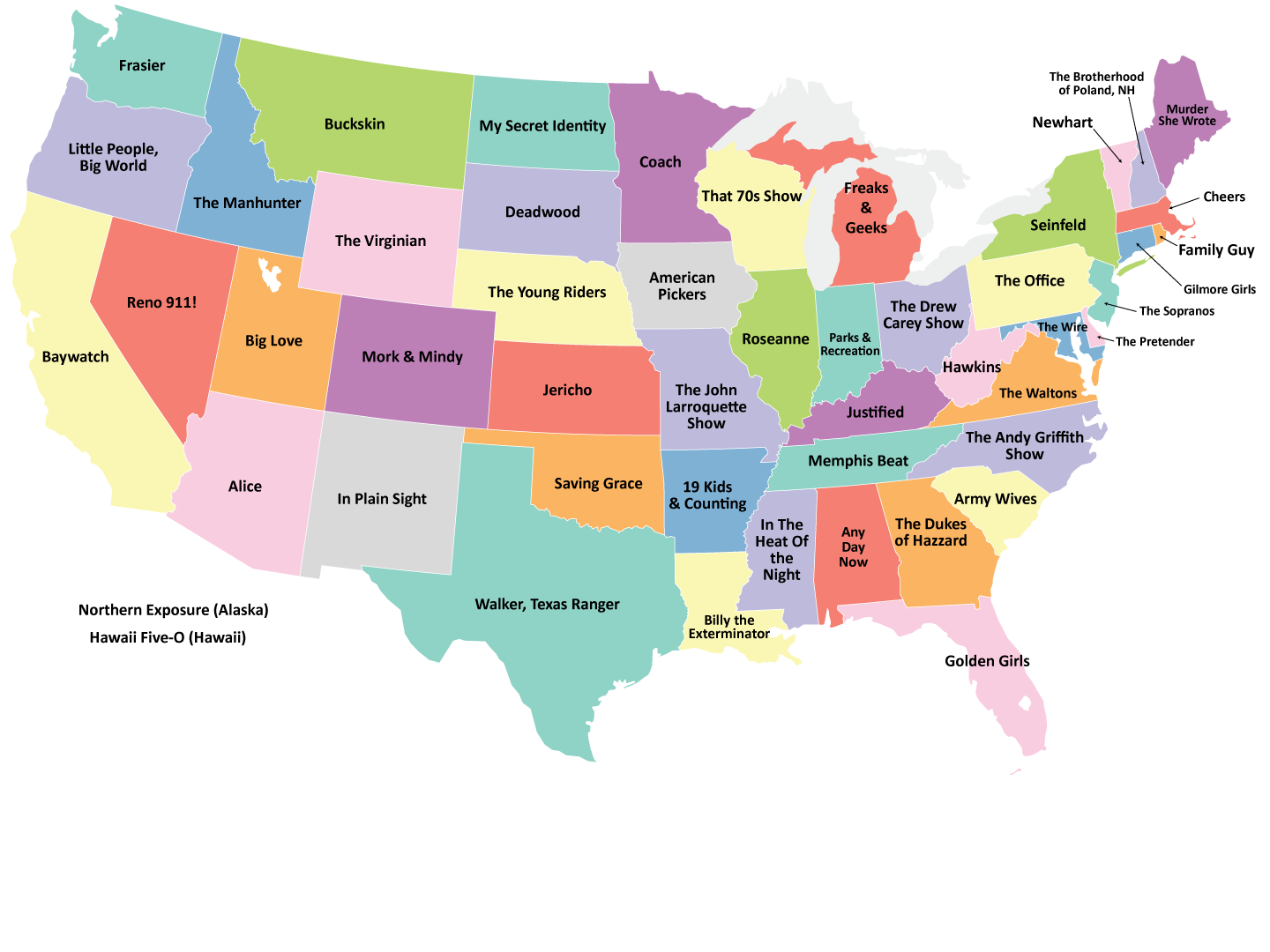
Many thanks to my friend Bryan for keeping me supplied with interesting maps -- such as the "Mean Map" I posted earlier this month. The latest is from a November 2010 blog post by Kent State geographer Andrew Shears, who has decided to represent each state with a television series. As he points out, the available choices are far from even. New York and California are default settings for producers who do not think much about place, or who do such thinking without really thinking, as it were. As Dr. Shears (who is to be congratulated on his new PhD!) details, many states leave him with a single choice, and others with precious few. States fortunate enough to have a handful of choices, of course, bring out the back-seat cartographers who will quibble with the choices, as all such lists tend to do.

Click map to enlarge
Visit Pseudogeographically for original post

I will not fall into that trap (at least not too deeply), though I will make a couple of observations. First, I am pleased that of the several choices available for Maryland, Shears chose a series in which my own father-in-law had a role. I've still not seen The Wire, as we've not gotten a copy of his episode. Another good choice for Maryland that would have filled the same condition is Homicide, in which my father-in-law played two different roles: one living, one dead. Several choices ring very true for me -- Alice for Arizona, Drew Carey for Ohio, and the Andy Griffith Show for North Carolina. That show --  and the Waltons (Virginia) -- really capture my rural, southern childhood.

If I were to quibble with any choice, it would be Coach for Minnesota, until I read what Shears had to say about this choice in his blog. As a geographer who has spent several years each in many different parts of the United States, his answer rings true. As I reported on my Celebrating the States entry for Missouri, cultural touchstones are tied both to time and place. Coach represented Minnesota while Shears was growing up, just as MTM epitomized the state when I was in my formative TV-watching years. Apparently Baby Boomers such as myself dominated the feedback Shears received, as his remix map does put Mary Richards in the Land of 10,000 Lakes.
The television mental map actually builds on an earlier post, in which Shears built upon a map of movies by state that had appeared on The Huffington Post. Shears seems to have put more thought and research into his choices than had the earlier cartographer, for example taking Fargo out of Minnesota. In addition to the choices he mapped, he included several interesting alternatives for most states. Readers of Environmental Geography will recall that state-by-state movie choices were integral to the Celebrating the States blog that I co-authored with Pamela Hayes-Bohanan. The main page of that blog includes the films Pam chose for us to watch as part of that project, and the individual postings include her reviews and comments. Although we liked some of them very much, it is by no means a list of favorites!

Click map to enlarge
Visit Pseudogeographically for original post


Thursday, February 24, 2011

Coffee Shop Jr.


Thanks, as always, to my favorite librarian for sharing some interesting news about coffee. In this case, it is a coffee shop organized by a creative middle-school teacher in Edison, New Jersey. Thomas Macchiaverna started the weekly cafe as a way of helping students with autism and learning disabilities to learn a variety of life skills, from social interaction to math. It has been popular with students and teachers alike, and has allowed the students to fund some valuable activities that had fallen victim to cost cutting.

Tuesday, February 22, 2011

Ten Trillion Beans

Annual coffee consumption in the United States is close to ten trillion beans per year (1.3 million metric tons with about 3,500 beans per pound) -- more than any other country. Brazil is a close second in total consumption, but neither country comes close to the top in per-capita consumption: the average person living in the Nordic countries consumes coffee at 2-3 times the U.S. or Brazilian rate!

Based on a World Resources Institute report, the interactive map of coffee consumption is accompanied by a detailed chart. The details allow for any number of interesting comparisons. (The map below is a static screen capture.) At indexmundi, I found a ranked list of producing countries. Comparison between the two is complicated by the difference in units used (tonnes versus bags), but may be nonetheless intriguing.

Which Came First?

Which came first, the coffee shop or the sweets to go with it? The tradition of exquisite chocolate treats goes centuries in Vienna, but the confections were developed after the first coffee shops opened there, at least according to a recent article on World Stamp News.

The article mentions that a confectioner was assigned to the imperial court as early as the mid-16th century. According to Mark Pendergrast's Uncommon Grounds, however, the first coffee shops opened in the 17th Century;  the discrepancy might just be an error with the nomenclature (17th Century = 1600s).

In any case, coffee and confections have a long history together, and the Austrian post office is celebrating the original Schweden-Bomben (which sounds a lot like bon-bon to me) with a new stamp. My thanks, as always, to Henry Lukas of the Spellman Museum for this scrumptious tidbit of coffee history!

Monday, February 14, 2011

Japan Java

My university has had strong connections to Japan for over a century, and the connections have afforded me some interesting -- if inconsistent -- glimpses into the geography of coffee in Japan. From a faculty colleague I have had samples of coffee packaged for convenient brewing in a form I have not seen elsewhere. Last year, a student who went for a semester-long exchange sent a digital S.O.S. because he could not find whole-bean coffee, a grinder, or a French press, all key components of the kind of coffee care I had taught him. More recently, two students from Japan participated in my Nicaragua study tour, and had not had much prior experience with high-end coffee.

Others have told me, though, that coffee is very important in Japan, and not limited to the high-tech varieties of canned and instant coffees that dominate the market. Courtesy of my favorite librarian comes a story from yesterday's New York Times, extolling the virtues of slow coffee in Japan. Apparently, while I was not watching, Japan has become a source for all kinds of low-tech coffee preparation equipment of exactly the type my student (under my tutelage) was seeking. It turns out that even Williams-Sonoma has eclipsed me in this area! Time for some new research on my part, though I have not even broken in my Chemex yet!

Thursday, February 10, 2011

HarassMap

Yesterday my geography students and I had the privilege of a guest lecture by a Fulbright Scholar-in-Residence who recently arrived on our campus from Egypt. Dr. Hassan described the Fulbright SIR and other Fulbright programs and shared insights that helped us to place the current political events in a broader context. During her presentation, she mentioned that Egyptian women are starting to make some advances against repressive attitudes and practices. This reminded me of a very interesting and encouraging story that I described a couple of months ago on one of my other blogs.

HarassMap combines telecommunication and geotechnologies in order to learn more about how, when, and where women in Egypt experience sexual harassment of various kinds. The resulting maps can help individual women in their daily travels and can be used to help set priorities for social-service providers and law-enforcement officials.


Blog Ideas

coffee (25) GEOG381 (24) GEOG388 (23) GEOG470 (18) climate change (18) GEOG130 (16) geography (16) GEOG332 (13) GEOG431 (12) musica (11) GEOG 332 (9) GEOG 381 (9) Mexico (9) Brazil (8) GEOG286 (8) Texas (8) education (8) migration (8) GEOG298 (7) borderlands (7) GEOG199 (6) GEOG331 (6) Massachusetts (6) US-Mexico (6) deBlij04 (6) immigration (6) GEOG 130 (5) GEOG 286 (5) GEOG287 (5) climate justice (5) cultural geography (5) fair trade (5) food (5) geographic education (5) nicaragua (5) water (5) Arizona (4) GEOG 171 (4) GEOG171 (4) GEOG295 (4) Safina (4) africa (4) deBlij05 (4) land protection (4) music (4) politics (4) Bolivia (3) Boston (3) COVID-19 (3) Detroit (3) Ethiopia (3) Managua (3) Obama (3) border (3) cartography (3) drought (3) libraries (3) pesticides (3) suburban sprawl (3) trade (3) unemployment (3) Alaska (2) Amazon (2) Bridgewater (2) Canada (2) Chiapas (2) China (2) Colonialism (2) EPA (2) EarthView (2) Economy (2) Environment (2) GEOG 199 (2) GEOG 287 (2) GEOG 388 (2) Google Maps (2) Government (2) Hawaii (2) India (2) Lexington (2) Maldives (2) Mozambique (2) NOLA (2) NPR (2) National Monuments (2) National Parks (2) New Orleans (2) Religion (2) Rio Grande (2) Taunton River Wild and Scenic (2) Tex-Mex (2) The View from Lazy Point (2) United States (2) Venezuela (2) anthropocene (2) cape verde (2) censorship (2) central america (2) chocolate (2) corn (2) deBlij07 (2) deforestation (2) demographic transition (2) demography (2) education reform (2) employment (2) environmental geography (2) film (2) forest fire (2) global warming (2) islands (2) landscape ecology (2) librarians (2) maps (2) organic (2) peak oil (2) refugees (2) sense of place (2) soccer (2) sustainability (2) television (2) water rights (2) whales (2) #bbc (1) #nicaragua (1) #sosnicaragua (1) #sosnicaragua #nicaragua (1) 100 Years of Solitude (1) ACROSS Lexington (1) Accents (1) Adam at Home (1) Alice (1) Alt.Latina (1) American Hustle (1) April (1) Association of american Geographers (1) Audubon (1) Aunt Hatch's Lane (1) BBC (1) BSU (1) Baby Boomers (1) Banda Aceh (1) Bay Circuit Trial (1) Bechtel (1) Beleza Tropical (1) Belize (1) Beloit College (1) Ben Linder Cafe (1) Bet The Farm (1) Bhopal (1) Biafra (1) Bikeway (1) Bikini (1) Bill Gates (1) Bill Moyers (1) Boeing 777 (1) Brazilian (1) Brazilianization (1) Bridge (1) British Columbia (1) Brockton (1) Bus Fare (1) Bush (1) Cabo Verde (1) California (1) Cambridge (1) Cape Cod Bay (1) Carl Stafina (1) Catholic (1) Ceuta (1) Chalice (1) Chipko (1) Citgo (1) Climate risks (1) Cochabamba (1) Colombia (1) Common Core (1) Commuter (1) Computers (1) Cuba (1) Cups and Summits (1) Dallas (1) David Byrne (1) Deans Beans (1) Delaware Valley (1) Dunkin Donuts (1) Earth Day (1) Earth View (1) Easton (1) El Salvador (1) Elizabeth Warren (1) Ellicott City (1) Emilia Laime (1) English-only (1) Environmental History (1) Euphrates (1) European Union (1) Evo Morales (1) FIFA (1) FYS (1) Fades Out (1) Farms (1) First-Year Seminar (1) Food Trade (1) Frederick Kaufman (1) French press (1) Fresh Pond Mall (1) GEOG 431 (1) GEOG 441 (1) GEOG213 (1) GEOG490 (1) Gabriel García Márquez (1) Garden of Gethsemane (1) Gas wells (1) Gateway Cities (1) General Motors (1) Gini Coefficient (1) Girl in the Cafe (1) Google (1) Gordon Hempton (1) Gravina Island Bridge (1) Great Migration (1) Great Molasses Flood (1) Guy Lombardo (1) Haiti (1) Hawks (1) Heart (1) Higher Education (1) History (1) Holyhok Lewisville (1) Homogenous (1) Honors (1) How Food Stopped Being Food (1) Hugo Chavez (1) IMF (1) Iditarod (1) Imperial Valley (1) Income Inequality (1) Indonesia (1) Iraq (1) Irish (1) Japan (1) Junot Diaz (1) Kenya (1) Ketchikan (1) Key West (1) Kindergarden Students (1) King Corn (1) Kiribati (1) Latin America (1) Limbaugh (1) Literature (1) Living On Earth (1) Louisiana (1) Love Canal (1) Luddite (1) M*A*S*H (1) MCAS (1) MacArthur Genius (1) Maersk (1) Malawi (1) Malaysia (1) Malaysian Air Flight 370 (1) Mali (1) Manu Chao (1) Map (1) Marblehead (1) Mary Robinson Foundation (1) Maryland (1) Massachusetts Bay Colony (1) Math (1) Maxguide (1) May (1) Maya (1) Mayan (1) Mayan Gold (1) Mbala (1) McDonald's (1) Melilla (1) Mexicans (1) Michael Pollan (1) Michelle Obama (1) Micronesia (1) Military (1) Military Dictatorship (1) Minuteman Trail (1) Mongolia (1) Monsanto (1) Montana (1) Morocco (1) Mount Auburn Cemetery (1) Muslim (1) NPS (1) Nantucket (1) National Education Regime (1) Native American (1) Native Americans (1) New Bedford (1) New Hampshire (1) New York City (1) New York Times (1) Nigeria (1) No Child Left Behind Act (1) Norquist (1) North Africa (1) Nuts (1) Oakland (1) Oaxaca (1) Occupeligo (1) Occypy (1) Oklahoma (1) Oklahoma City (1) Oppression (1) PARCC (1) Pakistan (1) Pascal's Wager (1) Peanut (1) Pearson Regime (1) Philadelphia (1) Philippines (1) Pink Unicorns (1) Poland (1) Portuguese (1) Protest (1) Public Education (1) Puebla (1) Puritans (1) Quest University (1) Rachel Carson (1) Reading (1) Republican (1) Retro Report (1) Robert Reich (1) Rock Legend (1) Ronald Reagan (1) Rondonia (1) Rosa Parks (1) SEXCoffee (1) Safety (1) Samoza (1) Sandino (1) Sara Vowell (1) Save the Children (1) Scotch (1) Scotland (1) Seinfeld (1) Senegal (1) Sergio Mendes (1) Severin (1) Sharrod (1) Silent Spring (1) Sinatra (1) Slope (1) Smokey the Bear (1) Somalia (1) Sombra (1) Sonora (1) Sonoran desert (1) Sonoran hot dog (1) South America (1) Spain (1) Stairway to Heaven (1) Storm (1) Suare Inch of Silence (1) Sumatra (1) Swamp (1) Tacloban (1) Tanzania (1) The Amazon (1) The Amazon Trail (1) Tigris (1) Tucson (1) Tufts (1) U.S Federal Reserve (1) U.S Government (1) U.S. economy (1) USDA (1) USLE Formula (1) Uganda (1) Unfamiliar Fishes (1) Union Carbide (1) Vacation (1) Vexillology (1) Vietnam (1) ViralNova (1) WNYC Data News (1) Wall Street (1) Walsenburg (1) Walt Disney (1) Walt and El Grupo (1) Ward's Berry Farm (1) West (1) Whaling (1) Wilson (1) Winter Storm Saturn (1) Wisconsin (1) World Bank (1) Xingu (1) YouTube (1) Zombies (1) agriculture (1) antitrust (1) aspen (1) austerity (1) aviation (1) banned books (1) bark beetle (1) bean (1) beavers (1) bicycle (1) bicycling (1) bike sharing (1) binary (1) biodiversity (1) bioneers (1) books (1) boston globe (1) cacao (1) cafe (1) campaign (1) campus (1) cantonville (1) capitals (1) carbon dioxide (1) carbon offsets (1) carioca (1) cash (1) cashews (1) census (1) chemex (1) chemistry (1) chronology (1) churrasco (1) civil rights (1) coffee grounds (1) coffee hell (1) coffee prices (1) coffee quality (1) college (1) compost (1) computerized test (1) congress (1) conservation commission (1) corporations (1) countries (1) cubicle (1) dams (1) deBlij06 (1) deBlij08 (1) death (1) deficit (1) development (1) dictatorship (1) distracted learning (1) distraction (1) drug war (1) dtm (1) earth (1) economic diversification (1) economic geography (1) election (1) embargo (1) energy (1) enhanced greenhouse effect (1) environmentalist (1) ethnomusicology (1) exremism (1) failed states (1) farming (1) financial crisis (1) football (1) forestry (1) forro (1) fracking (1) free market (1) free trade (1) fuel economy (1) garden (1) genocide (1) geography education (1) geography games (1) geography of chocolate (1) geography of food (1) geologic time (1) geotechnology (1) gerrymandering (1) global pizza (1) globe (1) goodall (1) green chemistry (1) ground water (1) guacamole (1) guatemala (1) habitat (1) high-frutcose (1) home values (1) hospitality (1) hourglass (1) housing (1) hydrology (1) illegal aliens (1) income (1) indigenous (1) interfaith (1) journalism (1) kitchen garden (1) labor (1) language (1) libertarianism (1) library (1) linguistics (1) little rock (1) llorona; musica (1) macc (1) maccweb (1) magic realism (1) maple syrup (1) mapping (1) masa no mas (1) massland (1) medical (1) mental maps (1) mi nina (1) microlots (1) microstates (1) mining (1) mltc (1) monopoly (1) municipal government (1) nautical (1) neoclassical economics (1) new england (1) newseum (1) newspapers (1) noise pollution (1) pandas (1) petroleum (1) piracy (1) pirates (1) poison ivy (1) police (1) political geography (1) pollution (1) provincial government (1) proxy variables (1) public diplomacy (1) quesadilla (1) rabbi (1) racism (1) real food cafe (1) regulations (1) remittances (1) resilience (1) resistance (1) respect (1) rigoberta menchu (1) rios montt (1) romance (1) roya (1) runways (1) russia (1) satellites (1) science (1) sea level (1) selva negra (1) sertao (1) sertão (1) sex (1) sex and coffee (1) simple (1) sin (1) smokey (1) solar (1) solar roasting (1) south africa (1) sovereignty (1) species loss (1) sporcle (1) sports (1) state government (1) taxes (1) tea party (1) teaching (1) textile (1) texting (1) tortilla (1) training (1) transect; Mercator (1) travel (1) triple-deckers (1) tsunami (1) urban geography (1) utopia (1) vermont (1) vice (1) video (1) wall (1) water resources (1) water vapor (1) whiskey (1) whisky (1) widget (1) wifi (1) wild fire (1) wildfire (1) wildlife corridor (1) wto (1)