Saturday, November 19, 2022

Fashionable Reckoning

Just as the first book I purchased on Amazon the online store was about Amazon the forest, the most recent video I purchased on the site is about Amazon the river. Specifically, it is the second episode of the first season of Rivers of Life, recommended by a fellow geographer and available on PBS and Amazon Prime.

But this post is not about the Amazon -- it is about the Nile, because my favorite librarian and I decided to watch the series in order, and it begins with what is commonly thought of as the longest river, followed by the other top contenders: the Amazon and the Mississippi. It so happens that we watched the Nile episode on the same day that our EarthView team had been showing our giant floor map of Africa to some delightful second graders. I had been spending quite a bit of the morning looking at the Nile and its tributaries -- especially when the last group decided that they would ALL use their feet to measure the river!

This geographer on our Africa map, sans second graders.

While looking at the big print map, I remember looking at various headwaters areas, and noticed for the first time that one of the tributaries near Lake Albert is called the Albert Nile. I learned a lot of geographic details from the PBS program that I wish I had known to share with the kids, and that I hope I remember next time! Two of these are that the Nile stretches from the equator to more than 30°N and that Lake Victoria is the world's largest tropical lake. The program and I both point out that the Nile -- like virtually all rivers -- has more than one source. 


I recommend watching the show as I did -- with a laptop handy, open to Google Maps. I will be doing this for all of the remaining episodes. Among the most interesting things I learned this way is that some of the river's major tributaries pass through areas that are either so narrow (rocky gorges) or so broad (marshy wetlands) that they really do not appear as rivers on satellite imagery. 

All of this was in mind -- especially some questions I had about Lake Albert and the Albert Nile -- when I heard a story about a project of post-colonial reckoning at a London museum. More specifically, the Victoria and Albert Museum -- named for two leaders in the colonial subjugation of the continent -- has launched an exhibit that highlights post-colonial African fashions. As the museum web site describes the exhibit, "Africa Fashion explores the vitality and global impact of a fashion scene as dynamic and varied as the continent itself."

At right, from the exhibit: 

Alchemy collection, Thebe Magugu, Autumn/Winter 2021, Johannesburg, South Africa. Photography: Tatenda Chidora , Styling + Set: Chloe Andrea Welgemoed, Model: Sio

On the western side of the continent, by the way, I told a couple of stories about the brilliant and fabulous singer Angélique Kidjo. I showed them her home country of Benin and described her anthem Afrika (which I heard her perform in Providence in early 2020) and the ballad Iemanja, which was my introduction to her beautiful and multilingual body of work. 

Lagniappe

African leaders on our Africa map: the Bridgewater State University 2022 class of the Mandela Washington Fellowship program.

Context: Following the death of Nelson Mandela, the Young African Leaders (YALI) Fellowship program was renamed in his honor. Each year, 40 colleges and universities around the United States host 25 Fellows each for a six-week program of professional development, followed by a two-week program with all 1,000 Fellows in Washington, DC. BSU has hosted Fellows for each of the past several years, and they have always had a visit with our EarthView program -- going inside the globe and exploring the National Geographic floor map. In this 2022 visit, one of the participants suggested sitting around the edges of the continent rather than each standing on their own country -- a much better visual! 

Monday, November 14, 2022

Crossing the Bay


I took this photo yesterday (November 13, 2022) -- at the beginning of my second walk across the southern span of the twin-span Chesapeake Bay Bridge. The first walk had been with my favorite librarian and eventual spouse, so long ago that we did not even know she was going to be a librarian yet. She was with me this time as well, along with our sister-in-law, who now lives at the far end of this bridge. This year my brother shuttled us to the shuttle, but we will all four do this together some time! 

The bridges were built in the 1960s where a ferry had previously operated. The first span has two lanes and was augmented with the three-lane span some years later, but long before I moved to the area in 1980. Neither span has even the hint of a sidewalk or bike lane, so the occasional opening for a walk is a real treat.

When we walked in 1986, it was not yet a regular event. It is now known at the Chesapeake Bay Bridge Run/Walk, a 10k event that is popular among those who travel to such things. 


Wh

NOTE: If this is the last paragraph you see in this post, please come back later. I don't know how many geographers were among the 16,000 people in this crowd, but there was one at least, and he has some geographic observations (and more maps) to share!

Wednesday, November 09, 2022

Towering Emergent

A friend who is both a geographer and a librarian (great combination!) recently shared the story of a very tall tree. Indeed, this beautiful 290-foot angelim vermelho is the tallest tree ever measured in the Amazon rain forest. 

Image: Imazon/Idelflor/AFP

An October article in Nature tells the story of this tree, which emerges so high above the surrounding canopy that the individual tree was identified by remote sensing. Its distance from roads and rivers made it very difficult to reach and this indeed is what has allowed it to grow to this size. Even knowing exactly where it was, researchers spent a lot of time and effort to reach it. 

And to protect it, the location is described only vaguely in the article; they indicate only that it is somewhere in the reserve shown below, well to the west of Belem. Wood poachers sometimes destroy large tracts of forest on their way to harvesting a single specimen like this.

The article does not use the term "emergent" but that is what such towering trees are called. They require an enormous base of buttresses for support, because roots reach only a few inches into the surprisingly poor rainforest soils.

The Environmental Geographer showing off the 
buttresses of a much smaller tree in a different
part of the Amazon in 2003.

The article mentions not only the hardships of the journey to the single tree in Amapá, but also a large number of people involved in the work. I remember a presentation by a scientist who mounted a similar expedition to find rare lemurs in Madagascar. She and a photographer and a guide were going, but they needed people to cook food, carry the cameras, and carry the tents. And then those people needed more tents, food, and the like. In this way an expedition of 2-3 people quickly becomes almost two dozen.


Sunday, October 30, 2022

Paving Paradise

During my first or second visit to Brazil -- it would have been 1996 or 2000 -- I remember starting a little debate among a small group of students and faculty in Porto Velho by asking a simple (it seemed) question: "Can a person drive from here to Manaus?" which is about 600 miles to the northeast. 

Half of the people present said yes, because you could take BR-319. The other said it was impossible, because that highway exists "only on the map." Both answers were correct in their own way. Two decades later, Google Maps is not ambivalent at all: get started before breakfast and you could be there by bedtime.

Just take the highway: Google Maps

The reason for the debate, of course, is that roads paved in the Amazon do not remain paved for long. Often carved into an undulating terrain with almost no surveying ahead of construction, steep slopes, poorly structured clayey soils and extremely heavy rainfall make pavement little better than gauze over time.

This all came to mind today, as I listened to a report on the paving of this very road by John Otis on NPR. The condition of this road is of international interest as the presidency of Brazil is being decided in a run-off election today. As Otis suggests in his reporting, while the previous incumbent -- the once-and-future Luiz Inácio "Lula" da Silva -- has equivocated on the question, while the current incumbent -- Jair Bolsonaro -- is firmly committed to the repaving of BR-319. 

Where there are roads, there are cattle. Deforestation is directly proportional to road construction.
The web version of the reporting by John Otis includes several stunning photos by Bruno Kelly.

As with other aspects of national policy regarding the Amazon rain forest, the choice is between ineffective protection and very effective exploitation. Within an hour of my posting this story, we expect to which direction the voters of Brazil are taking. And within an hour or two of that, we will know whether the voters will be heeded, as Bolsonaro is hinting that he might ignore the results, as his friend to the north attempted on January 6, 2021.

Update: On November 5, NPR journalist Carrie Kahn detailed the outcome of the election I had been awaiting when writing the above. It took a few days, but Lula won and the incumbent eventually stopped contesting the win. Kahn's reporting describes that win and the importance of the Amazon among Lula's challenges. UPDATE: On November 16, Kahn reported on Lula's stunning appearance at the climate conference in Egypt, which he attended instead of the sitting president.

The last academic conference I attended before the Covid lockdown was in Porto Velho, where I was invited to speak on the acceleration of deforestation there. The conferees were interested in hearing my insider/outsider views. My talk was called Fogo, Política, Bife, y Soja -- Fire, Politics, Beef, and Soy -- because they are all connected.

Lagniappes

The story mentions Dr. Philip Fearnside, the first person I met in Brazil and still one of the forest's most ardent academic advocates.

About a week after posting this story, a geographer/librarian friend shared another story from the Amazon -- this an encouraging story of discovery in an area far from any roads, in the easternmost part of the rainforest. I introduced the story in Towering Emergent.

And finally -- I am going to make that trip between Manaus and Porto Velho in 2023, but I will not see the BR-219. I will be on a boat like this, as I originally intended to do in 1996. 

The photo is by the amazing Ocampo Fernandes, posted in the online group Rondônia, Minha Querida Rondônia.


Wednesday, October 19, 2022

Nowhere-ing a Bridge

Most of the Amazon Basin is flat, very flat. How flat? Flat enough that the Rio Solimões and Rio Negro flow languidly beside each other for about 30 miles past their confluence, in the famous Wedding of the Waters near Manaus.

The slope of Amazonian rivers is remarkably flat even hundreds of miles upstream, closer to headwaters areas, as I was reminded when trying to understand this pair of photographs, which I noticed this morning on the Rondônia, Minha Querida Rondônia page on Facebook. 


Group administrator Dacosta Dacosta shared these, with the caption "Ponte EFMM de Mutum Paraná, em duas épocas" (Madeira-Mamoré Railroad bridge at Mutum Paranà, in two different periods).

My first instinct was to look for the bridge on Google maps, based on the place name he used. There is an interesting difference between the map version and the satellite version of the map right now; the map has not caught up with this inundation, even though it seems to be more or less permanent.


Both images, Google Maps as accessed October 19, 2022

The main indication that this is a permanent flood -- indeed, an anticipated flood -- is that a causeway and  bridge were built for the BR-364 highway, where nothing more than a culvert is present on the map version.

 I assumed that this related to hydroelectric projects that were completed about a decade ago -- none were present during my first three visits to the area, but I did see the Santo Antâo dam when I returned in 2019. My master's thesis involved finding dams of various sizes on aerial photographs and satellite images, so I assumed searching the area of the lake that now contains Rio Cutia would be simple. I looked over this area, to no avail:

Back I went to Google. This time I searched for the Mutum Paraná and the word "usina" for hydroelectric plant. I remember the word from visiting and researching Usina Samuel on the Rio Candeias years ago. This led to an article about Usina Hidrelétrica de Jirau, which fortunately includes geographic coordinates --  9°15′51.8″ S, 64°38′30.8″ O. Realizing that O is for Oeste, I searched for this lat/long, changing the last character to W, and found the Jirau hydroelectric. 

Usina Jirau, Google Maps accessed on
October 19, 2022

Zooming out, I could see that this is nowhere near the inundation that first got my attention. In fact, it is about 60 kilometers (35 miles) downstream -- with many miles in between where the Madeira (the Amazon's longest tributary) seems to be within its normal banks.

The engineers who built the dam, however, know exactly how flat this land is, and they used Geographic Information Systems to figure out where the floods would be and what steps they would need to take in order to protect the BR364 highway as it passes over what was previously a trivial tributary, many miles from their main project.

Lagniappe

During my first visit to Rondônia (Brazil's 26th state) in 1996, I saw the first internet server while it was still in a shipping box. For years after, my (now outdated) Rondônia Web page was the only online English-language resource about the place. Now it is a place full of very connected people of all ages, and this particular Facebook group has almost as many members as the entire state did in 1960. This page is similar to many groups pages I find in U.S. communities, brimming with nostalgia.


Monday, October 10, 2022

The "Crying Indian" Ad

 Anybody who was watching U.S. television in 1970 and the following few years will remember the poignancy of this video, which was called Keep America Beautiful but was better known as the Crying Indian. It was released around the time of the first Earth Day. 

I do remember learning much later that the actor was not Native American: he was Italian-American Iron Eyes Cody (1904-1999). Still, I thought, the video was well-intended, and it did cause people -- at least some people -- to think about our place in the environment. 

It was not until I started looking for the video for this year's Indigenous Peoples Day that I learned the insidious background of the story. Writing for the Chicago Tribune in 2017, journalist Finis Dunaway argues that the ad fooled the environmental movement by shifting attention -- and thereby responsibility for pollution away from manufacturers and toward individuals. It was, Dunaway argues, part of a greenwashing campaign that ushered in an era of disposable packaging. Half a century later, we still struggle to develop sustainable waste-management strategies that actually existed prior to this ad.   

Writing for The Columbian (Vancouver, WA) in April of this year, journalist Greg Jayne offers a different perspective, insisting that the ad had a positive influence on a generation of young people.

Monday, October 03, 2022

Coffee & Volcanoes: Travel Course in Cabo Verde

UPDATE: This May 2023 program was postponed to January 2024 because of airline scheduling problems. Please contact Study Abroad immediately if you would like to join us. Students from any university -- and even non-students -- may apply.

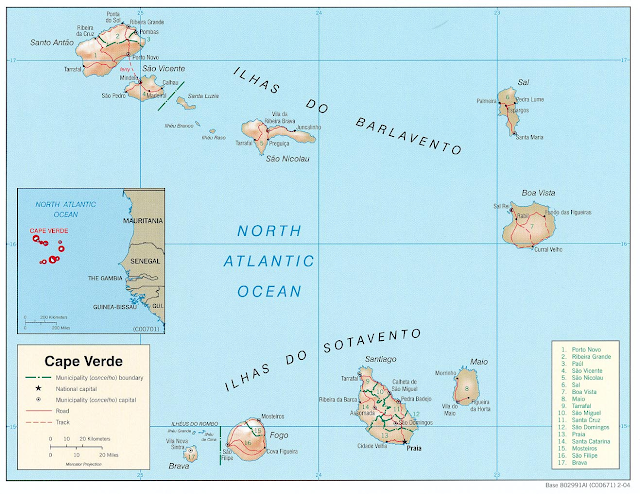
When I led my first Cabo Verde travel course in 2006, we spent all of our time on Santiago (which was fantastic) but we were not able to get to Fogo (which would have made a great trip even better). All these years later, we are finally doing it! Both islands will be part of my next travel course.

We are taking applications now for Geography of Coffee and Volcanoes in Cabo Verde. We will start on Santiago with an introduction to the country and its important role over five centuries connecting (in ways both terrible and wonderful) Africa, Europe, and the Americas. We will then fly to Fogo to learn about one of the world's smallest and most unusual coffee industries -- where the coffee is grown inside an active volcano. (Active means recently erupting, not currently erupting.)

This course is available for undergraduate or graduate credit (contact me directly if seeking the latter) and is open to BSU students as well as alumni, students at other universities, and other adults who want to have this learning experience. For BSU students, the class can count toward a major or minor in geography and toward minors in Cape Verdean studies, sustainability, or African studies. 

I use "we" above because this course results from deep collaboration with the Office of Study Abroad and the Pedro Pires Institute for Cape Verdean Studies. We will also be working closely with the University of Cabo Verde and the schools and municipal governments of the island of Fogo. Pre-departure meetings wil be both on campus in Bridgewater and via Zoom as I travel to Fogo for a coffee festival about a month before the trip itself.

Please apply now, using the following links.

Everybody can look at the program brochure for highlights of the trip. The $2,900 cost is the same for all participants, whether seeking credit or not. Also see syllabus for more details.

Current BSU students can apply by starting at the course application page. Please read it carefully!

People who are nod current BSU students needs to start by getting a Banner ID from the Take a Course page at the College of Continuing Studies.


This course will visit two of the Sotavento (Leeward) Islands.
See my Cabo Verde Basics post for introductory geography notes.


Wednesday, September 28, 2022

Buffalo and Other Climate Havens

Buffalo, New York declared itself a climate have in 2019 and has an Office of New Americans to facilitate its role as a place of welcome. In yesterday's episode of On Point, journalist Kimberly Atkins Stohr brings together an impressive array of guests -- from planners and scholars to a recent climate refugee in Buffalo itself -- to examine the many geographic implications of climate migration in America.

America’s Climate Havens of the Future begins with the story of Maria Agosto, a refugee from the eponymous hurricane that drove her from her home in Puerto Rico to her new home in western New York. On  Point is always worth listening to; this episode is worth listening to twice -- and taking notes. Some of its lessons are in my own notes below.

This photo from Isle of Jean Charles, Louisiana accompanies the podcast. As I mentioned in my 2016 article Climate Attack, this community may have been the first in the U.S. to be abandoned entirely because of climate change.

Sociology professor and demographer Matt Hauer describes lessons that are already beginning to be learned about the migration of humans because of environmental push factors. His own research focuses on migration that is likely to result from rising seal levels, and he is well aware that other consequences of climate change will also result in migration. Some patterns are counterintuitive, though: as dangerous as increased temperature itself is, a lot of migration is toward such urban heat islands as Atlanta and Austin, which exhibit pull factors that will continue to further their growth. 

His models estimate 13 million migrants resulting from rising sea level alone. During the interview, he explains why other serious hazards -- from wildfires to hurricanes -- do not necessarily drive significant migration. 

Beth Gibbons, executive director of the nonprofit American Society of Adaptation Professionals, says, "the past is no longer a good guide for what the future is going to look like." In some ways -- such as flood modeling -- the past is not even a good guide to the present.

Both Hauer and Gibbons note that a lot of migration continues to be stepwise -- people tend to move to nearby places where they might have some social capital before they make long-distance moves to places where they have little prior connection. The story of Maria Agosto and her family is an exception that may become increasingly common. Planners in Buffalo, in fact, are counting on it. 

The city is already known as a welcoming place and is embracing its potential as a climate haven. Even the most welcoming places are working to mitigate aspects of rapid growth on housing affordability, indigenous communities, suburban sprawl, and more.

During the program, Missy Stultz, sustainability manager for Ann Arbor, Michigan describes some specific ways in which her city is preparing for its role as a climate haven Geographers, by the way, are well prepared for exactly the kind of work she is doing. 

Gibbons points out that "legacy" (aka Rustbelt") cities of the north have the potential to benefit from climate-driven migration. She cites Detroit, whose population has declined from 1,200,000 to 700,000 and therefore has a lot of physical space for newcomers, but would need significant restoration of its infrastructure to return to anything like its former population.

She further describes how infrastructure investments can use both state and federal resources not only to accommodate new residents, but also to do so in more equitable and sustainable ways. Among the many specific details she mentions is the rarely discussed but increasingly dangerous problem of combined sewer overflow (CSO), which is just as nasty as it sounds. 

Lagniappe 

We have been here before, though for different reasons. The episode page includes a link to What Migrants Displaced By The Dust Bowl And Climate Events Can Teach Us, a 2018 article by Francesca Paris on Here & Now Compass.

Blog Ideas

coffee (25) GEOG381 (24) GEOG388 (23) GEOG470 (18) climate change (18) GEOG130 (16) geography (16) GEOG332 (13) GEOG431 (12) musica (11) GEOG 332 (9) GEOG 381 (9) Mexico (9) Brazil (8) GEOG286 (8) Texas (8) education (8) migration (8) GEOG298 (7) borderlands (7) GEOG199 (6) GEOG331 (6) Massachusetts (6) US-Mexico (6) deBlij04 (6) immigration (6) GEOG 130 (5) GEOG 286 (5) GEOG287 (5) climate justice (5) cultural geography (5) fair trade (5) food (5) geographic education (5) nicaragua (5) water (5) Arizona (4) GEOG 171 (4) GEOG171 (4) GEOG295 (4) Safina (4) africa (4) deBlij05 (4) land protection (4) music (4) politics (4) Bolivia (3) Boston (3) COVID-19 (3) Detroit (3) Ethiopia (3) Managua (3) Obama (3) border (3) cartography (3) drought (3) libraries (3) pesticides (3) suburban sprawl (3) trade (3) unemployment (3) Alaska (2) Amazon (2) Bridgewater (2) Canada (2) Chiapas (2) China (2) Colonialism (2) EPA (2) EarthView (2) Economy (2) Environment (2) GEOG 199 (2) GEOG 287 (2) GEOG 388 (2) Google Maps (2) Government (2) Hawaii (2) India (2) Lexington (2) Maldives (2) Mozambique (2) NOLA (2) NPR (2) National Monuments (2) National Parks (2) New Orleans (2) Religion (2) Rio Grande (2) Taunton River Wild and Scenic (2) Tex-Mex (2) The View from Lazy Point (2) United States (2) Venezuela (2) anthropocene (2) cape verde (2) censorship (2) central america (2) chocolate (2) corn (2) deBlij07 (2) deforestation (2) demographic transition (2) demography (2) education reform (2) employment (2) environmental geography (2) film (2) forest fire (2) global warming (2) islands (2) landscape ecology (2) librarians (2) maps (2) organic (2) peak oil (2) refugees (2) sense of place (2) soccer (2) sustainability (2) television (2) water rights (2) whales (2) #bbc (1) #nicaragua (1) #sosnicaragua (1) #sosnicaragua #nicaragua (1) 100 Years of Solitude (1) ACROSS Lexington (1) Accents (1) Adam at Home (1) Alice (1) Alt.Latina (1) American Hustle (1) April (1) Association of american Geographers (1) Audubon (1) Aunt Hatch's Lane (1) BBC (1) BSU (1) Baby Boomers (1) Banda Aceh (1) Bay Circuit Trial (1) Bechtel (1) Beleza Tropical (1) Belize (1) Beloit College (1) Ben Linder Cafe (1) Bet The Farm (1) Bhopal (1) Biafra (1) Bikeway (1) Bikini (1) Bill Gates (1) Bill Moyers (1) Boeing 777 (1) Brazilian (1) Brazilianization (1) Bridge (1) British Columbia (1) Brockton (1) Bus Fare (1) Bush (1) Cabo Verde (1) California (1) Cambridge (1) Cape Cod Bay (1) Carl Stafina (1) Catholic (1) Ceuta (1) Chalice (1) Chipko (1) Citgo (1) Climate risks (1) Cochabamba (1) Colombia (1) Common Core (1) Commuter (1) Computers (1) Cuba (1) Cups and Summits (1) Dallas (1) David Byrne (1) Deans Beans (1) Delaware Valley (1) Dunkin Donuts (1) Earth Day (1) Earth View (1) Easton (1) El Salvador (1) Elizabeth Warren (1) Ellicott City (1) Emilia Laime (1) English-only (1) Environmental History (1) Euphrates (1) European Union (1) Evo Morales (1) FIFA (1) FYS (1) Fades Out (1) Farms (1) First-Year Seminar (1) Food Trade (1) Frederick Kaufman (1) French press (1) Fresh Pond Mall (1) GEOG 431 (1) GEOG 441 (1) GEOG213 (1) GEOG490 (1) Gabriel García Márquez (1) Garden of Gethsemane (1) Gas wells (1) Gateway Cities (1) General Motors (1) Gini Coefficient (1) Girl in the Cafe (1) Google (1) Gordon Hempton (1) Gravina Island Bridge (1) Great Migration (1) Great Molasses Flood (1) Guy Lombardo (1) Haiti (1) Hawks (1) Heart (1) Higher Education (1) History (1) Holyhok Lewisville (1) Homogenous (1) Honors (1) How Food Stopped Being Food (1) Hugo Chavez (1) IMF (1) Iditarod (1) Imperial Valley (1) Income Inequality (1) Indonesia (1) Iraq (1) Irish (1) Japan (1) Junot Diaz (1) Kenya (1) Ketchikan (1) Key West (1) Kindergarden Students (1) King Corn (1) Kiribati (1) Latin America (1) Limbaugh (1) Literature (1) Living On Earth (1) Louisiana (1) Love Canal (1) Luddite (1) M*A*S*H (1) MCAS (1) MacArthur Genius (1) Maersk (1) Malawi (1) Malaysia (1) Malaysian Air Flight 370 (1) Mali (1) Manu Chao (1) Map (1) Marblehead (1) Mary Robinson Foundation (1) Maryland (1) Massachusetts Bay Colony (1) Math (1) Maxguide (1) May (1) Maya (1) Mayan (1) Mayan Gold (1) Mbala (1) McDonald's (1) Melilla (1) Mexicans (1) Michael Pollan (1) Michelle Obama (1) Micronesia (1) Military (1) Military Dictatorship (1) Minuteman Trail (1) Mongolia (1) Monsanto (1) Montana (1) Morocco (1) Mount Auburn Cemetery (1) Muslim (1) NPS (1) Nantucket (1) National Education Regime (1) Native American (1) Native Americans (1) New Bedford (1) New Hampshire (1) New York City (1) New York Times (1) Nigeria (1) No Child Left Behind Act (1) Norquist (1) North Africa (1) Nuts (1) Oakland (1) Oaxaca (1) Occupeligo (1) Occypy (1) Oklahoma (1) Oklahoma City (1) Oppression (1) PARCC (1) Pakistan (1) Pascal's Wager (1) Peanut (1) Pearson Regime (1) Philadelphia (1) Philippines (1) Pink Unicorns (1) Poland (1) Portuguese (1) Protest (1) Public Education (1) Puebla (1) Puritans (1) Quest University (1) Rachel Carson (1) Reading (1) Republican (1) Retro Report (1) Robert Reich (1) Rock Legend (1) Ronald Reagan (1) Rondonia (1) Rosa Parks (1) SEXCoffee (1) Safety (1) Samoza (1) Sandino (1) Sara Vowell (1) Save the Children (1) Scotch (1) Scotland (1) Seinfeld (1) Senegal (1) Sergio Mendes (1) Severin (1) Sharrod (1) Silent Spring (1) Sinatra (1) Slope (1) Smokey the Bear (1) Somalia (1) Sombra (1) Sonora (1) Sonoran desert (1) Sonoran hot dog (1) South America (1) Spain (1) Stairway to Heaven (1) Storm (1) Suare Inch of Silence (1) Sumatra (1) Swamp (1) Tacloban (1) Tanzania (1) The Amazon (1) The Amazon Trail (1) Tigris (1) Tucson (1) Tufts (1) U.S Federal Reserve (1) U.S Government (1) U.S. economy (1) USDA (1) USLE Formula (1) Uganda (1) Unfamiliar Fishes (1) Union Carbide (1) Vacation (1) Vexillology (1) Vietnam (1) ViralNova (1) WNYC Data News (1) Wall Street (1) Walsenburg (1) Walt Disney (1) Walt and El Grupo (1) Ward's Berry Farm (1) West (1) Whaling (1) Wilson (1) Winter Storm Saturn (1) Wisconsin (1) World Bank (1) Xingu (1) YouTube (1) Zombies (1) agriculture (1) antitrust (1) aspen (1) austerity (1) aviation (1) banned books (1) bark beetle (1) bean (1) beavers (1) bicycle (1) bicycling (1) bike sharing (1) binary (1) biodiversity (1) bioneers (1) books (1) boston globe (1) cacao (1) cafe (1) campaign (1) campus (1) cantonville (1) capitals (1) carbon dioxide (1) carbon offsets (1) carioca (1) cash (1) cashews (1) census (1) chemex (1) chemistry (1) chronology (1) churrasco (1) civil rights (1) coffee grounds (1) coffee hell (1) coffee prices (1) coffee quality (1) college (1) compost (1) computerized test (1) congress (1) conservation commission (1) corporations (1) countries (1) cubicle (1) dams (1) deBlij06 (1) deBlij08 (1) death (1) deficit (1) development (1) dictatorship (1) distracted learning (1) distraction (1) drug war (1) dtm (1) earth (1) economic diversification (1) economic geography (1) election (1) embargo (1) energy (1) enhanced greenhouse effect (1) environmentalist (1) ethnomusicology (1) exremism (1) failed states (1) farming (1) financial crisis (1) football (1) forestry (1) forro (1) fracking (1) free market (1) free trade (1) fuel economy (1) garden (1) genocide (1) geography education (1) geography games (1) geography of chocolate (1) geography of food (1) geologic time (1) geotechnology (1) gerrymandering (1) global pizza (1) globe (1) goodall (1) green chemistry (1) ground water (1) guacamole (1) guatemala (1) habitat (1) high-frutcose (1) home values (1) hospitality (1) hourglass (1) housing (1) hydrology (1) illegal aliens (1) income (1) indigenous (1) interfaith (1) journalism (1) kitchen garden (1) labor (1) language (1) libertarianism (1) library (1) linguistics (1) little rock (1) llorona; musica (1) macc (1) maccweb (1) magic realism (1) maple syrup (1) mapping (1) masa no mas (1) massland (1) medical (1) mental maps (1) mi nina (1) microlots (1) microstates (1) mining (1) mltc (1) monopoly (1) municipal government (1) nautical (1) neoclassical economics (1) new england (1) newseum (1) newspapers (1) noise pollution (1) pandas (1) petroleum (1) piracy (1) pirates (1) poison ivy (1) police (1) political geography (1) pollution (1) provincial government (1) proxy variables (1) public diplomacy (1) quesadilla (1) rabbi (1) racism (1) real food cafe (1) regulations (1) remittances (1) resilience (1) resistance (1) respect (1) rigoberta menchu (1) rios montt (1) romance (1) roya (1) runways (1) russia (1) satellites (1) science (1) sea level (1) selva negra (1) sertao (1) sertão (1) sex (1) sex and coffee (1) simple (1) sin (1) smokey (1) solar (1) solar roasting (1) south africa (1) sovereignty (1) species loss (1) sporcle (1) sports (1) state government (1) taxes (1) tea party (1) teaching (1) textile (1) texting (1) tortilla (1) training (1) transect; Mercator (1) travel (1) triple-deckers (1) tsunami (1) urban geography (1) utopia (1) vermont (1) vice (1) video (1) wall (1) water resources (1) water vapor (1) whiskey (1) whisky (1) widget (1) wifi (1) wild fire (1) wildfire (1) wildlife corridor (1) wto (1)