Showing posts sorted by relevance for query drug mexico. Sort by date Show all posts

Thursday, June 21, 2012

No se olviden Mexico


No se olviden Mexico, Mexico, mi Mexico
Mi Mexico

This is the plaintive cry as the music fades in Carlos Santana's Africa Bamba, his celebration of the rich diversity of the Americas: "Do not forget Mexico, my Mexico."
Mexico is the first place I visited in Latin America, and I was a close neighbor throughout most of the 1990s, first in southern Arizona and then in WAY southern Texas. I have since spent more time in Nicaragua and Brazil and elsewhere, but Mexico is never far from my mind, particularly over the past week or two. It has actually been impossible to forget, as the country has been in the news in so many important ways over the past week or two.
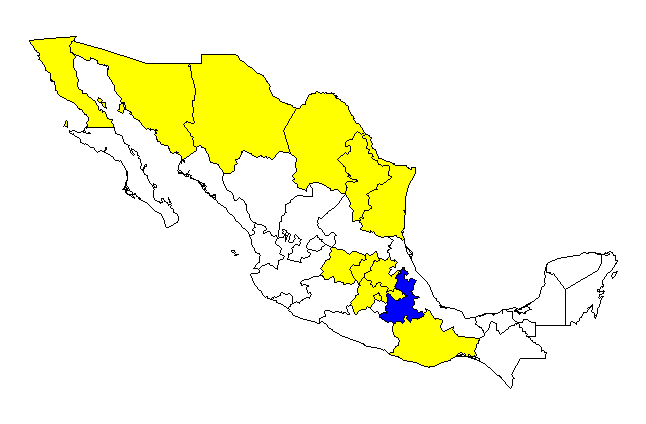
The states of Mexico I have visited, beginning with a quick
trip to Ensenada circa 1985.
This post is an attempt to bring together several disparate threads relating to a country whose fate -- whether any of us wishes this or not -- is interwoven with that of the United States. The far right in the United States has managed to paint Mexico as the root of financial devastation that began much farther north, while Mexico itself continues to derive both much of its pain and much of its gain from proximity to a northern neighbor that views it mostly in terms of well-worn stereotypes.

The Summit
When world leaders met in 1944 to write the rules for the world economy, they gathered at the Mt. Washington Hotel in New Hampshire in a conference known as Bretton Woods. (Readers can decide for themselves whether this intercourse was more or less transgressive than that of Rob Lowe and Jodie Foster in the other Hotel New Hampshire). All 44 of the Allied countries that had opposed Germany, Japan, and Italy in World War II agreed at that point to create the World Bank, the International Monetary Fund, and the General Agreement on Tariffs and Trade (GATT, which would eventually spawn the World Trade Organization, WTO).
Both Mexico and Brazil were represented in that initial meeting, but in subsequent decades such important matters were discussed in much narrower circles, often excluding those most affected. Both G7 and G8 (Group of 7 or 8, depending on whether the Russians were invited) drove the proverbial bus for many years, until they landed it in a colossal ditch of bank deregulation in 2008. At that time, the fig leaf of eight-country consensus was inadequate to the exposure, so a broader group of leaders was called together -- the G20 included such emerging economies as Mexico, Brazil, India, and China in a meeting that is sometimes called Bretton Woods II. Depending on one's point of view, the summit averted financial catastrophe or perpetuated an imbalance of power in favor of banks, or perhaps both.
Leaders of the G20 met in Mexico last week, with very low expectations and the predictable meager achievement of minimizing the damage thought likely to emanate from Europe. The kinds of crises that once threatened collapse only from the periphery now routinely infect the core, but no challenge to economic orthodoxies are yet forthcoming. Even Mexico, which was the host country and nominal "president" of the meeting, made only the feeblest of entreaties for IMF support of debt relief. The outcome was a predictably vague commitment to fostering growth, with no clear vision of how to do this or even whether it is desirable.


Clarification: Although 2008 marked a dramatic expansion in the importance of the G20, it had in fact first met in 1999. Geographer Matt Rosenberg describes the group's evolution in more detail on his What is the G-20? He mentions several other economic groupings and lists the five countries invited to this year's meeting by Mexico.


Chiapas and Greenwash
The latest G20 meeting took place almost simultaneously with a United Nations summit in Rio de Janeiro (described in more detail in a Brazil post I completed earlier today). Again, expectations were low, as leaders focus on short-term crises in the world's financial apparatus, to the exclusion of far deeper crises in the biosphere itself. And those expectations were met, with countries trumpeting environmental euphemisms rather than grappling with environmental realities.Writing for Triple Crisis, Timothy Wise charges that many of the food-security programs trumpeted by Mexico's at G20 are far less than real.
A further coincidence is that this all takes place just as two young friends have headed to Chiapas for a documentary film project that delves into the very real costs of empty environmental promises. Their blog CO2lonialism and the Green Economy examines the sometimes false promise of carbon offsets. Even when working honestly, these arrangements assuage first-world guilt by protecting forests to absorb carbon equivalent to that emitted by our own profligacy. But in Chiapas --- home both to Mexico's most marginalized indigenous communities and its most abundant biodiversity -- even that promise is not met.
Incidentally, as I discuss these and other matters with students in my Geography of Latin America course, I offer them two relevant coffees from Deans Beans, a genuine fair-trade company here in Massachusetts. One is Dean's NOCO2 from Peru, a delicious coffee whose carbon offsets are fully reliable; the other is Birdwatcher's Blend, which comes from certified bird habitat in Chiapas and Guatemala.

Drug War
We recently marked the 40th anniversary of President Nixon's declaration of war on drugs, a misnamed and misguided effort that has been as devastating abroad as it has been ineffective at home. I will not rehearse the many geographic implications that I have previously covered in this space, but again, a few stories are both relevant and quite recent.
It is in this context that Caravana por La Paz a USA (Caravan for Peace to the USA) is being organized, to begin later this summer. Activists from both countries will cross the United States from California to Washington, DC to bring attention to the brutal price ordinary Mexicans continue to pay for living adjacent to a country with such peculiar approaches to guns and drugs. It is difficult to know what to make of the current Fast and Furious scandal -- a weapons sting operation gone horribly wrong -- but it highlights the role of U.S.-origin weapons in the horrendous violence sweeping some of my favorite old haunts in northern Mexico. The degree of violence is brought home by the fact that the McAllen Monitor -- a paper to which I once subscribed -- recently carried a recommendation that diners tip their tables as shields in an event that a restaurant meal is interrupted by a tossed grenade. Yes, GRENADES are now part of the complex landscape of violence where the most heinous crimes are committed by those who were formerly the most elite police units.

Immigration
Regarding immigration, Mitt Romney
is running for Hypocrite-in-Chief
 
Immigration is not, of course, synonymous with Mexico, as thousands of people enter the country legally and illegally -- or overstay legal entries -- every year, from many parts of the world. In Boston, undocumented Irish are part of the social fabric. But no land border in the world joins two countries with a wider wealth disparity than that between the United States and Mexico, so it is natural that labor would be traded across it. As I explained in The Border: Human Sieve, much of the debate about immigration centers around a desire to bring the labor without the humans.
Meanwhile, contrary to the wailing of nativists on the racist right,
President Obama has served as Deporter-in-Chief, sending more
undocumented people out of the country than any other president.
The question of migration has been very much in the news lately, largely because President Obama has responded to courageous and well-organized young Americans who have been living in limbo because they moved to the United States as children. Unable to become fully established in the country they consider home but also lacking roots in their countries of birth, many have risked deportation by speaking out for a compromise. Last week, the president issued a ruling that will allow young adults brought here as children to avoid deportation and gain the ability to work and study legally, though the benefits of the ruling are not as robust as many assume.
One very encouraging bit of news amid all the election-year noise on this subject is that people in the United States -- outside of the more demented segments of talk radio and Fox "News" -- are starting to put the question of immigration in a more realistic perspective than had been the case. Deportations are up, illegal crossings are down, and most people realize by now that the real threats to employment do not come from poor immigrants. As reported on Market Place, immigration is not a top priority for most Democratic or Republican voters, and those who do express an opinion generally support the accommodations the president has made for U.S.-raised migrants.
A related story that appeared in the New York Times represents a very large group of children who will not be helped at all by this week's decision: it describes the difficult adjustment faced by American-born children who join deported parents.

Walmart
And as if Mexico were not putting up with enough, the invasive retail species known as Walmart continues to encroach. Just this morning, I learned that Walmart is slowing its expansion in Mexico, meaning that it is still expanding plenty. Over 6 percent of the world's largest retailer's revenues already come from Mexico, but more than 300 new stores will soon be added. Outside sources link slightly reduced pace of expansion to past bribery scandals, but Walmart simply asserts a desire to ensure proper business practices in its real estate transactions. 
Walmart infection poised to spread.
Map: William & Mary
AMST 370 students
In other words, the expansion is expected to be carried out legally, though the impacts will be criminal in a very real sense. Employment will be created, of course, but as in the United States, for every "real" Walmart job there are 100 menial jobs in which people will gain only slightly, and for each one of those, there will be an untold number of job losses in existing retail and manufacturing firms. As if Mexico did not have enough problems, the Walton family will be feeding on Mexico like a mosquito for years to come.

Election
Last but certainly not least, Mexico will continue to be in the news as a presidential election is taking place there on July 1. After decades of essentially meaningless elections, the past few cycles have been very interesting, as power shifts among three major parties. NPR's Morning Edition reports that Mexican youth are expected to figure prominently in the upcoming decision.

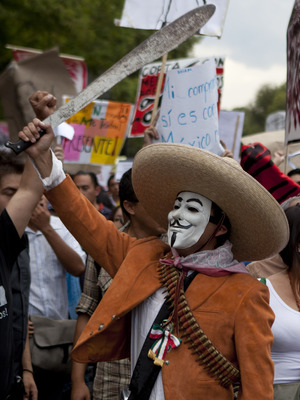
The protester shown here objects to a possible return to rule by the PRI -- the Institutional Revolutionary Party, and oddly-named coalition that ruled Mexico longer than any other political party in modern history -- over seventy years -- before its power was eroded from both the left (PRD) and the right (PAN).

Thursday, February 16, 2012

Outsourced Horrors

The Mexican poet Octavio Paz famously lamented: "Alas, poor Mexico! So far from God and so close to the United States!" The Valentine's Day fire killing hundreds of prisoners in Comayagua, Honduras suggests that the smaller countries of the region are imperiled by proximity to both Mexico and the United States.


As I wrote last March, President Obama has joined a century-long, bipartisan succession of U.S. Presidents who care little about how U.S. policies affect the people of the region. During the 2009 coup in Honduras, Brazil did far more than the U.S. to uphold due process, and our failure ultimately enabled for the presidency to be stolen. 

As both the BBC and NPR have reported, a culture of police violence has grown in Honduras, and the implicit support for the coup is at least partly to blame. The cause of the prison fire at Comayagua is as yet unknown, but it is already known that close to half of the prisoners died, many of them in cells to which no keys could readily be found. In the aftermath, violence erupted between police and relatives of prisoners.


I have written a number of stories on this blog about the drug-related violence gripping Mexico -- including many border areas that I once enjoyed visiting regularly. I have tried to make the case that in many ways, what has befallen Mexico is that the most difficult parts of the U.S. "war on drugs" have been outsourced to Mexico, just as surely as we have outsourced low-paid manufacturing and its attendant misogyny and violence. The BBC reported more than a year ago that Mexico's efforts to quell drug-related violence were, in  turn, pushing the cartel battles into El Salvador. 

The same BBC article mentions that El Salvador in particular was already wracked by the export of gang violence from Los Angeles. Whenever possible, the United States deports violent criminals to their birth countries, even if they immigrated at two years of age and learned all of their criminality here. Blame for violence in Central America rests ultimately with the criminals -- in and out of uniform -- of the region itself. But much of the violence has roots in the United States and Mexico that must also be remembered.

In addition to the BBC coverage cited above, see the New York Times for details of the fire.

Tuesday, November 23, 2010

Drug War Refugees


View Larger Map

Over the past couple of months, I have posted quite a few stories about the growing war on the northern edge of Mexico, within the borderlands region where I lived for the seven years prior to moving to Bridgewater, Massachusetts in 1997. We had spent four years in Tucson, in the middle of the Gadsden Purchase, followed by three years living in Pharr and working in McAllen and Brownsville. I mentioned my Brownsville teaching job last week, because of the cross-fire that had shut down my former campus. We lived on the U.S. side of the border, which remains remarkably safe (El Paso, for example, is on track to be the safest large city in the United States this year, and McAllen has a crime rate that is relatively low and declining), but our neighbors just across the border were part of a shared cultural landscape, and what is happening on the southern side of the border affects the community on both sides.

Recently I heard the most disturbing story yet, this one from about 50 miles up-river of our old home. The U.S. town of Roma is located just where the river -- and Route 83 -- takes a jog to the north towards Laredo. In other words, it is the last in the east-to-west string of towns, of which we were in the center. It is known as one of the locations in the 1952 film ¡Viva Zapata! and the excellent 2004 documentary Mojados: Through the Night. As the first title and many of the place names in the area suggest, it was in the thick of the Mexican Revolution (1910-1920) and as the second title suggests, it is one of many places that has for the past few decades been a pivotal stopping point in cross-border migration.

We had passed through Roma many times in our travels, but the town across the border -- Ciudad Miguel Alemán-- just once. We had visited on our way to see the Falcon Reservoir, where drought had exposed long-flooded places such as Guerrero. I remember Alemán as quite a quiet, dusty little town. I remember having a nice lunch at a restaurant that would have served very well as a revolution-era movie set.

"Cartel de Golfo" and a heart mark the territory of the
former town of Mier.


It was from Miguel Alemán that a most chilling is now emerging. In "An Entire Mexican Village Flees Mexican Drug Violence," veteran NPR reporter compares this tiny town to many he has seen in the aftermath of natural disasters. Violence in the nearby town of Mier has been so ghastly that most of its 6,500 residents have fled, as from a flood or fire, and many of them are now in Miguel Alemán. In a broader story on the perception that the Mexican Revolution has failed, the turmoil in Tamaulipas is cited as a reason that centennial celebrations have been suspended. The Revolution killed a million people, and though the numbers today are not at that level, with 28,000 dead, comparisons are starting to be made.


Although NPR and I are willing to use the term "refugee," it will be very interesting to see whether it is formally applied to those fleeing violence. As long as the refugees remain in Mexico, the formal term would be "internally displaced persons," a term that the United Nations Refugee Agency is not yet using anywhere in Mexico. If it does, the U.N. would be obligated to help them in Mexico, and the potential exists for them to seek asylum in the United States. I imagine all efforts will be made to avoid describing the situation in Ciudad Miguel Alemán with any kind of candor on the part of U.S. or U.N. officials.


It is difficult to know exactly why such intense violence has erupted in this particular part of the world, making it more dangerous than Baghdad or Kabul. Several factors clearly are at work, including very lax gun laws in the United States and the ever-higher prices people here are willing to pay for drugs. This combines with global race-to-the-bottom labor policies, "free trade" agreements that work against agriculture in Mexico, and the maquila program that brought millions to the border seeking employment. Endemic corruption in Mexico's public institutions is also certainly a part of the problem. No single explanation is satisfactory, because all of these things were true long before the violence reached this level. It is clear, though, that the greed and ruthlessness of the cartels exceeds their humanity.

Friday, May 01, 2009

Immigrant bashing

Talk-radio host Jay Severin has been suspended from Boston radio station WTKK, for racist comments related to the current flu outbreak. His hate speech is the predictable result of a perfect storm to brew xenophobia: in a country that knows little about math and less about geography, a disease outbreak during an economic collapse create perfect scapegoats.

Taking Severin off the air, of course, only draws attention (this post included) to his vitriol. The incident creates a perfect opportunity, however, to address the four underlying factors mentioned above.

First, math: the flu outbreak is serious and the numbers are growing. Public-health officials in the U.S., Mexico, and beyond are rightly concerned and are making recommendations about specific, short-term measures based on evidence. Within two countries covering several million square miles and 400 million people, however, it is important to recognize that most people and most places are safe, at least for now.

Second, geography: Severin's comments reflect a deep failure to understand the interdependencies of the United States and Mexico. I lived for seven years in the borderlands of Arizona and Texas, and have spent several months in Mexico itself. I learned that we are connected in many ways, most of them positive. I also learned that just as some problems in both countries are related. Migration from Mexico may surpress wages in the United States, but drug policies and weak gun laws in the U.S. elevate crime in Mexico.

Third, disease: Because epidemics are inherently scary and difficult to understand, fear and ignorance thrive.

Fourth, economy: Prosperity in rich countries is absolutely dependent on low wages in poor countries. We who prosper work hard, so the illusion is created that we deserve our prosperity and that those who are poor must not be working. The reality is that excessive prosperity in one place requires poverty elsewhere. The economic problems of the middle and working class in the United States are clearly -- CLEARLY -- the fault of giving too much power to the super-rich. It is easiest, however, to blame the poor for our problems, and this is what Severin has done.

Severin and his ilk serve the interests of the super-rich by shifting attention from the real criminals -- at banks and brokerages -- to the "criminal" behavior of economic migrants. When the economy rebounds, the high dudgeon will cease until the next time a scapegoat is needed. And when that happens bottom-feeders will stand ready to exploit the fear and ignorance once again.

Tuesday, July 03, 2012

Mexican Hopes


I hesitate to include this photograph of the dashing young president-elect of Mexico, in light of COHA's observation that media coverage of the recent political season has been as superficial as it was scant. Enrique Peña Nieto was, however, elected on Sunday with a substantial plurality, amid high voter turnout, and we should start to getting to know him. To catch up, I recommend three articles:

The Economist published The PRI is Back on Monday; it is the best introduction to the story. BBC and others are now reporting on the reluctance of the PRD candidate Obregon to concede the election. All Things Considered also discussed the return of PRI as The Old is New Again, but inexplicably used the term "iron fist" to describe what was a much more complicated seven decades of rule.

I recommend reading and listening to these before reading more in-depth analysis from the Council on Hemispheric Affairs. What a Return to a PRI-Dominated Government Would Mean for Mexican Democracy was published just a couple of days before the election, and examines the apparent repudiation of the PAN approach to drug cartels. Although PAN's Calderon took an approach generally favored in Washington, it clearly did not work, and did not require enough of Presidents Bush or Obama. With over 50,000 people dead, Mexico seems to be ready for a different approach.

Once the election is truly settled, attention can turn toward determining the new balance of priorities in Mexico, particularly in its northernmost states. For more of my thoughts on the challenges facing Mexico and its northern neighbor, see my recent posts No se Olviden Mexico on Environmental Geography and Migration and Faith on First Parish Bridgewater.

Friday, July 06, 2012

Drug-War Refugees Redux


Earlier today, I posted an article -- from Fox News of all places -- about the difficulty of obtaining asylum faced by refugees from northern Mexico's drug war.

A friend asked a good question about why the United States should take responsibility for this problem. Aside from the general responsibility that all countries have for providing asylum to refugees, I see responsibility in this case falling in three main areas. 


First, of course thugs in Mexico are directly responsible for being thugs. Looking into deeper sources of the problem does not excuse the inhuman behavior of the cartels -- and particularly of those who once served as narcotics police.

But second, just as in Colombia, the stronger the interdiction, the more vicious the criminal element it attracts. So the first part of our responsibility is that we prohibit something that so many of our people are willing to buy, and we shift the burden of prevention to supplying countries. And that burden results in thousands of innocent dead and -- as I wrote back in 2010 -- large areas in which regular people cannot safely live. One difference here is that much of the violence relates to pot, of which possession in small quantities is a misdemeanor in many places.

And third, the weapons increasingly come from the United States, where there are essentially no limits. Mexico tries to stop the guns at the border, but there they are so easy to obtain in large quantities at gun shows -- particularly in our border states -- that even legitimate Mexican authorities would be hard-pressed to stop them. And the money corrupting authorities on both side means that even those efforts will be minimal.

This is a HUGE case of the proverbial cat out of the bag, and I do not know anyone with a cogent solution in the short term. Last weekend's election is the result of a rather desperate desire for change but it is not clear what the PRI will be able to do, other than distance itself from U.S. policy.

Without any cogent solution, though, we have an obligation to accept refugees, under international agreements. The United States always is very selective in its application of refugee status, refusing to designate people as refugees if they are fleeing situations for which we are in part to blame (see: Central America in the 1980s). As unpopular as it would be in this election year, however, there is added moral urgency to provide some relief for those whose circumstances we have helped to create.

Tuesday, November 02, 2010

Murder City

Photo: NPS
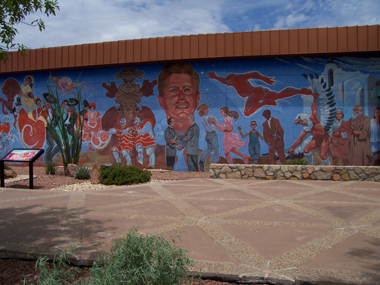
Ciudad Juarez was once one of my favorite places. Many years ago, I read Tom Miller's On the Border, about a journey in which he traversed every border crossing, from Tijuana to Matamoros, from Brownsville to San Diego. After years living in the Gasden Purchase section of Arizona -- where my wife Pamela actually got to work with Tom on one of his books --  and in the southmost tip of Texas, I realized that I had been through most of the border crossings. Los Ebanos with its hand-drawn ferry was a favorite, but so, too, was through the Chamizal Peace Park between El Paso and Ciudad Juarez.

Almost all of the cities on the Mexican side of the border are bigger than their U.S. counterparts, and Juarez is no exception. It is the largest border city in the world, with 2/3 of the population on the Chihuahua side. Despite its sprawling size, I enjoyed several visits in the 1990s, and walked around comfortably in the sunshine and even in the evenings. In those days, even the crossing back into the U.S. was simple and easy.

View Larger Map


In the 13 years since we left the borderlands, Juarez has become a tragic place -- one of the few I would rather not visit for a while. Jennifer Lopez has told the story -- at some risk to her own safety -- in Bordertown. I highly recommend both the fictionalized account (see trailer) and the DVD extra feature that explains how the film came to be made. The otherwise infamous narcocorrido singers Los Tigres del Norte told the story in the CD Pacto de Sangre. Both of these refer to the hundreds of young women who have been kidnapped, raped, killed, and left in the deserts surrounding Juarez over the past decade or more. Many of them have been attracted to the area for maquila manufacturing jobs, working long hours for low pay in factories that do not provide them adequate protection. It is thought that a conspiracy among very elite men is responsible for the failure to solve these crimes -- about two thousand women who have disappeared. The image at left is from a blog post called ¡Feminicidios sin resolver! -- one of many that expresses outrage and sorrow about the loss of innocent young lives in this once beautiful city. This particular image is remarkable for the way it integrates motifs representing femininity and veneration of the dead at one level, along with representations of crime scenes and of the border itself. The accompanying narrative is focused on the fact that many of the victims were killed going home from jobs that they were far too young to hold legally.


Pam reminded me that the first time we heard about the Juarez killings was through a performance of Eve Ensler's Vagina Monologues (an important program that is put on each February at BSU). Each year, the VDAY show focuses on a cause, and in 2004 the women of Juarez were that focus. One of the monologues, The Memory of Her Face, honors women victims of violence in Islamabad, Baghdad, and Ciudad Juarez, with a stanza of the reading representing a woman in each of these cities in which violence against women has become a consequence of wars -- declared and undeclared. Read more about the Women in Juarez Spotlight and about the 5,000 shows performed in Mexico City in support of Juarez women (second item on this news page).

In the past couple of years, this already tragic and violent story has gotten much worse -- probably ten times worse. The murder rate in Mexico as a whole remains relatively low, in part because firearms are very difficult to procure. But the murder rate in Ciudad Juarez has become much higher, as it has in other border towns. The reason: the Sinaloa drug cartel, which formerly operated with impunity throughout the northwest of the country, is in a battle over territory with a group called the Zetas in the northeast. I met a few of the Zetas during an inspection stop near Monterrey in the 1990s, when they were legitimate narcotics police. They eventually cooperated with the Gulf Cartel, and still later took it over. Now shootouts are so common in Matamoros, across the river from my former job at UT-Brownsville/Texas Southmost College that the campus has actually been hit by stray bullets.
Borderland journalist Charles Bowden describes the killing in Juarez in his book Murder City, which is at the same time compelling and unbearable. He explores the dynamics I outline above, but goes beyond this to put the brutality in the context of even larger forces related to economic exploitation. He discusses his claims -- and explains why he keeps going back to Juarez -- in an interview with NPR's Mary Louise Kelly that was recorded after three people affiliated with the U.S. consulate were killed last April.

View full gallery at
MexConnect
I argue, with Bowden, that  is not possible to understand violence on the border without acknowledging the transformation of the border itself from an edge situated within a bicultural zone of transition to an increasingly impersonal sieve that separates humans from their labor. It is also not possible, however, to understand death along the border without understanding the distinctive attitude toward death in Mexico, as exemplified by the Dia de los Muertos. November 1 is a colorful holiday -- as suggested below -- in which the dead are honored, celebrated, visited, and consulted.

As reported last spring in a fascinating article in National Geographic, the increasing brutality of the drug war has created a class of wealthy and youthful criminal class who are full of both bravado and fear and at the same time increasingly status-conscious. In this context, graves -- while always important -- have become sites of obsessive competition among traffickers. The focus of the article -- Troubled Spirits -- is on the veneration of Santa Muerte, literally Saint Death. Even in the panoply of images that embrace the figure of the skull, the imagery of Santa Muerte is remarkably chilling. Whether standing in a gown in a tiny living room or being carried on the shoulders of mourners at a gangster funeral, figures of Santa Muerte are arresting. Although not sanctioned by the Catholic Church, Santa Muerte is an increasingly important object of adoration and supplication, as traffickers seek both protection and riches through her. And although many assume Santa Muerte to be a very recent phenomenon, at least one Hoodoo practitioner claims several generations of veneration of Santa Muerte.

See the amazing, complete photo gallery at NGS Magazine

Lagniappe

In a late 2023 post, I cite New York Times reporting from our part of the borderlands in Texas, which highlights traditional, non-criminal associations with Santa Muerte. 

Wednesday, May 19, 2021

Break It All

My initial interest in Latin America was the problem of deforestation in the Amazon. I lived in Mexico and in the U.S.-Mexico borderlands for a number of years before living in Rondônia for three months for my dissertation research in 1996. Thanks to people I met during that stay, I started to learn something about the music of Latin America. 

I took more interest in the music around me during our last year living in southmost Texas, and I started to do a bit of research on the cultural geography of the music of the entire region. A decade later, I did a small tour of Massachusetts college campuses, discussing the topic as a MaCIE Lecturer -- complete with a wheeled suitcase full of CDs so I could play examples for my audiences.

The eclectic music I have found -- much of which I have also played for a lot of my classes -- has included rock music, and some of that rock has exhibited interesting connections with traditional musical forms. So I was excited to learn that the growing catalog of original international programming from Netflix would include a six-part series on Latin rock. 

My favorite librarian (and fellow Latin Americanist) and I have now watched the first and second episodes, and almost everything we have seen and heard is new to us. In other words, the world of Latin rock music is much bigger than we realized, and the coverage of Break It All: The History of Rock in Latin America is thorough.

The second installment -- "La Represión -- is particularly poignant, as it focuses on a period in which young musicians and their fans found themselves at odds with increasingly repressive governments, most of which were closely allied with -- or even installed by -- the United States. Weaving together archival video from the first half of the 1970s and interviews with many of the musicians themselves, we learn about varying degrees of repression in Mexico, Chile, and Argentina.

Young voters and rock music were part of Salvador Allende's political success,
and he recognized their importance. He is shown here praising Victor Jara,
a musician whose assassination followed his own by just a few days.

One chilling detail is the bonfire in which Chilean soldiers burned rock music albums during the 1973 U.S.-backed coup. It reminds me of the glee with which religious extremists in the United States were destroying albums just a few years later. I witness the breaking-not-burning version at indoor rallies of Kansas City Youth for Christ. I was never tempted to go that far in my "devotion" but nor did I understand the real implications of such frenzy until reading F451 years later. It was also at KC-YFC that I first heard the name of Guatemala's dictator Ríos Montt -- whose religiosity was admired by the group.

Allende's attitude toward youth and music was in sharp contrast to those of the dictators who followed him in Chile and elsewhere. In Argentina, for example, Jorge Alberto Fraga was both a military dictator and the secretary of social welfare. When asked for his opinion of the origin of drug addiction, he did not hesitate to equate social pathologies with the very act of thinking. More work and less studying were needed, in a view echoed by anti-intellectuals to this day.


Lagniappe: Brazil

So far, the series makes very little mention of Brazil, perhaps because the producers speak Spanish but not Portuguese (I'm speculating). This episode brings to mind three Brazilian artists -- two musicians and one visual artist -- whose stories I do know and share with my students. One of them is Chico Buarque de Holanda, whose ongoing performance of the song "Calice" was a remarkably brave act of defiance during that country's dictatorship. 

Another is Sergio Mendes, who spent much of his career in the United States after being forced to flee. When he eventually went home, he named his next album simply Brasileiro, meaning Brazilian. The Grammy-winning album bursts open with 100 samba drums recorded in Rio -- where these things are decided -- and continues as a musical declaration of this refugee's right to return.

The final example is an artist I met personally -- and whose work is on the wall in front of me as I type this: Anká. My encounter with him and his art is described in the third entry of my Folha da Fronteira newsletter, written just after I visited his Amazon hermitage in 1996. I explain that he would not tell me his full name nor the place of his birth -- and I thought he was kidding when he said that these were "details for the police." It was almost 20 years later that I realized he was not kidding at all, and that it was no coincidence that a Brazilian man of a certain age without a phone, a legal name, or even a street address would also be an artist. 

Monday, March 07, 2011

NarcoDonors


Last November, just after El Dia de Los Muertos, I posted an article about the violent unraveling of the US-Mexico border zone, a region in which I lived for seven years. The article focused on the growing violence that still remains largely confined to the Mexico side, though its roots are deep on both sides. I included a discussion of  Santa Sangre, a new, nihilistic religious movement created by and for the narcotraficantes themselves.

Damien Cave reports in today's NY Times that the movement has grown to about 6,000 independently-built chapels throughout the country. He also reports that the influence of traffickers is being felt in the mainstream church as well. His focus is on a new church building in Pachuca (north of Mexico City) that was funded by a well-known member of the Zeta gang. Although at least one blogger sees this as bias against the church, I find that journalist Cave offers a sympathetic description of the dilemma that church officials and parishioners face as they decide whether or not to accept such tainted money, and the difficulty of resistance. He also alludes to the moral taint that is often associated with more formally legitimate funding sources. The major implication of this piece, however, is that the U.S. drug war as it is currently pursued threatens to undermine the Mexican state.

Monday, October 26, 2015

Semana de los Muertos

The Smithsonian Latino Center offers cool teaching resources through the Día de Muertos theatrical interface and even more resources through the Latino Virtual Museum.
It seems that each year I begin to anticipate El Día de Muertos a bit earlier, and to learn new things about the cultural implications of the Day of the Dead. In fact, it is now my theme for an entire week -- my very own Semana de los Muertos.

Before adding a few new items, I am listing some of the posts from recent years:
  • A perfect vacation at a cooking school in Mexico that has a special lessons for Día de Muertos
  • The tragic story of Murder City, in which the drug lords of Ciudad Juarez have developed a very specific set of rituals and icons surrounding death
  • PRESENTES! describes how traditions surrounding death have been incorporated into my coffee travel course in Nicaragua, and how this relates to our proposal for an ethical cafe on our campus
  • Days of the Deads highlights -- and maps -- comparable festivals and traditions throughout the world
  • Finally, my Alt-dot-musica post introduces the NPR program Alt-Latino, which captures the multitude of fascinating musical tendencies current in Latin America. After writing quite a bit about its work with my hero Manu Chao, I turn to a discussion of its special episode on Dia de los Muertos. Give a listen -- you won't regret it!
All of this is by way of background for a couple of short pieces that came to my attention recently, and that are not nearly as provocative. Those not very familiar with the tradition, in fact, might to best to start with these short videos.

From the Film School Shorts series of the Ringling College of Arts and Design comes a delightful introduction to the tradition. At first "Dia de los Muertos" (s2e5, 3mins) resembles the 2014 feature film Book of Life, which I discussed at length in Dia de los Libros. That film was intended to capture the essence of the holiday, but quickly got caught up in the pressures to conform to Hollywood norms that even "indie" films face. The short production from Ringling students is much more successful in its representation of a young girl encountering her dead relatives with a fearlessness and joy that would be out of place in many cultures.
Dia de los Muertos

Finally, the indispensable Tish Hinojosa describes the Day of the Dead in Hasta Los Muertos Salen a Bailar (When the Dead Come Out to Dance), from her children's album Cada Niño (Every Child). As with most of her music, this song is English/Spanish bilingual in the sense that entire verses are sung in one language and then the other, so everyone gets the message. This particular video version really captures the whimsy of the holiday by putting an obscure Disney short to Hinojosa's tune.


Of course, Casa Hayes-Boh and Whaling House are festooned for the week, and after years of acquaintance with the Mexican traditions, we do honor the dead in our own lives a bit differently that we otherwise would.
Photo by Pamela Hayes-Bohanan. Sugar skulls by the whole family. Miniature figures by artisans in Mexico. Candy bowl most likely from China.

Blog Ideas

coffee (25) GEOG381 (24) GEOG388 (23) GEOG470 (18) climate change (18) GEOG130 (16) geography (16) GEOG332 (13) GEOG431 (12) musica (11) GEOG 332 (9) GEOG 381 (9) Mexico (9) Brazil (8) GEOG286 (8) Texas (8) education (8) migration (8) GEOG298 (7) borderlands (7) GEOG199 (6) GEOG331 (6) Massachusetts (6) US-Mexico (6) deBlij04 (6) immigration (6) GEOG 130 (5) GEOG 286 (5) GEOG287 (5) climate justice (5) cultural geography (5) fair trade (5) food (5) geographic education (5) nicaragua (5) water (5) Arizona (4) GEOG 171 (4) GEOG171 (4) GEOG295 (4) Safina (4) africa (4) deBlij05 (4) land protection (4) music (4) politics (4) Bolivia (3) Boston (3) COVID-19 (3) Detroit (3) Ethiopia (3) Managua (3) Obama (3) border (3) cartography (3) drought (3) libraries (3) pesticides (3) suburban sprawl (3) trade (3) unemployment (3) Alaska (2) Amazon (2) Bridgewater (2) Canada (2) Chiapas (2) China (2) Colonialism (2) EPA (2) EarthView (2) Economy (2) Environment (2) GEOG 199 (2) GEOG 287 (2) GEOG 388 (2) Google Maps (2) Government (2) Hawaii (2) India (2) Lexington (2) Maldives (2) Mozambique (2) NOLA (2) NPR (2) National Monuments (2) National Parks (2) New Orleans (2) Religion (2) Rio Grande (2) Taunton River Wild and Scenic (2) Tex-Mex (2) The View from Lazy Point (2) United States (2) Venezuela (2) anthropocene (2) cape verde (2) censorship (2) central america (2) chocolate (2) corn (2) deBlij07 (2) deforestation (2) demographic transition (2) demography (2) education reform (2) employment (2) environmental geography (2) film (2) forest fire (2) global warming (2) islands (2) landscape ecology (2) librarians (2) maps (2) organic (2) peak oil (2) refugees (2) sense of place (2) soccer (2) sustainability (2) television (2) water rights (2) whales (2) #bbc (1) #nicaragua (1) #sosnicaragua (1) #sosnicaragua #nicaragua (1) 100 Years of Solitude (1) ACROSS Lexington (1) Accents (1) Adam at Home (1) Alice (1) Alt.Latina (1) American Hustle (1) April (1) Association of american Geographers (1) Audubon (1) Aunt Hatch's Lane (1) BBC (1) BSU (1) Baby Boomers (1) Banda Aceh (1) Bay Circuit Trial (1) Bechtel (1) Beleza Tropical (1) Belize (1) Beloit College (1) Ben Linder Cafe (1) Bet The Farm (1) Bhopal (1) Biafra (1) Bikeway (1) Bikini (1) Bill Gates (1) Bill Moyers (1) Boeing 777 (1) Brazilian (1) Brazilianization (1) Bridge (1) British Columbia (1) Brockton (1) Bus Fare (1) Bush (1) Cabo Verde (1) California (1) Cambridge (1) Cape Cod Bay (1) Carl Stafina (1) Catholic (1) Ceuta (1) Chalice (1) Chipko (1) Citgo (1) Climate risks (1) Cochabamba (1) Colombia (1) Common Core (1) Commuter (1) Computers (1) Cuba (1) Cups and Summits (1) Dallas (1) David Byrne (1) Deans Beans (1) Delaware Valley (1) Dunkin Donuts (1) Earth Day (1) Earth View (1) Easton (1) El Salvador (1) Elizabeth Warren (1) Ellicott City (1) Emilia Laime (1) English-only (1) Environmental History (1) Euphrates (1) European Union (1) Evo Morales (1) FIFA (1) FYS (1) Fades Out (1) Farms (1) First-Year Seminar (1) Food Trade (1) Frederick Kaufman (1) French press (1) Fresh Pond Mall (1) GEOG 431 (1) GEOG 441 (1) GEOG213 (1) GEOG490 (1) Gabriel García Márquez (1) Garden of Gethsemane (1) Gas wells (1) Gateway Cities (1) General Motors (1) Gini Coefficient (1) Girl in the Cafe (1) Google (1) Gordon Hempton (1) Gravina Island Bridge (1) Great Migration (1) Great Molasses Flood (1) Guy Lombardo (1) Haiti (1) Hawks (1) Heart (1) Higher Education (1) History (1) Holyhok Lewisville (1) Homogenous (1) Honors (1) How Food Stopped Being Food (1) Hugo Chavez (1) IMF (1) Iditarod (1) Imperial Valley (1) Income Inequality (1) Indonesia (1) Iraq (1) Irish (1) Japan (1) Junot Diaz (1) Kenya (1) Ketchikan (1) Key West (1) Kindergarden Students (1) King Corn (1) Kiribati (1) Latin America (1) Limbaugh (1) Literature (1) Living On Earth (1) Louisiana (1) Love Canal (1) Luddite (1) M*A*S*H (1) MCAS (1) MacArthur Genius (1) Maersk (1) Malawi (1) Malaysia (1) Malaysian Air Flight 370 (1) Mali (1) Manu Chao (1) Map (1) Marblehead (1) Mary Robinson Foundation (1) Maryland (1) Massachusetts Bay Colony (1) Math (1) Maxguide (1) May (1) Maya (1) Mayan (1) Mayan Gold (1) Mbala (1) McDonald's (1) Melilla (1) Mexicans (1) Michael Pollan (1) Michelle Obama (1) Micronesia (1) Military (1) Military Dictatorship (1) Minuteman Trail (1) Mongolia (1) Monsanto (1) Montana (1) Morocco (1) Mount Auburn Cemetery (1) Muslim (1) NPS (1) Nantucket (1) National Education Regime (1) Native American (1) Native Americans (1) New Bedford (1) New Hampshire (1) New York City (1) New York Times (1) Nigeria (1) No Child Left Behind Act (1) Norquist (1) North Africa (1) Nuts (1) Oakland (1) Oaxaca (1) Occupeligo (1) Occypy (1) Oklahoma (1) Oklahoma City (1) Oppression (1) PARCC (1) Pakistan (1) Pascal's Wager (1) Peanut (1) Pearson Regime (1) Philadelphia (1) Philippines (1) Pink Unicorns (1) Poland (1) Portuguese (1) Protest (1) Public Education (1) Puebla (1) Puritans (1) Quest University (1) Rachel Carson (1) Reading (1) Republican (1) Retro Report (1) Robert Reich (1) Rock Legend (1) Ronald Reagan (1) Rondonia (1) Rosa Parks (1) SEXCoffee (1) Safety (1) Samoza (1) Sandino (1) Sara Vowell (1) Save the Children (1) Scotch (1) Scotland (1) Seinfeld (1) Senegal (1) Sergio Mendes (1) Severin (1) Sharrod (1) Silent Spring (1) Sinatra (1) Slope (1) Smokey the Bear (1) Somalia (1) Sombra (1) Sonora (1) Sonoran desert (1) Sonoran hot dog (1) South America (1) Spain (1) Stairway to Heaven (1) Storm (1) Suare Inch of Silence (1) Sumatra (1) Swamp (1) Tacloban (1) Tanzania (1) The Amazon (1) The Amazon Trail (1) Tigris (1) Tucson (1) Tufts (1) U.S Federal Reserve (1) U.S Government (1) U.S. economy (1) USDA (1) USLE Formula (1) Uganda (1) Unfamiliar Fishes (1) Union Carbide (1) Vacation (1) Vexillology (1) Vietnam (1) ViralNova (1) WNYC Data News (1) Wall Street (1) Walsenburg (1) Walt Disney (1) Walt and El Grupo (1) Ward's Berry Farm (1) West (1) Whaling (1) Wilson (1) Winter Storm Saturn (1) Wisconsin (1) World Bank (1) Xingu (1) YouTube (1) Zombies (1) agriculture (1) antitrust (1) aspen (1) austerity (1) aviation (1) banned books (1) bark beetle (1) bean (1) beavers (1) bicycle (1) bicycling (1) bike sharing (1) binary (1) biodiversity (1) bioneers (1) books (1) boston globe (1) cacao (1) cafe (1) campaign (1) campus (1) cantonville (1) capitals (1) carbon dioxide (1) carbon offsets (1) carioca (1) cash (1) cashews (1) census (1) chemex (1) chemistry (1) chronology (1) churrasco (1) civil rights (1) coffee grounds (1) coffee hell (1) coffee prices (1) coffee quality (1) college (1) compost (1) computerized test (1) congress (1) conservation commission (1) corporations (1) countries (1) cubicle (1) dams (1) deBlij06 (1) deBlij08 (1) death (1) deficit (1) development (1) dictatorship (1) distracted learning (1) distraction (1) drug war (1) dtm (1) earth (1) economic diversification (1) economic geography (1) election (1) embargo (1) energy (1) enhanced greenhouse effect (1) environmentalist (1) ethnomusicology (1) exremism (1) failed states (1) farming (1) financial crisis (1) football (1) forestry (1) forro (1) fracking (1) free market (1) free trade (1) fuel economy (1) garden (1) genocide (1) geography education (1) geography games (1) geography of chocolate (1) geography of food (1) geologic time (1) geotechnology (1) gerrymandering (1) global pizza (1) globe (1) goodall (1) green chemistry (1) ground water (1) guacamole (1) guatemala (1) habitat (1) high-frutcose (1) home values (1) hospitality (1) hourglass (1) housing (1) hydrology (1) illegal aliens (1) income (1) indigenous (1) interfaith (1) journalism (1) kitchen garden (1) labor (1) language (1) libertarianism (1) library (1) linguistics (1) little rock (1) llorona; musica (1) macc (1) maccweb (1) magic realism (1) maple syrup (1) mapping (1) masa no mas (1) massland (1) medical (1) mental maps (1) mi nina (1) microlots (1) microstates (1) mining (1) mltc (1) monopoly (1) municipal government (1) nautical (1) neoclassical economics (1) new england (1) newseum (1) newspapers (1) noise pollution (1) pandas (1) petroleum (1) piracy (1) pirates (1) poison ivy (1) police (1) political geography (1) pollution (1) provincial government (1) proxy variables (1) public diplomacy (1) quesadilla (1) rabbi (1) racism (1) real food cafe (1) regulations (1) remittances (1) resilience (1) resistance (1) respect (1) rigoberta menchu (1) rios montt (1) romance (1) roya (1) runways (1) russia (1) satellites (1) science (1) sea level (1) selva negra (1) sertao (1) sertão (1) sex (1) sex and coffee (1) simple (1) sin (1) smokey (1) solar (1) solar roasting (1) south africa (1) sovereignty (1) species loss (1) sporcle (1) sports (1) state government (1) taxes (1) tea party (1) teaching (1) textile (1) texting (1) tortilla (1) training (1) transect; Mercator (1) travel (1) triple-deckers (1) tsunami (1) urban geography (1) utopia (1) vermont (1) vice (1) video (1) wall (1) water resources (1) water vapor (1) whiskey (1) whisky (1) widget (1) wifi (1) wild fire (1) wildfire (1) wildlife corridor (1) wto (1)